Blue spirulina (phycocyanin): benefits, safety and quality
The short answer
Blue spirulina is phycocyanin, the blue pigment of spirulina. It is a coloured protein extracted from spirulina with water, then dried into a bright blue powder. It is used as a natural food colour (international code INS 134, approved by the FDA) and as a supplement. Lab studies show antioxidant and anti-inflammatory effects, but human evidence is very thin: a handful of small trials. The real issue is quality: like spirulina, a poorly controlled extract can contain microcystins (algal toxins) or heavy metals.
This article is for information and does not replace medical advice.
What is phycocyanin?
Spirulina (Arthrospira platensis) is a cyanobacterium, the “blue-green alga”. Its colour comes from green chlorophyll and blue phycobiliproteins, mainly C-phycocyanin. This pigment dissolves in water: spirulina is mixed with water, filtered, and the blue solution is concentrated and dried.
Blue spirulina vs green spirulina
| Green spirulina | Blue spirulina (phycocyanin) | |
|---|---|---|
| What it is | The whole dried cyanobacterium | A water extract concentrated in phycocyanin |
| Taste | Strong, “pond-like” | Almost neutral |
| Nutrients | Protein, iron, beta-carotene, chlorophyll | Mainly phycocyanin; little iron, chlorophyll or beta-carotene |
| Use | Nutritional supplement | Blue food colour and targeted supplement |
For whole spirulina, see spirulina benefits.
A recognised food colour
The FAO/WHO expert committee (JECFA) evaluated spirulina extract, INS 134, and gave it an acceptable daily intake “not specified” (confirmed in 2022), meaning no toxicity was seen in animal studies. In the US, the FDA has allowed it as a colour additive since 2013, in candy, ice cream, drinks, yogurts and more.
Blue spirulina benefits: what the studies show
Plenty of lab effects
In cells and animals, phycocyanin is antioxidant, anti-inflammatory (it inhibits the COX-2 enzyme) and immunomodulating. A 2021 review (Braune et al.) covers its effects on tumour cells, but only from in vitro and animal studies: there is no human evidence of an anti-cancer effect.
Very few human trials
The most cited trial (Jensen et al., 2016) gave a phycocyanin-rich spirulina extract or placebo to 24 adults for 2 weeks. The 2.3 g daily dose provided about 1 g of phycocyanin, the highest dose the FDA recognises as safe (GRAS). Clotting and platelet markers did not change, a liver enzyme (AST) fell, and self-rated chronic pain decreased. Reassuring for safety, but too small and short to prove a benefit. A larger French hospital trial is testing phycocyanin against chemotherapy nerve damage (protocol published in 2023).
Energy, immunity, workouts? These popular claims rest on whole-spirulina studies or lab mechanisms. No solid trial shows a phycocyanin extract reduces fatigue, prevents infections or boosts performance. If that is your goal, see how to boost your immune system with food and our best supplements for fatigue.
Is blue spirulina safe? Side effects and quality
The main risk: contamination
Spirulina takes up whatever is in its growing water. If other cyanobacteria grow in the pond, they can produce microcystins, toxins that harm the liver.
- Of 18 spirulina or AFA supplements sold in Canada, 8 contained toxins above tolerable daily intake levels (Roy-Lachapelle et al., 2017).
- Another analysis of 18 algae supplements found microcystins at more than 40 times the 1 µg per gram limit (Miller et al., 2020).
- By contrast, 623 samples from small French spirulina farms (2013 to 2021) stayed within regulatory limits (Pinchart et al., 2023): good farming makes the difference.
For spirulina extract used as a colour, the FDA requires lead and arsenic at most 2 mg/kg, mercury at most 1 mg/kg, and no microcystins. Use those as benchmarks and ask for batch analyses. Our best spirulina comparison explains how to read them.
Side effects and precautions
- About 1 g of phycocyanin a day caused no clotting problems in the 2-week trial. Mild digestive upset is possible at first: start with half a serving.
- No human data in pregnancy, breastfeeding or children: avoid as a precaution.
- On anticoagulants, immunosuppressants or chemotherapy, or with an autoimmune disease, talk to your doctor first.
- The pigment may tint your stools: harmless.
- Phycocyanin breaks down with heat: add it to cold foods and drinks.
How to take blue spirulina
The only dose studied in a randomised human trial is about 1 g of phycocyanin a day for 2 weeks. Blue spirulina powders are used at 3 to 5 g a day, which provides a similar amount depending on concentration. Liquid phycocyanin is easy to dose but often far less concentrated: compare phycocyanin per serving, not volume. Data only cover a few weeks, so take breaks.
Nutrition•pro: organic blue spirulina, analysed batch by batch
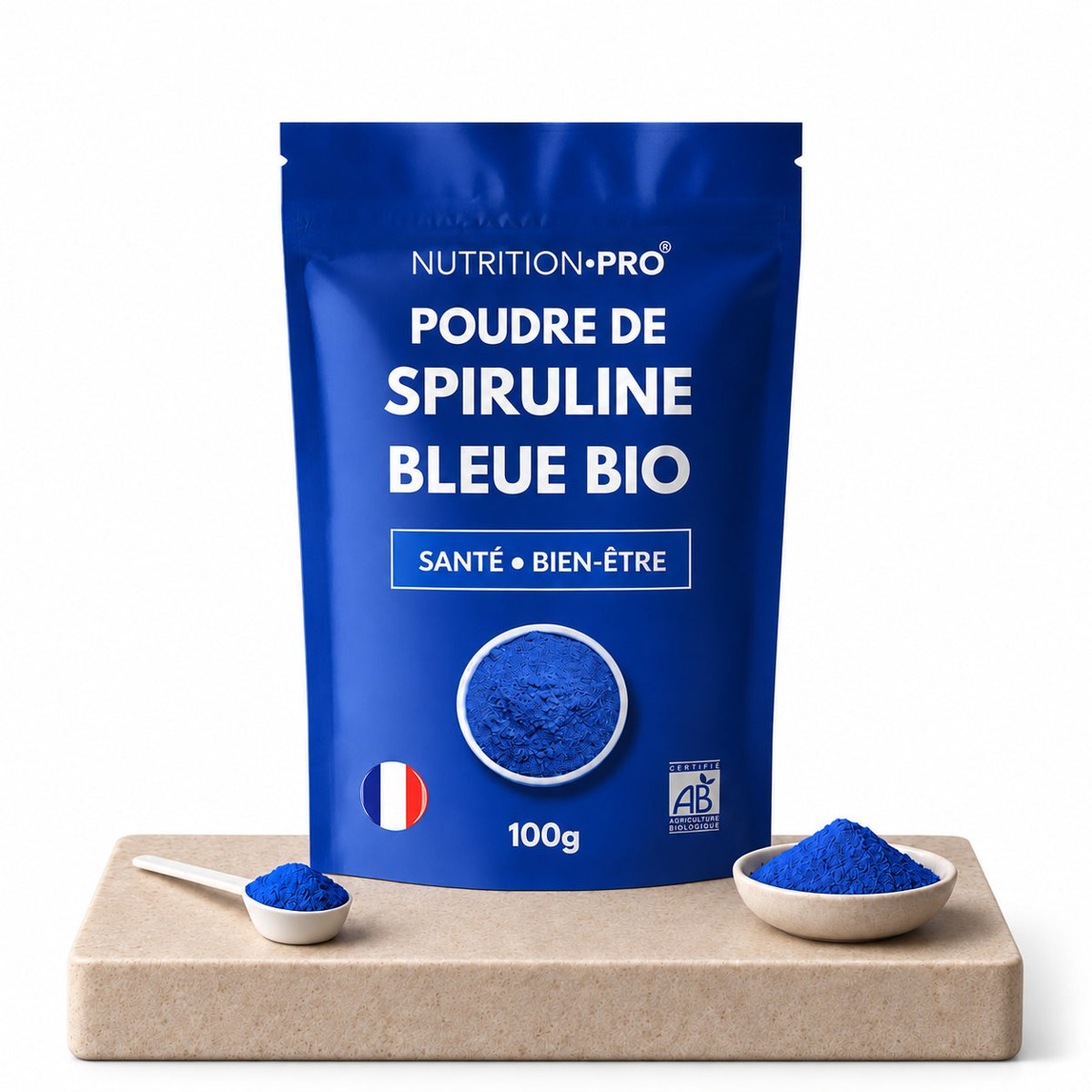
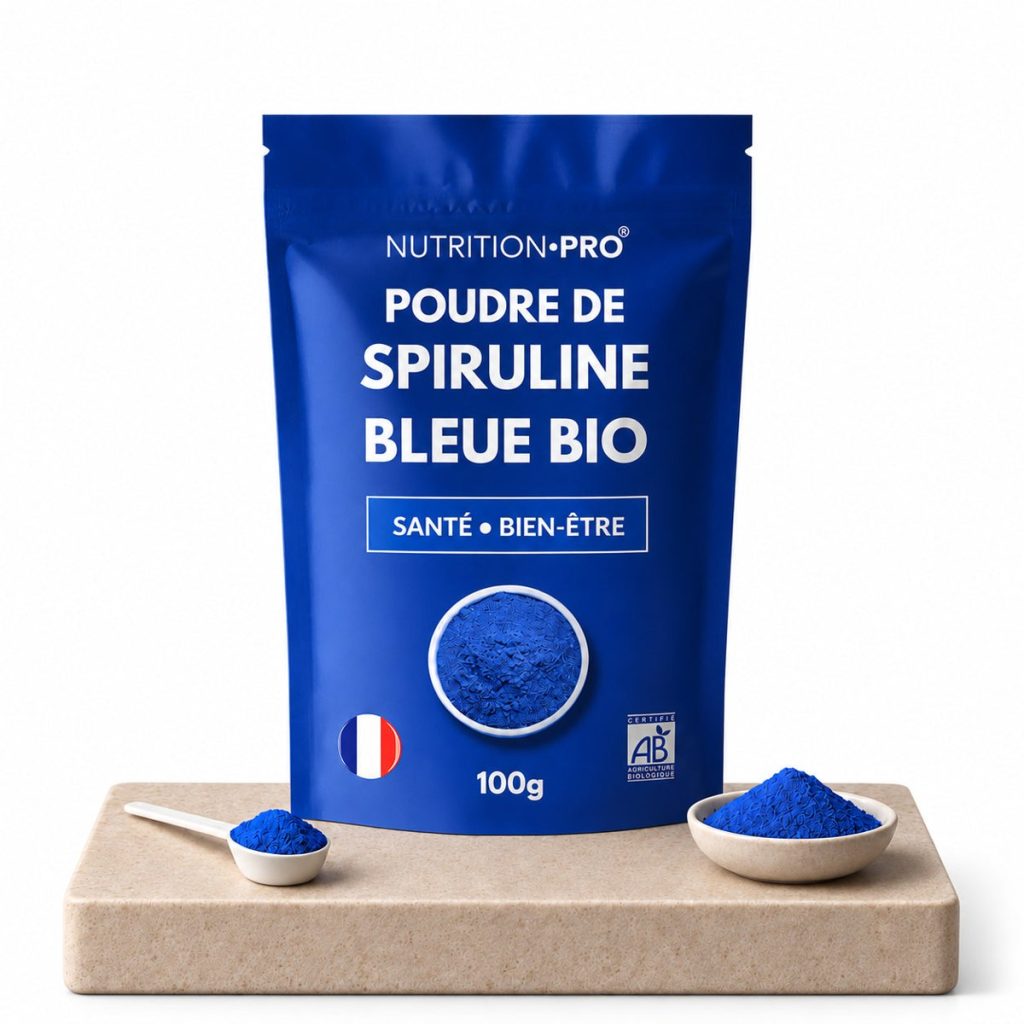
Nutrition•pro is a French brand based in Paris. Its organic blue spirulina has two strengths that matter here: organic certification, rare for an algae extract, and analyses on every batch for heavy metals, microcystins and bacteria.
- organic spirulina extract, over 30% phycocyanin according to the brand;
- gentle low-temperature extraction, no additives, vegan, gluten-free;
- organic spirulina, checked and packed in France; the country of cultivation is not stated on the product page;
- suggested use: 3 g a day (1 level teaspoon) in juice, water, a smoothie or yogurt, uncooked;
- 100 g bag, about 33 days;
- €24.99 per bag (price checked on 22/11/2026), about €0.75 a day.
Our take: at over 30% phycocyanin, 3 g provide at least 0.9 g, close to the dose of the 2016 safety trial. A sensible dose. For the exact content of your batch, ask customer service for the certificate of analysis. The benefits listed on the product page (energy, immunity, recovery) are not proven in humans: choose it first as a batch-analysed organic phycocyanin to colour and enrich your drinks and bowls.
Promo code: SEOCONSULTINGSL for 10% off your order, €22.49 per bag, about €0.67 a day (as of 22/11/2026).
See Nutrition•pro organic blue spirulina →
Partner link: we earn a commission if you order through this link, at no extra cost to you.
Frequently asked questions
What is blue spirulina good for?
Mainly as a natural blue food colour. As a supplement, it shows antioxidant and anti-inflammatory effects in the lab, but human benefits are not established.
Is blue spirulina better than green spirulina?
Not better, different. Green spirulina offers more iron, protein and beta-carotene; blue spirulina is a tasteless concentrated pigment.
Is blue spirulina safe to take every day?
At around 1 g of phycocyanin a day, it was well tolerated for 2 weeks. Choose batch-analysed products and take breaks.
Who should not take phycocyanin?
Pregnant or breastfeeding women and children, for lack of data. Ask your doctor if you take blood thinners, immunosuppressants or chemotherapy, or have an autoimmune disease.
Does phycocyanin fight cancer?
Only in lab and animal studies. Never use it in place of treatment, and tell your oncologist about any supplement.
Sources
- Jensen G.S. et al. Clinical Safety of a High Dose of Phycocyanin-Enriched Aqueous Extract from Arthrospira (Spirulina) platensis. J Med Food, 2016; 19(7): 645-53. PubMed 27362442
- Jensen G.S. et al. Antioxidant and anti-inflammatory properties of an aqueous cyanophyta extract derived from Arthrospira platensis. J Med Food, 2015; 18(5): 535-41. PubMed 25764268
- Braune S. et al. Phycocyanin from Arthrospira platensis as Potential Anti-Cancer Drug: Review of In Vitro and In Vivo Studies. Life (Basel), 2021; 11(2): 91. PubMed 33513794
- Le Gouill-Jaijarat C. et al. PROPERTY: study protocol for a randomized, double-blind, multicenter placebo-controlled trial (PHYCOCARE). Trials, 2023; 24(1): 50. PubMed 36670495
- Roy-Lachapelle A. et al. Detection of Cyanotoxins in Algae Dietary Supplements. Toxins (Basel), 2017; 9(3): 76. PubMed 28245621
- Miller T.R. et al. Microcystin Toxins at Potentially Hazardous Levels in Algal Dietary Supplements. J Agric Food Chem, 2020; 68(30): 8016-8025. PubMed 32597644
- Pinchart P.E. et al. Microcystins and Cyanobacterial Contaminants in the French Small-Scale Productions of Spirulina. Toxins (Basel), 2023; 15(6): 354. PubMed 37368655
- FDA, 21 CFR 73.530, Spirulina extract. ecfr.gov
- JECFA (FAO/WHO), Spirulina extract, INS 134. apps.who.int