Activated charcoal: benefits, side effects and drug interactions
The short answer
Activated charcoal is charcoal made extremely porous, so it can trap gases and molecules on its surface in the gut without being absorbed. For gas and bloating, the EU allows the claim that it helps reduce excessive flatulence after eating, with 1 g before and 1 g after the meal, but the trials are old, small and conflicting. For poisoning, it is a medical treatment given in hospital or on poison control advice, not a home remedy. The key safety point: it also binds medicines. Take it more than 2 hours apart from any medication, birth control pills included.
This article is for information and does not replace medical advice. In case of poisoning, call emergency services or poison control. If you take medication or the pill, ask your pharmacist before using charcoal.
What is activated charcoal?
It is made from plant material (wood, coconut shells) that is carbonised, then “activated” with high-temperature steam or a chemical process. Activation creates countless tiny pores: one gram has a surface area of several hundred square metres. That surface traps molecules, a process called adsorption.
In the gut, charcoal is not absorbed: it passes through and leaves in the stool with whatever it has bound. It comes as a pharmacy medicine, as supplement capsules or powder, and as technical charcoal for water or air filters, which is not meant to be swallowed.
Activated charcoal benefits: what the studies show
Gas and bloating: weak, conflicting evidence
EU Regulation 432/2012 authorises one claim: activated charcoal contributes to reducing excessive flatulence after eating, for products providing 1 g per serving, with 1 g taken at least 30 minutes before and 1 g shortly after the meal. Human trials disagree:
| Study | What was measured | Result |
|---|---|---|
| Jain et al., 1986 | 99 volunteers (US and India), gas induced with lactulose, charcoal vs placebo, double-blind | Less breath hydrogen; less bloating and cramping |
| Suarez et al., 1999 | 5 volunteers, 0.52 g four times a day for a week | No reduction in sulfur gases (odour), total gas or symptoms |
Suarez’s team suggests charcoal becomes saturated on its long trip through the gut. Bottom line: an effect on gas is possible, mainly at the claim’s dose, but not firmly proven.
If bloating keeps coming back, look for the cause: fermentable carbs are often involved, as explained in our low FODMAP diet guide. See also probiotics and gut microbiota.
Activated charcoal for poisoning: a medical use
The joint position of US and European toxicologists (Chyka et al., 2005) is cautious. In volunteers given at least 50 g, absorption of the poison fell by 47% when charcoal was given at 30 minutes, 40% at 1 hour, and only 16% to 21% at 2 and 3 hours. No study shows it improves patient outcomes. It should not be given routinely; it may be considered within an hour of swallowing a dangerous amount of a substance it binds. It is contraindicated when the airway is not protected (drowsiness, vomiting), because it can be inhaled.
A few capsules are nowhere near the tens of grams used in hospital, and charcoal does not bind every toxin. Activated charcoal for food poisoning or an overdose is not a DIY fix: call poison control or emergency services. For pets, ask a vet.
Diarrhea, detox, liver, weight loss
As a medicine for digestive upset, charcoal is meant for short use (5 to 10 days), and its label stresses rehydration first in case of diarrhea. For liver “detox” and weight loss we found no solid trial. See foods for liver health and detox myths and how to lose belly fat.
Teeth whitening: no evidence
An American Dental Association review (Brooks et al., 2017) screened 118 articles: none met its quality criteria, and data were insufficient to support the safety or efficacy of charcoal toothpastes. Ask your dentist, especially if your teeth are sensitive.
Activated charcoal side effects and drug interactions
The major interaction: medicines and the pill
Charcoal does not choose: it can bind a medicine just like a gas and reduce its absorption. The French label of charcoal medicines says to take any other medicine more than 2 hours apart where possible, and names in particular:
- thyroid hormones and digitalis heart drugs;
- some antibiotics (fluoroquinolones, tetracyclines) and tuberculosis drugs;
- aspirin, corticosteroids, some beta-blockers, phenothiazine antipsychotics, rosuvastatin;
- iron, bisphosphonates (osteoporosis), antivirals (dolutegravir, elvitegravir);
- ulipristal, used for emergency contraception.
What about birth control pills? The pill is a medicine, so the 2-hour rule applies. If you took charcoal less than 2 hours before or after your pill, absorption may have been reduced: ask your pharmacist whether you need backup contraception, as for a missed pill. Easiest: keep times well apart, for example pill in the morning, charcoal around dinner. Vitamins and minerals are affected too.
Side effects and precautions
| Situation | What to know |
|---|---|
| Black stools | Normal and harmless at high doses (label) |
| Very slow bowel movement (intestinal hypomotility) | Contraindication for the charcoal medicine |
| Ongoing medication, the pill | At least 2 hours apart; ask your pharmacist |
| Diarrhea | Rehydrate first; see a doctor if it lasts or with fever or blood |
| Pregnancy | Not absorbed but limited data: only if needed, with medical advice (label) |
| Breastfeeding | Possible according to the medicine’s label |
| Poisoning, drowsiness, vomiting | Never self-treat: emergency services or poison control |
How and when to take activated charcoal pills
- Reference dose for gas: 1 g at least 30 minutes before the meal and 1 g shortly after, per the EU claim.
- When: around the meal that bothers you, always more than 2 hours from medicines and supplements.
- How fast does it work? No study gives a precise time for bloating; the EU claim is based on taking it 30 minutes before eating.
- How long: short periods only, 5 to 10 days for the medicine. If symptoms persist or worsen, see a doctor.
- With a large glass of water, capsule swallowed whole.
Dynveo: organic activated charcoal produced in France
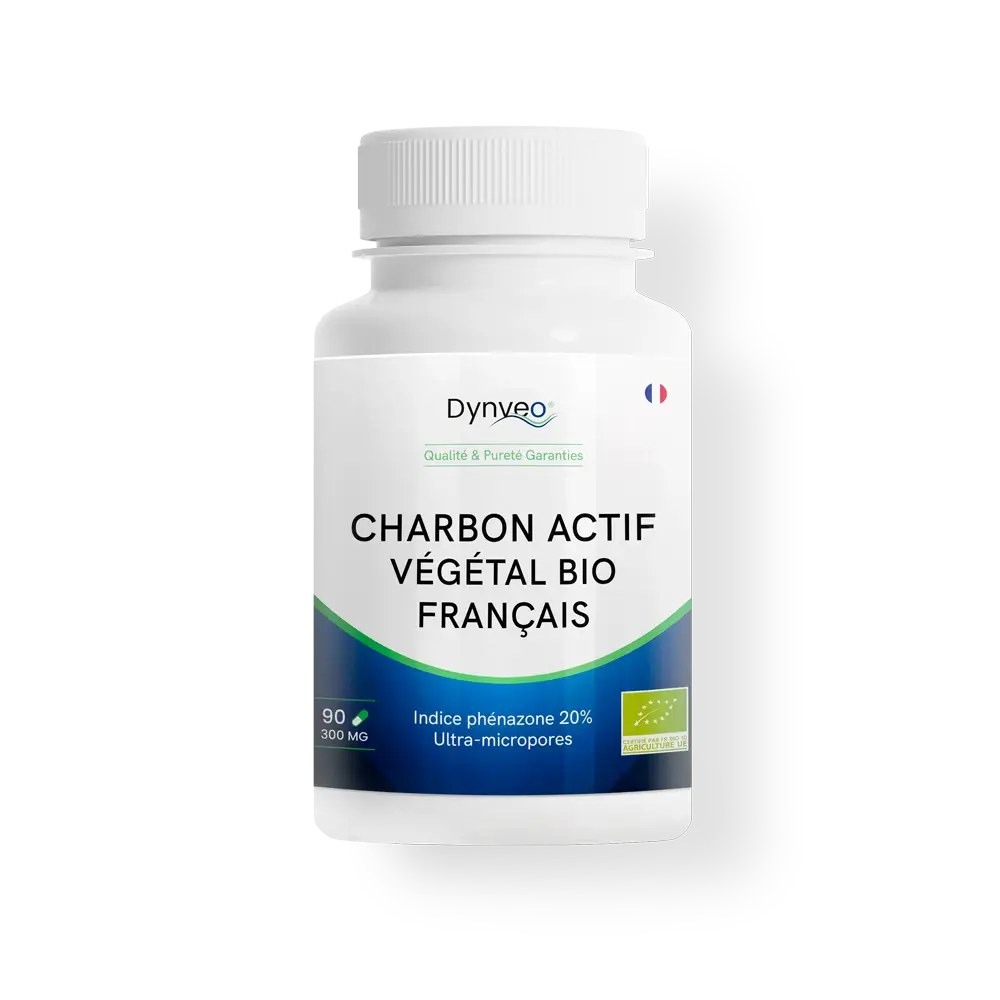
For a pure charcoal with nothing added, Dynveo’s Charbon végétal activé BIO stands out for how openly its page documents origin and processing:
- 100% vegetable charcoal from organic chestnut wood from the Dordogne (PEFC-certified forests), in a plant capsule, no additives;
- physical activation with steam only, no chemicals; stated adsorption surface of at least 800 m² per gram;
- the brand states a French production and publishes batch analyses (contaminants, heavy metals, pesticides);
- 300 mg per capsule; directions: 3 capsules before the meal and 3 right after (1,800 mg a day), starting with 2 a day;
- 90 capsules, a 15-day supply at the full dose; also sold as powder (120 g, €19.90);
- €15.90 for 90 capsules (price checked on 22/11/2026), about €1.06 a day at 6 capsules.
How does the dose compare? 3 capsules provide 900 mg, slightly under the 1 g before and after the meal of the EU claim. The gradual start the brand suggests is a sensible way to check tolerance. The trials above did not test this product, and their results on gas remain mixed.
In its FAQ, the brand also advises taking it 2 hours apart from any medicine or supplement: follow that rule, the pill included. If pregnant, ask your doctor or midwife.
See Dynveo Activated Charcoal →
Partner link: we earn a commission if you order through this link, at no extra cost to you.
Frequently asked questions
What is activated charcoal good for?
It may help reduce flatulence after meals at 1 g before and 1 g after, though trials conflict. In hospital, it is used for some poisonings. Evidence is lacking for detox, weight loss and whiter teeth.
What are the side effects of activated charcoal?
Black stools, and above all reduced absorption of medicines, the pill included, if taken less than 2 hours apart. Avoid it if your bowel movements are very slow.
Can I take activated charcoal with birth control?
Yes, if you keep at least 2 hours between them. If you didn’t, ask your pharmacist whether you need backup contraception.
Does activated charcoal work for food poisoning or a stomach bug?
Not as self-care: for poisoning it is a hospital treatment with uncertain benefit, and with a stomach bug, rehydration is the priority.
Is activated charcoal good for you every day?
It is meant for short-term use. Daily long-term use risks interfering with medicines and nutrients; recurring bloating deserves a medical check.
Sources
- Jain N.K., Patel V.P., Pitchumoni C.S. Efficacy of activated charcoal in reducing intestinal gas: a double-blind clinical trial. Am J Gastroenterol, 1986; 81(7): 532-5. PubMed 3521259
- Suarez F.L. et al. Failure of activated charcoal to reduce the release of gases produced by the colonic flora. Am J Gastroenterol, 1999; 94(1): 208-12. PubMed 9934757
- Chyka P.A. et al.; American Academy of Clinical Toxicology, European Association of Poisons Centres and Clinical Toxicologists. Position paper: Single-dose activated charcoal. Clin Toxicol (Phila), 2005; 43(2): 61-87. PubMed 15822758
- Brooks J.K., Bashirelahi N., Reynolds M.A. Charcoal and charcoal-based dentifrices: A literature review. J Am Dent Assoc, 2017; 148(9): 661-670. PubMed 28599961
- ANSM. Charbon de Belloc 125 mg soft capsule: summary of product characteristics, updated 27/02/2025. ansm.sante.fr
- Commission Regulation (EU) No 432/2012 establishing a list of permitted health claims (annex: activated charcoal). eur-lex.europa.eu