Grapefruit seed extract: benefits, side effects, drug interactions and what lab tests found
The short answer
Grapefruit seed extract (GSE) is marketed as a natural, broad-spectrum antimicrobial. But several independent labs that tested commercial extracts found synthetic disinfectants in them, mainly benzethonium chloride, sometimes triclosan or benzalkonium chloride. A German team concluded that the antimicrobial activity came from these preservatives: the one preservative-free product, and homemade extracts, had no effect at all. The remaining evidence is almost entirely in vitro (lab dishes), and we found no clinical trial of GSE taken by mouth. On safety, don’t confuse grapefruit juice, whose drug interactions are well established, with the extract, where data are scarce but not absent: a bleeding case on warfarin was linked to a product containing benzethonium. If you use it, pick an extract with batch testing that rules these out, and check with your pharmacist if you take any medication.
This article is for information and does not replace medical advice. Infections (urinary, sinus, gut, recurring yeast) need a health professional: a supplement is not a treatment.
What is grapefruit seed extract?
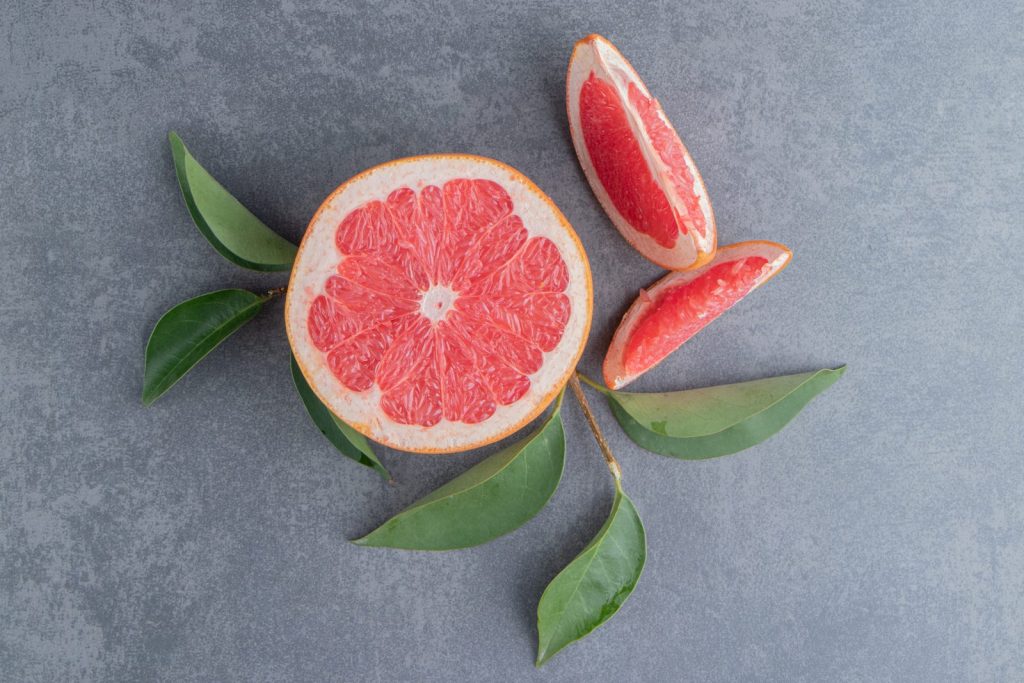
It is a liquid made from grapefruit (Citrus paradisi) seeds, often together with the pulp and white membranes. It is sold as drops, capsules, nasal sprays and cleaning products. It is not the same as grapefruit seed oil (a culinary or cosmetic oil) or grapefruit essential oil (from the peel).
Real grapefruit seeds contain limonoids (mainly limonin and nomilin) and some flavonoids. In 2016, a University of Mississippi team analyzed 17 products sold as GSE: many were rich in flavonoids, a sign that peel, pulp or seed coat had been used. The label “seed extract” tells you little about what is inside. For the fruit itself, see our grapefruit nutrition page.
The key issue: synthetic preservatives found in commercial GSE
| Study | Products tested | Findings |
|---|---|---|
| Sakamoto et al., 1996 (Japan) | GSE sold as a food additive | Triclosan and methylparaben; profile unlike a real seed extract |
| von Woedtke et al., 1999 (Germany) | 6 commercial extracts | Benzethonium in all 5 active extracts, triclosan and methylparaben in 3; preservative-free and homemade extracts: no activity |
| Takeoka et al., 2001 (USDA) | Liquid and powder GSE | Main constituent: benzethonium chloride, 8% of the liquid, more in powders |
| Ganzera et al., 2006 (Austria) | 9 products for organic farming | 7 of 9 adulterated with benzethonium or benzalkonium |
| Avula et al., 2007 (USA) | Commercial GSE samples | Benzethonium at 0.29% to 21.84%; triclosan in 2 samples |
| Sugimoto et al., 2008 (Japan) | 41 products | Benzethonium or benzalkonium in most of them |
| Avula et al., 2016 (USA) | 17 products | Benzethonium in 2 |
Benzethonium and benzalkonium chloride are synthetic disinfectants used in hygiene and cleaning products; triclosan is a synthetic antibacterial. The most recent analysis found them in fewer products, which suggests the market has improved, but the problem has not gone away. An extract that kills “everything” in a lab dish is not necessarily natural: only batch testing can tell.
Grapefruit seed extract benefits: what the studies show
Antimicrobial activity, mostly in vitro
- Reagor et al., 2002: a commercial extract (Citricidal) inhibited all 67 bacterial strains tested;
- Heggers et al., 2002: the same extract was toxic to human skin cells down to a 1:128 dilution, and non-toxic only at 1:512;
- Cvetnić et al., 2004: a lab-made ethanol extract of seeds and pulp slowed bacteria and yeasts, but only at high concentrations (2% to 16.5%);
- Han et al., 2021: activity against antibiotic-resistant staph, proposed as a coating for medical materials.
These studies did not always rule out added preservatives, and lab-dish activity says nothing about a few drops in a glass of water.
What is grapefruit seed extract good for in humans?
We found no randomized trial of oral GSE for immunity, candida, parasites, colds or as an “antibiotic”, so there is no evidence-based antibiotic dosage. Nasal sprays are also not backed by solid trials. For immune support that is actually studied, see how to boost your immune system with food and our best immune support supplement comparison.
Grapefruit seed extract side effects and drug interactions
Grapefruit juice: proven interactions
Grapefruit juice raises blood levels of many drugs: its furanocoumarins block CYP3A4, a gut enzyme that normally breaks down part of the dose. Prescrire lists serious interactions with immunosuppressants, some statins, benzodiazepines, most calcium channel blockers, indinavir and carbamazepine. See our grapefruit juice page for its nutrients.
The extract: fewer data, one serious case
| Grapefruit juice | Grapefruit seed extract | |
|---|---|---|
| Proven interactions | Yes, many human studies | No human studies; “occasionally implicated” per Prescrire |
| Mechanism | Furanocoumarins block gut CYP3A4 | Furanocoumarin content undocumented; benzethonium found in some products blocks CYP3A4 and CYP2C9 in vitro |
| Case report | Many | Woman on warfarin: INR 7.9 and bruising after 3 days of drops (Sweden) |
| What to do | Avoid with affected drugs | Same caution: ask your pharmacist first |
In the Swedish case, the three products analyzed by the Medical Products Agency contained benzethonium, glycerol and water, and no genuine seed extract.
Who should avoid it
- anyone on a drug whose label says to avoid grapefruit, especially blood thinners, immunosuppressants, statins, blood pressure drugs or sedatives;
- pregnancy and breastfeeding (no data), children without medical advice, citrus allergy.
Undiluted, it is acidic and irritating: always dilute. Unusual bleeding or bruising while on medication: stop and see a doctor.
How to use it if you choose to
- Dose: none validated by studies; follow the label, always diluted in a large glass of water.
- Timing: with or after a meal if your stomach is sensitive; spacing it from medication is not enough to rule out an interaction: ask your pharmacist.
- Duration: short courses only.
- Choosing a product: a quantified, organic formula and a certificate of analysis that screens for benzethonium, benzalkonium and triclosan.
Related reading: bee propolis benefits and side effects, pomelo benefits, and a citrus dish, our prawn, avocado and grapefruit salad.
Nutrition•pro: organic grapefruit seed extract drops
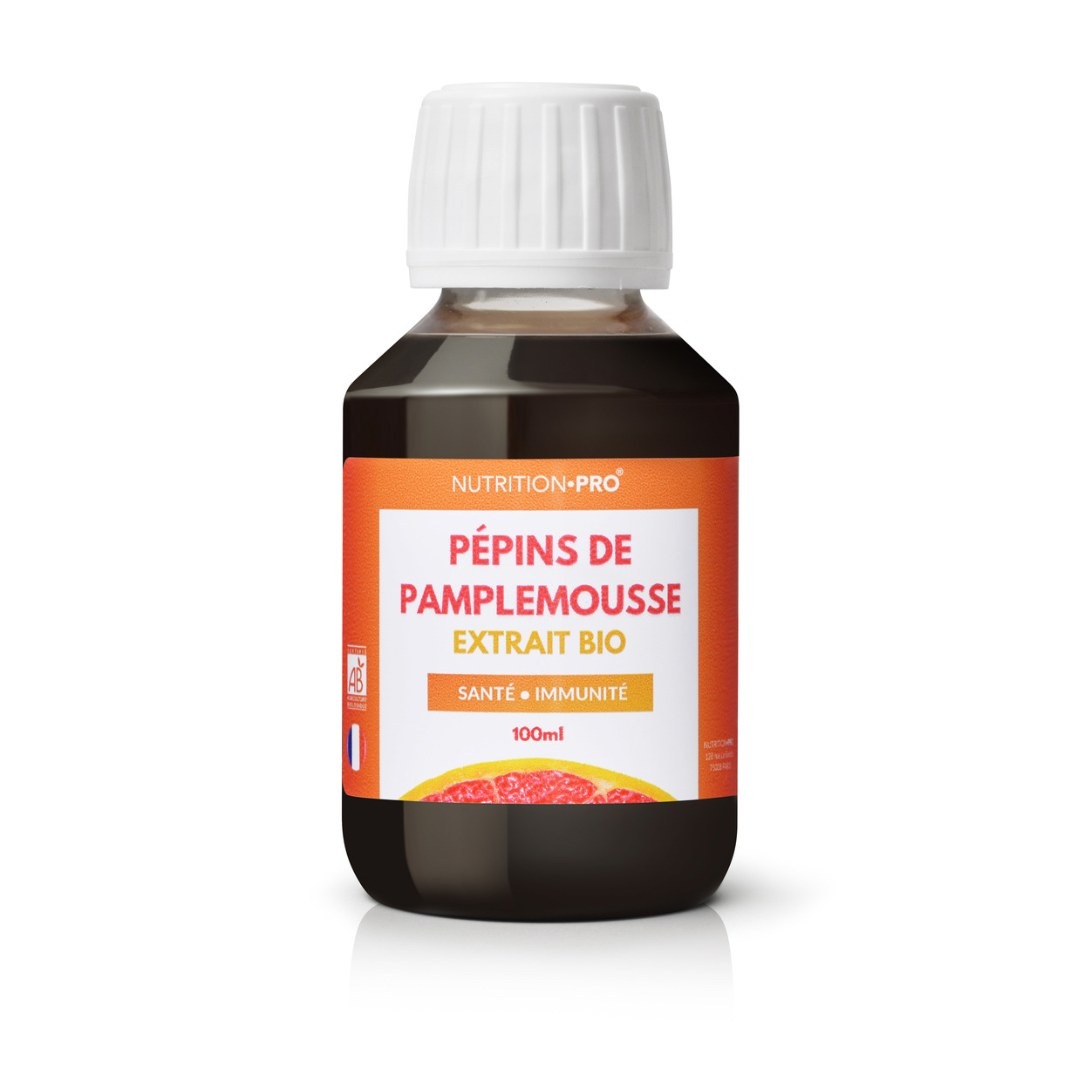
If you want to try it, Nutrition•pro’s organic grapefruit seed extract has a short, fully declared formula. Its page states:
- per day (3 droppers, 0.9 ml): 0.72 ml grapefruit seed extract and 0.18 ml agave syrup, both organic;
- a formula described as alcohol-free and preservative-free, to dilute in water;
- a 100 ml bottle, about 110 days at 0.9 ml a day;
- the brand says it designs and manufactures its formulas in France;
- €29.99 per bottle (price checked on 22/11/2026), about €0.27 a day.
Worth knowing. The directions tab says “3 drops a day” while the composition table says 3 droppers (0.9 ml), so ask customer service to confirm the dose. The page gives no flavonoid content and no published lab report; given this product category’s history, asking for a batch certificate (benzethonium and benzalkonium screening) is a reasonable step. The studies above did not test this product. The brand advises against it in pregnancy and breastfeeding; we add: check with your pharmacist if you take a blood thinner or any grapefruit-sensitive drug.
Promo code: SEOCONSULTINGSL for 10% off your order, €26.99 per bottle (as of 22/11/2026).
See Nutrition•pro Organic Grapefruit Seed Extract →
Partner link: we earn a commission if you order through this link, at no extra cost to you.
Frequently asked questions
What are the benefits of grapefruit seed extract?
In lab dishes, extracts inhibit bacteria and yeasts. In humans, no clinical trial has shown a benefit, and part of the measured activity came from added synthetic preservatives.
What are the side effects of grapefruit seed extract?
Irritation if undiluted, and possible drug interactions: one published case of dangerously thin blood on warfarin. Products adulterated with disinfectants add their own risks.
Does grapefruit seed extract kill parasites?
There is no human trial showing it. If you suspect a parasite, see a doctor for testing and proven treatment.
Is grapefruit seed extract a natural antibiotic?
No. It has no proven antibiotic dosage or clinical effect, and should never replace an antibiotic your doctor prescribes.
Does grapefruit seed extract interact with medications like grapefruit juice?
Juice interactions are proven; extract interactions are poorly studied. Apply the same precautions as for juice.
Sources
- von Woedtke T. et al. Aspects of the antimicrobial efficacy of grapefruit seed extract and its relation to preservative substances contained. Pharmazie, 1999; 54(6): 452-6. PubMed 10399191
- Takeoka G. et al. Identification of benzethonium chloride in commercial grapefruit seed extracts. J Agric Food Chem, 2001; 49(7): 3316-20. PubMed 11453769
- Ganzera M. et al. HPLC/UV/MS method for simultaneous determination of 18 preservatives in grapefruit seed extract. J Agric Food Chem, 2006; 54(11): 3768-72. PubMed 16719494
- Avula B. et al. Benzethonium chloride, methyl paraben and triclosan in commercial products labeled as grapefruit seed extract. Pharmazie, 2007; 62(8): 593-6. PubMed 17867553
- Sugimoto N. et al. Survey of synthetic disinfectants in grapefruit seed extract and its compounded products. Shokuhin Eiseigaku Zasshi, 2008; 49(1): 56-62. PubMed 18344660
- Avula B. et al. Limonoids and flavonoids in seeds of grapefruits, other Citrus species, and dietary supplements. Planta Med, 2016; 82(11-12): 1058-69. PubMed 27224266
- Brandin H. et al. Adverse effects by artificial grapefruit seed extract products in patients on warfarin therapy. Eur J Clin Pharmacol, 2007; 63(6): 565-70. PubMed 17468864
- Reagor L. et al. Processed grapefruit-seed extract as an antibacterial agent: I. An in vitro agar assay. J Altern Complement Med, 2002; 8(3): 325-32. PubMed 12165190
- Heggers J.P. et al. Processed grapefruit-seed extract as an antibacterial agent: II. Mechanism of action and in vitro toxicity. J Altern Complement Med, 2002; 8(3): 333-40. PubMed 12165191
- Seden K. et al. Grapefruit-drug interactions. Drugs, 2010; 70(18): 2373-407. PubMed 21142260
- Prescrire. Grapefruit and drug interactions. Prescrire Int, 2012; 21(133): 294-8. PubMed 23373097