Black radish: benefits, liver claims, side effects and how to eat it
The short answer
Black radish (also called Spanish black radish) is first of all a good winter vegetable: low in calories (28 kcal per 100 g), watery, with potassium, some vitamin C and the sulfur compounds that make it hot. Its liver benefits, promoted by “liver detox” supplements, rest on tradition and mouse or rat studies: we found no human trial. Because it is thought to stimulate bile flow, be careful if you have gallstones: no supplement course without medical advice. As a food, raw or cooked, it is fine.
This article is for information and does not replace medical advice. Pain under the right ribs, yellow skin or known liver disease: see a doctor before taking any herbal product.
What is black radish?
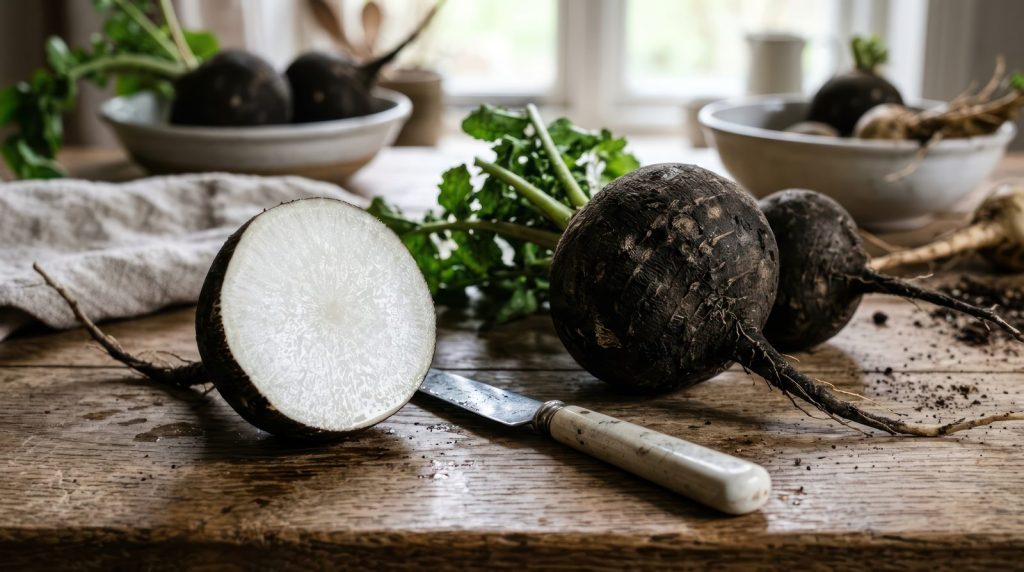
It is a variety of radish (Raphanus sativus var. niger) in the cabbage and mustard family: a large root with black skin and white flesh, much sharper than the common radish. Its bite comes from glucosinolates, the same family of compounds as in horseradish, released when the root is cut or grated.
| Raw black radish | Per 100 g |
|---|---|
| Energy | 28.2 kcal |
| Carbohydrates | 5.52 g |
| Fiber | 1.2 g |
| Protein | 0.94 g |
| Potassium | 300 mg |
| Calcium | 39 mg |
| Vitamin C | 9.58 mg |
Black radish benefits: what the studies show
Liver and bile: animal studies only
| Study | Model | Result |
|---|---|---|
| Castro-Torres et al., 2012 | Mice fed a gallstone-inducing diet | Juice cleared cholesterol gallstones in 6 days; lower cholesterol and triglycerides |
| Lugasi et al., 2005 | Rats on a high-fat diet | Better antioxidant markers |
| Sipos et al., 2002 | Rats on a high-fat diet | Protected colon lining |
| N’jai et al., 2012 | Mice, diet with 20% black radish | More active detox enzymes, faster clearance of a toxin |
| Ahn et al., 2019 | Mice, fermented black radish | Less fatty liver damage |
These are animal results, with huge doses or concentrated juice. We found no human trial, and the European Medicines Agency has no monograph on black radish, unlike artichoke or milk thistle.
What is Spanish black radish used for in supplements?
Mostly “liver detox” and bile support. Your liver clears toxins on its own; nothing shows that a black radish supplement changes that in humans. Our guide on liver health and detox myths sorts fact from marketing.
Black radish side effects
Gallstones: the main caution
A herb that increases bile flow could, in theory, move a stone and trigger biliary colic. There is no official text on black radish, but the EMA applies this logic to herbs with the same use: it contraindicates artichoke leaf in bile duct obstruction, gallstones or liver disease, and advises against turmeric in the same cases “due to possible stimulation on bile secretion”. Apply the same rule to black radish supplements and juice.
| Situation | As a vegetable | Supplements, juice |
|---|---|---|
| Healthy adult | Yes | Possible, no proven benefit |
| Gallstones, bile duct obstruction | Normal portions | Not without medical advice |
| Liver disease | Normal portions | Not without medical advice |
| Sensitive stomach, reflux, IBS | As tolerated, cooked | Caution |
| Pregnancy, breastfeeding | Yes, washed well | No data: avoid |
- Heartburn, bloating: its sulfur compounds can irritate in large amounts, especially raw on an empty stomach;
- Allergy: rare, but a case of anaphylaxis to black radish has been published (Sousa et al., 2010);
- Detox blends often add artichoke, turmeric or dandelion, each with its own cautions: see is turmeric dangerous?
How to eat black radish
- Raw, thinly sliced or grated: salt it for 10 minutes and rinse to soften the bite.
- In salads: grated with a mustard dressing, apple or carrot.
- Cooked: pan-fried, roasted or in soup, it turns mild, like turnip.
- Black radish juice is very strong: start small and diluted, and skip it if you have gallstones.
- Zero waste: radish greens make a good radish top soup.
Nutrimea: an organic black radish, artichoke, turmeric and dandelion blend
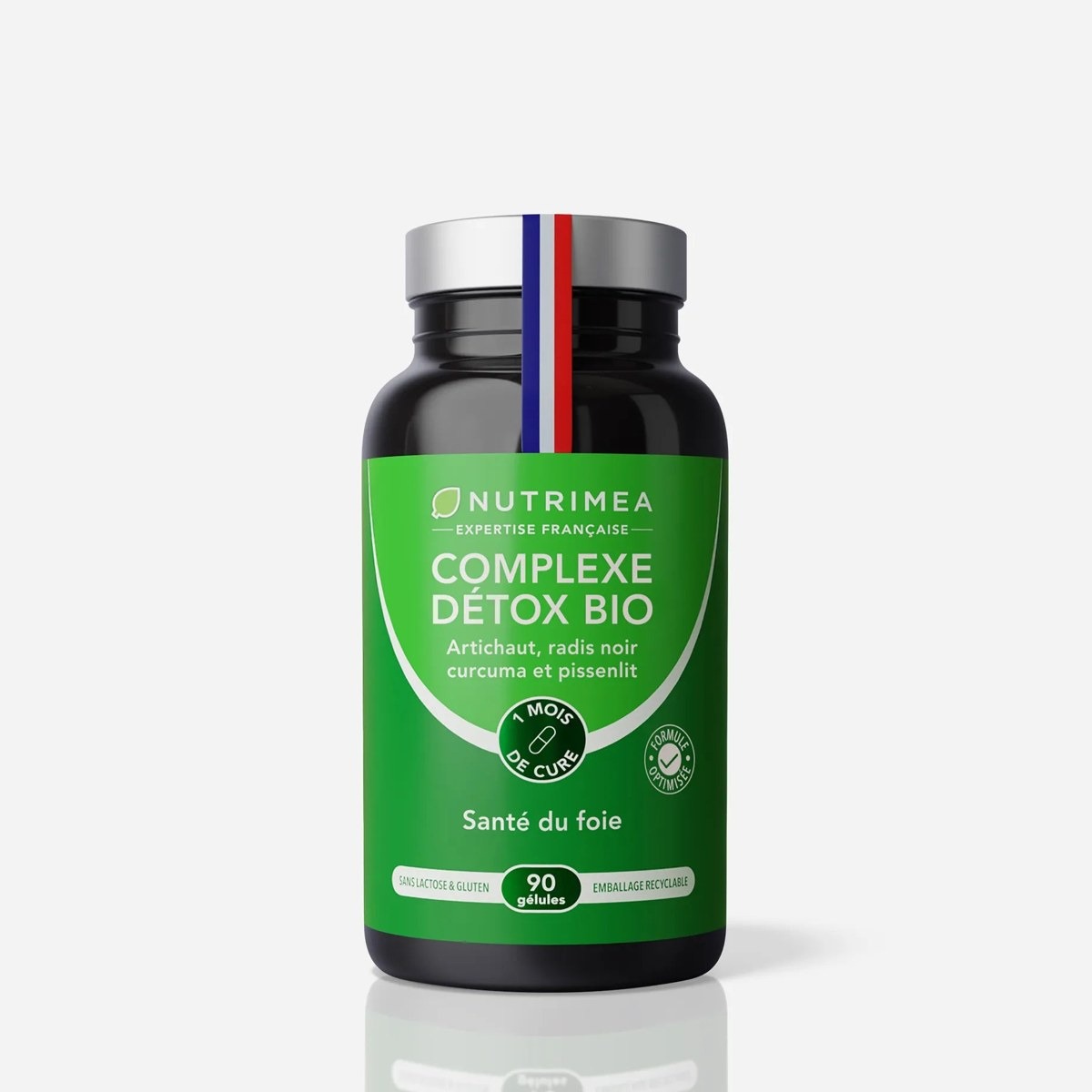
If you prefer capsules to vials, Nutrimea’s Complexe Détox Bio has a short, organic, fully quantified formula:
- per 3 capsules: 480 mg black radish root powder, 480 mg turmeric, 150 mg artichoke leaf and 150 mg dandelion root, all organic;
- plain powders in a plant capsule, no alcohol or sugar, unlike many vials;
- 3 capsules a day, one with each meal; 90 capsules, a 30-day supply;
- batch tests published (microbiology, heavy metals); the brand says the formula is designed in France;
- €18.90 per jar (price checked on 22/11/2026), about €0.63 a day.
How does the dose compare? 480 mg of dried black radish is small next to the juices and diets used in animals, and no human dose has been validated. The studies above did not test this product. The brand advises against it in pregnancy and asks you to check with a doctor if you take anticoagulants or have thyroid issues. Our own caution: with black radish, artichoke and turmeric, it is not for you if you have gallstones or liver disease, unless your doctor agrees.
See Nutrimea Organic Detox Complex →
Partner link: we earn a commission if you order through this link, at no extra cost to you.
For water-loss “drainer” formulas, see our best natural diuretic comparison.
Frequently asked questions
What are the health benefits of black radish?
As a vegetable: few calories, water, potassium, some vitamin C and fiber. Liver and bile effects have only been shown in animals.
Does black radish help the liver?
In mice and rats, its juice reduced gallstones and liver damage. In humans, there are no trials, so its “detox” effect is unproven.
What are the side effects of Spanish black radish?
Heartburn or bloating in large amounts, rare allergy, and a possible risk of biliary colic in people with gallstones when taken as a concentrated supplement.
Can you eat black radish raw?
Yes: thinly sliced or grated, salted and rinsed to soften it. You can keep the skin if well scrubbed.
Sources
- Castro-Torres I.G. et al. Antilithiasic and hypolipidaemic effects of Raphanus sativus L. var. niger on mice fed with a lithogenic diet. J Biomed Biotechnol, 2012; 2012: 161205. PubMed 23093836
- Castro-Torres I.G. et al. Raphanus sativus L. var niger as a source of phytochemicals for the prevention of cholesterol gallstones. Phytother Res, 2014; 28(2): 167-71. PubMed 23495001
- Lugasi A. et al. Antioxidant effect of squeezed juice from black radish in alimentary hyperlipidaemia in rats. Phytother Res, 2005; 19(7): 587-91. PubMed 16161062
- N’jai A.U. et al. Spanish black radish diet enhances clearance of DMBA. Nutr Cancer, 2012; 64(7): 1038-48. PubMed 23061907
- Ahn M. et al. Fermented black radish attenuates diet-induced nonalcoholic fatty liver disease in mice. Food Sci Nutr, 2019; 7(10): 3327-3337. PubMed 31660146
- Sousa N., Gaspar A., Morais-Almeida M. Anaphylaxis to Raphanus niger. Allergy, 2010; 65(9): 1202. PubMed 20148802
- EMA, HMPC. European Union herbal monograph on Cynara cardunculus L., folium, EMA/HMPC/194014/2017. ema.europa.eu
- EMA, HMPC. European Union herbal monograph on Curcuma longa L., rhizoma, EMA/HMPC/329755/2017. ema.europa.eu