Group · Condiments & sauces
Horseradish
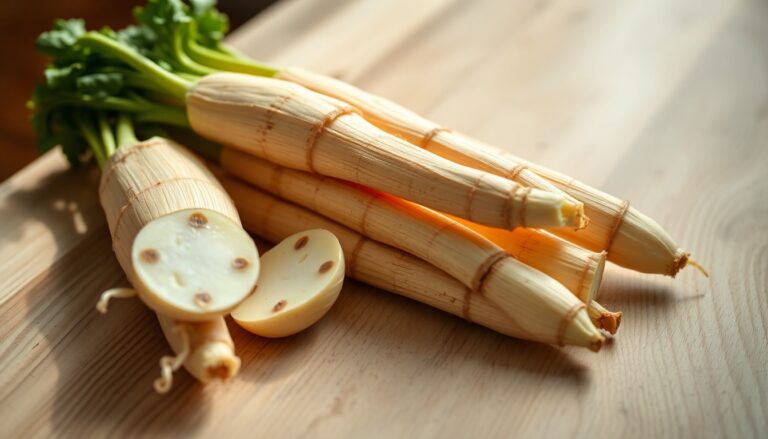
Horseradish is a root with a sharp, fresh taste, a cousin of mustard and wasabi. When grated, it releases sulphur compounds responsible for the powerful flavour that wakes up dishes. You can find it as a fresh root to grate yourself, but also as a ready-to-use condiment, in a cream or a sauce. With just 73.2 kcal per 100 g, horseradish is low in calories and provides fibre (7.5 g) as well as a few minerals. Widely used in Central European and British cooking, it traditionally accompanies red meat, smoked fish or cured meats. Its intensity lets you liven up a dish without too much fat, making it an ally of well-judged seasoning.
Macronutrient breakdown
Nutrition table per 100 g
| Calories | 73 kcal |
| Kilojoules | 307 kJ |
| Protein | 5,3 g |
| Carbohydrate | 7,8 g |
| Fat | 0,5 g |
| Fibre | 7,5 g |
Micronutrients per 100 g
All measured nutrients, ranked by share of the daily reference intake.
- Vitamin C134 mg168 %
- Copper0,23 mg23 %
- Manganese0,46 mg23 %
- Potassium394 mg20 %
- Zinc1,4 mg14 %
- Vitamin B60,18 mg13 %
- Calcium102 mg13 %
- Iron1,65 mg12 %
See the other 10 nutrients
- Phosphorus76,8 mg11 %
- Omega-3 ALA0,21 g11 %
- Vitamin B10,1 mg9 %
- Magnesium31 mg8 %
- Vitamin B20,11 mg8 %
- Vitamin B30,55 mg3 %
- Omega-6 LA0,1 g1 %
- Iodine0,9 µg1 %
- Selenium0,2 µg0 %
- Vitamin A0,92 µg0 %
Anses Ciqual 2025. Source: Anses, 2025, Ciqual food composition table
Tips
Horseradish is used in small touches: a teaspoon of grated root is enough to flavour a sauce, a vinaigrette or a mash. Its sharp flavour fades quickly after grating and with cooking, so add it raw and at the last moment. Mixed with a little crème fraîche, fromage blanc or yoghurt, it becomes a creamy sauce that is ideal with roast beef, smoked salmon, eggs or steamed potatoes.
Nutrition facts and benefits. With around 73.2 kcal per 100 g, 7.79 g of carbohydrate and 7.5 g of fibre, horseradish is light, especially as the portions eaten are tiny. It contains sulphur compounds (glucosinolates) typical of the cruciferous family, as well as vitamin C and a little potassium. It is an ideal condiment for giving character to a plate without weighing down the calorie balance, unlike fattier sauces such as mayonnaise or tartare sauce.
Practical tips and storage. Choose a firm root with no blemishes. Once cut, keep it in the fridge wrapped up, or grated and placed in a little vinegar to preserve its kick. Jarred horseradish keeps for several weeks in the fridge. You can vary the pairings:
- as a cold sauce with grilled meat or fish;
- mixed with brown mustard for a spicy seasoning;
- stirred into a homemade vinaigrette to perk up a salad;
- as a touch in a vegetable mash or a tartare.
For active people. Horseradish is not a source of protein or energy, but it lets you lift dishes rich in lean protein (fish, poultry, eggs) without adding fats or hidden sugars. This is useful if you are watching your intake while still looking for taste. To plan your meals around exercise, overall balance is what matters most, as explained in our feature on fitness nutrition.
Weight control. Plain horseradish is an excellent weight-loss ally thanks to its low energy density. Beware of creamed versions or shop-bought sauces, though, which are often sweeter or fattier: read the labels and compare the nutrition facts. To explore other light condiments, discover the whole condiments and sauces family. Eaten in moderation, horseradish adds plenty of flavour for very few calories.