Artichoke benefits: nutrition, how to cook it and artichoke leaf extract
The short answer
Artichoke comes in two very different forms: the vegetable you cook and eat, and artichoke leaf extract, sold as capsules or tea. The vegetable is low in calories (33 kcal per 100 g cooked) and one of the highest-fiber vegetables you can buy, with 8.3 g per 100 g. Steam or boil it for 30 to 45 minutes. Artichoke leaf extract is recognized by the European Medicines Agency (EMA) as a traditional herbal medicine for indigestion with fullness, bloating and gas. In trials it modestly eased dyspepsia and lowered LDL cholesterol by about 15 mg/dL on average. Avoid the extract if you are allergic to the daisy family, have gallstones or a blocked bile duct, have liver disease (unless your doctor agrees), are pregnant or breastfeeding, or for children under 12.
This article is for information and does not replace medical advice. If you take medication, have liver or gallbladder disease, or are pregnant or breastfeeding, talk to your doctor or pharmacist before taking artichoke extract.
What is artichoke?
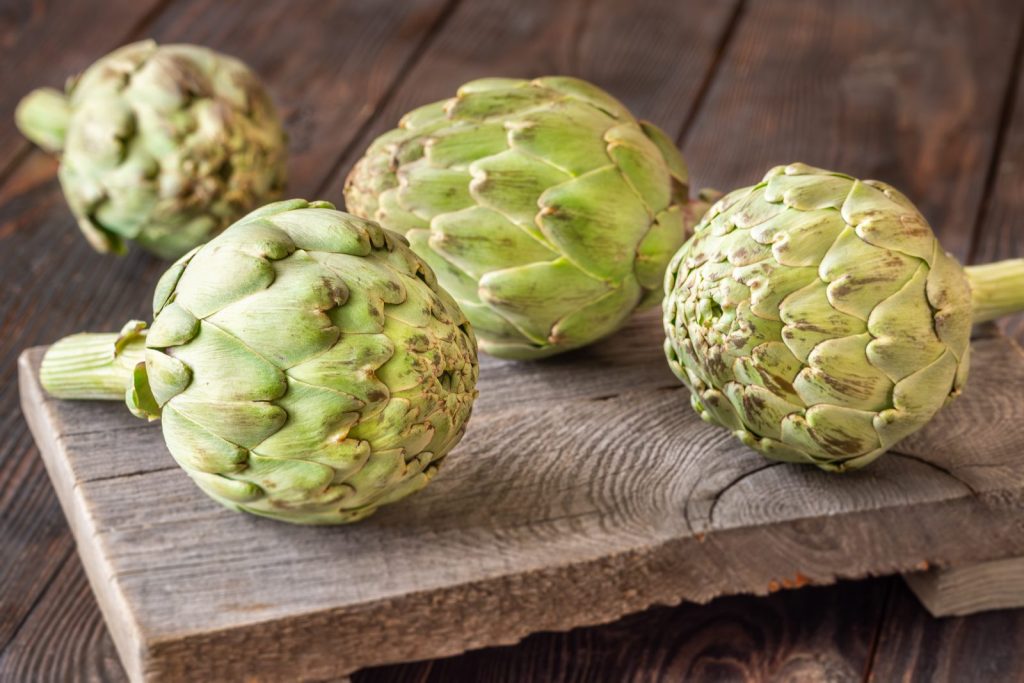
The globe artichoke (Cynara cardunculus, formerly Cynara scolymus) is a large thistle in the Asteraceae (daisy) family, like chamomile, dandelion and milk thistle. What we eat is the unopened flower bud: the heart and the fleshy base of the bracts, the “leaves” you dip and scrape with your teeth. Not to be confused with the Jerusalem artichoke, a tuber from a different plant.
Supplements do not use the bud but the plant’s large bitter leaves, rich in caffeoylquinic acids such as cynarin, which is often used to standardize extracts. So the vegetable and the extract differ in both composition and use.
Artichoke nutrition and health benefits
| Per 100 g cooked artichoke | Amount |
|---|---|
| Energy | 33 kcal |
| Fiber | 8.3 g |
| Protein | 2.5 g |
| Carbohydrates | 1 g |
| Fat | 0.3 g |
| Potassium | 427 mg |
| Magnesium | 45 mg |
| Folate (vitamin B9) | 89 µg |
| Vitamin C | 9.1 mg |
Fiber is its big strength: a 150 g serving provides 12.5 g, about 42% of a 30 g daily target, for only 50 kcal. It tops our list of vegetables high in fiber. Part of that fiber is inulin, which gut bacteria ferment. That feeds your microbiota, but it can cause gas if your gut is sensitive: if you have IBS, test it carefully, as explained in our low-FODMAP diet guide. Full nutrient data are on our artichoke page.
How to cook an artichoke
- Prep: snap off the stem close to the base to pull out the tough fibers, rinse upside down, and rub cut surfaces with lemon so they don’t darken.
- Steam or boil in salted water: 30 to 45 minutes depending on size.
- Pressure cooker or Instant Pot: much faster; follow your appliance’s guide.
- It’s done when a middle leaf pulls out easily and a knife slides into the base.
- Storage: once cooked it oxidizes quickly; refrigerate and eat within 24 to 48 hours.
Scrape each leaf with your teeth, remove the fuzzy choke, then eat the heart. A light vinaigrette is all it needs: try our artichokes vinaigrette. Values for the cooked version are on our cooked artichoke page.
Artichoke leaf extract: what the research shows
What the European Medicines Agency recognizes
In 2018 the EMA’s herbal committee (HMPC) published a monograph on artichoke leaf. It classifies it as a traditional herbal medicine for the relief of digestive complaints such as dyspepsia with fullness, bloating and flatulence. “Traditional” means the status rests on long-standing use, not on trials judged sufficient. The EMA recognizes no use for cholesterol or the liver.
Indigestion: a modest benefit from one main trial
The strongest trial (Holtmann et al., 2003) enrolled 247 people with functional dyspepsia (indigestion with no visible cause). For 6 weeks they took an artichoke leaf extract (two 320 mg capsules three times a day, 1,920 mg a day) or a placebo. Symptoms and quality of life improved more with the extract.
The 2023 Cochrane review of herbal medicines for dyspepsia (41 trials, 27 herbs) rates the artichoke effect as modest, with low-certainty evidence, because it rests on a single trial of 244 analyzed patients.
Cholesterol: a real but limited drop
| Meta-analysis | Data | Effect vs placebo |
|---|---|---|
| Sahebkar et al., 2018 | 9 trials, 702 people | Total cholesterol -17.6 mg/dL; LDL -14.9 mg/dL; triglycerides -9.2 mg/dL; HDL unchanged |
| Shahinfar et al., 2021 | 14 studies | LDL -17.5 mg/dL on average; HDL unchanged |
LDL fell more when it started higher. That is a modest effect, far smaller than a statin’s, with extracts and doses that varied between trials. Artichoke extract is never a substitute for prescribed treatment. Diet matters more: see our guide to foods to lower cholesterol.
Artichoke and the liver: promising, but not for self-treatment
A meta-analysis (Kamel and Farag, 2022) pooled 5 trials and 333 patients with non-alcoholic fatty liver disease. The leaf extract lowered liver enzymes (ALT, AST) and cholesterol. Encouraging, but the trials are few and small. And the EMA monograph actually contraindicates self-medication with artichoke leaf in liver or biliary disease: if your liver is involved, talk to your doctor. Liver “detox” with herbs is largely a myth, as our guide foods for liver health and detox myths explains.
Artichoke extract side effects and who should avoid it
The vegetable is safe for most people, apart from gas in sensitive guts and, rarely, allergy. The extract was generally well tolerated in trials. The EMA lists possible effects of unknown frequency: mild diarrhea with abdominal cramps, nausea, heartburn and allergic reactions.
| Situation | EMA position on artichoke leaf |
|---|---|
| Allergy to artichoke or the daisy family (chamomile, ragweed, arnica…) | Contraindicated |
| Gallstones, bile duct obstruction, cholangitis | Contraindicated without medical advice |
| Liver disease | Contraindicated without medical advice |
| Pregnancy and breastfeeding | Not recommended (no data) |
| Children under 12 | Not recommended (no data) |
| Medications | No interactions reported; still check with your pharmacist |
| Symptoms lasting over 2 weeks | See a doctor |
Artichoke extract dosage
- EMA doses depend on the preparation. For a dry water extract of dried leaves (ratio 2 to 7.5:1): 400 to 1,320 mg a day, in single doses of 200 to 640 mg. Powdered leaf: 600 to 1,500 mg a day. Tea: 3 to 6 g of leaf a day, for example 1.5 g in 150 ml of boiling water four times a day.
- Dyspepsia trial dose: 1,920 mg a day of a specific extract, in three doses.
- Timing: before or at the start of meals, since the aim is digestion.
- Duration: see a doctor if symptoms last more than 2 weeks.
Artichoke or milk thistle? Both belong to the daisy family and have an EMA monograph for digestive complaints; milk thistle is the one studied mainly for the liver. See our guide to milk thistle benefits and side effects.
Dynveo: an artichoke leaf extract standardized for cynarin
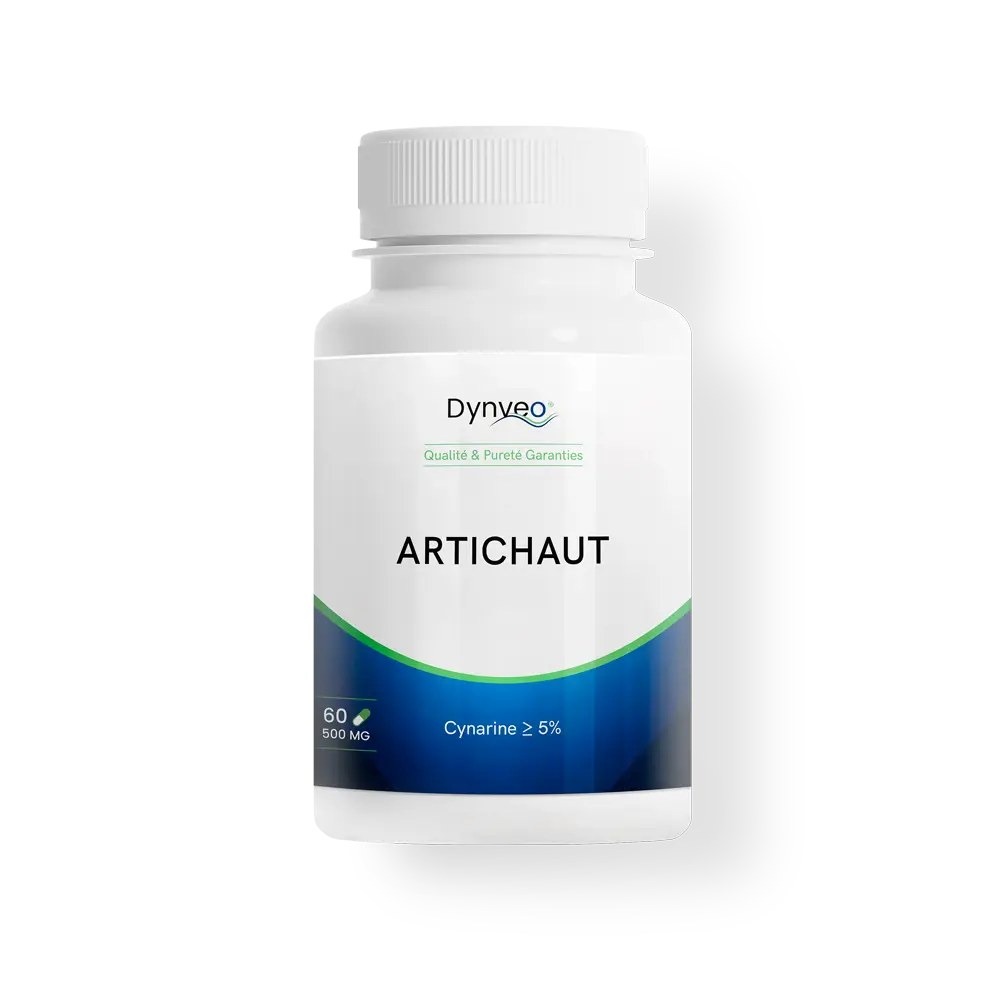
Dynveo is a French supplement brand known for short formulas and published lab analyses. Its Artichoke Extract is a single-ingredient, standardized product:
- dry artichoke leaf extract, water-extracted with no chemical solvent, ratio 6:1;
- standardized to at least 5% cynarin and 3% caffeoylquinic acid;
- 1,000 mg of extract a day in two 500 mg capsules, at least 50 mg of cynarin;
- nothing else but a pullulan vegetable capsule;
- leaves grown and extracted in Spain; the brand says the capsules are made in its own laboratory in France;
- batch certificates of analysis published (actives, heavy metals, pesticides, pyrrolizidine alkaloids, microbiology);
- 2 capsules a day, just before the two main meals; 60 capsules, one month;
- €17.90 a bottle (price checked on 22 November 2026), about €0.60 a day.
How does the dose compare? A 6:1 water extract falls within the EMA’s dry water extract category (2 to 7.5:1), and 1,000 mg a day sits inside its 400 to 1,320 mg range. It is lower than the 1,920 mg used in the Holtmann trial, which used a different extract. The studies above were not on this product, so they cannot guarantee its effect.
The brand advises against it in pregnancy and breastfeeding, under 12, with bile duct obstruction or biliary disorders, and with a daisy-family allergy, in line with the EMA. Add the EMA’s caution: no self-medication if you have liver disease.
See Dynveo Artichoke Extract →
Partner link: we earn a commission if you order through this link, at no extra cost to you.
Frequently asked questions
Is artichoke good for you?
Yes: it is very high in fiber (8.3 g per 100 g) and low in calories, with potassium and folate. The leaf extract is a traditional remedy for indigestion and modestly lowered LDL cholesterol in trials.
What are the benefits of artichoke extract?
Relief of indigestion (traditional use recognized by the EMA, one positive trial) and a small drop in LDL cholesterol. Liver results are early and small.
What are the side effects of artichoke extract?
Mild diarrhea with cramps, nausea, heartburn and, rarely, allergy. Avoid it with gallstones, bile duct problems or a daisy-family allergy.
How long do you cook an artichoke?
30 to 45 minutes steamed or boiled, less in a pressure cooker. It’s ready when a leaf pulls away easily.
Is artichoke good for your liver?
Small trials in fatty liver disease show lower liver enzymes with the leaf extract, but it is not a proven treatment, and the EMA advises against self-medication in liver disease.
Sources
- EMA, Committee on Herbal Medicinal Products. European Union herbal monograph on Cynara cardunculus L. (syn. Cynara scolymus L.), folium. EMA/HMPC/194014/2017, 27 March 2018. ema.europa.eu
- Holtmann G. et al. Efficacy of artichoke leaf extract in the treatment of patients with functional dyspepsia: a six-week placebo-controlled, double-blind, multicentre trial. Aliment Pharmacol Ther, 2003; 18(11-12): 1099-105. PubMed 14653829
- Báez G. et al. Non-Chinese herbal medicines for functional dyspepsia. Cochrane Database Syst Rev, 2023; 6: CD013323. PubMed 37323050
- Sahebkar A. et al. Lipid-lowering activity of artichoke extracts: A systematic review and meta-analysis. Crit Rev Food Sci Nutr, 2018; 58(15): 2549-2556. PubMed 28609140
- Shahinfar H. et al. Effects of artichoke leaf extract supplementation or artichoke juice consumption on lipid profile: A systematic review and dose-response meta-analysis of randomized controlled trials. Phytother Res, 2021; 35(12): 6607-6623. PubMed 34569671
- Kamel A.M., Farag M.A. Therapeutic Potential of Artichoke in the Treatment of Fatty Liver: A Systematic Review and Meta-Analysis. J Med Food, 2022; 25(10): 931-942. PubMed 35763310
- Anses. Ciqual 2025 French food composition table (artichoke, cooked).