L-theanine: benefits for stress and sleep, side effects, dosage and caffeine

The short answer
L-theanine is an amino acid found almost only in tea. As a supplement, at 200 mg, it has a modest but real effect in trials: slightly less stress, better attention within the hour, and slightly better self-rated sleep. It is not a sleeping pill and does not treat anxiety disorders or depression. With caffeine it mainly sharpens attention, although the European Food Safety Authority (EFSA) attributes tea’s effect on attention to its caffeine. Trials report no serious side effects; avoid it if pregnant or breastfeeding, and check with your doctor if you take medication for mood, sleep or blood pressure.
This article is for information and does not replace medical advice. Anxiety that disrupts daily life, lasting insomnia or very low mood should be discussed with a doctor.
What is L-theanine?
It is a non-protein amino acid from the tea plant (Camellia sinensis): green, black, white tea and matcha. Its structure resembles glutamate, an excitatory brain messenger, which is the leading explanation for its calming effect, still poorly proven in humans.
A 2025 analysis measured about 12.5 mg per 200 ml cup of green tea and 12.3 mg for black tea, with wide variation. Trials often use 200 mg, roughly 16 cups. See our tea nutrition page; matcha, made from whole ground leaves, provides more per cup, along with more caffeine.
L-theanine benefits: what the research shows
Stress and anxiety: a modest effect
The largest review (2026) pooled 31 randomized trials and 1,168 people (Gerolymos et al.):
- a single 200 mg dose gave a modest drop in acute stress, largely driven by trials at high risk of bias;
- effects on anxiety were inconsistent and not significant, except in one trial in psychotic patients (400 mg a day for 8 weeks);
- no effect on fatigue.
So what is the L-theanine dose for anxiety? An earlier review of 9 trials suggested 200 to 400 mg a day may help people under stressful conditions, while calling for longer, larger trials (Williams et al., 2020). In Hidese’s trial (2019), 30 healthy adults taking 200 mg a day for 4 weeks improved on depression, anxiety and sleep scores; the trial was short and partly run by the theanine supplier.
L-theanine for sleep
| Self-rated sleep outcome | Trials | Effect |
|---|---|---|
| Time to fall asleep | 10 | Very small (SMD 0.15) |
| Daytime functioning | 9 | Small (SMD 0.33) |
| Overall sleep quality | 12 | Small to moderate (SMD 0.43) |
Many trials combined theanine with other ingredients, and the best dose and duration are unknown. Effects are small: it is not a sleeping pill. See foods that help you sleep, our best sleep supplement comparison and valerian root.
Depression and blood pressure
The 2026 meta-analysis found fewer depressive symptoms after a single dose in healthy people, a result its authors say needs confirming. It is not an antidepressant: never stop prescribed medication for it. In a 14-person trial, theanine blunted the blood pressure rise caused by a mental task in strong responders (Yoto et al., 2012), which is not the same as treating high blood pressure.
L-theanine and caffeine
| Study | Doses | Result |
|---|---|---|
| Haskell et al., 2008 (27 people) | 250 mg theanine + 150 mg caffeine | Versus placebo: faster reactions and working memory, less mental fatigue and headache |
| Owen et al., 2008 (27 people) | 100 mg + 50 mg | Faster, more accurate task switching, less distraction |
| Giesbrecht et al., 2010 (44 people) | 97 mg + 40 mg | Better task-switching accuracy and alertness; no effect on other tasks |
| Payne et al., 2025 (meta-analysis) | Theanine + caffeine vs placebo | Small to moderate gains in attention and mood within 2 hours, with wide uncertainty |
In 2018, EFSA reviewed a black tea and attention claim and concluded the effect was explained by caffeine (at least 75 mg within 90 minutes). In Haskell’s trial, theanine alone slightly increased headache ratings. The “smoother caffeine” idea is plausible, but effects are modest. For caffeine limits, see how much coffee per day.
L-theanine side effects
Across 31 trials, no serious adverse events were reported, at doses up to 400 mg a day for a few weeks. Still:
- headache was reported in one trial at 250 mg alone;
- pregnancy and breastfeeding: no data, avoid;
- children: only with medical advice;
- medications: no well-documented interactions, but little data; ask your doctor if you take antidepressants, anti-anxiety drugs, sleeping pills or blood pressure drugs;
- green tea extract-based products may contain a little caffeine.
How much L-theanine per day, and when to take it
- Dose: 200 mg a day in most trials, sometimes 100 to 400 mg.
- When: 30 to 60 minutes before a demanding or stressful moment; for sleep, about an hour before bed.
- Duration: stress and sleep trials lasted 4 to 8 weeks.
- Combinations: often paired with magnesium glycinate in sleep formulas; each ingredient has its own evidence.
- Diet: see diet and stress management.
Dynveo: a plant-based, standardized and batch-tested L-theanine
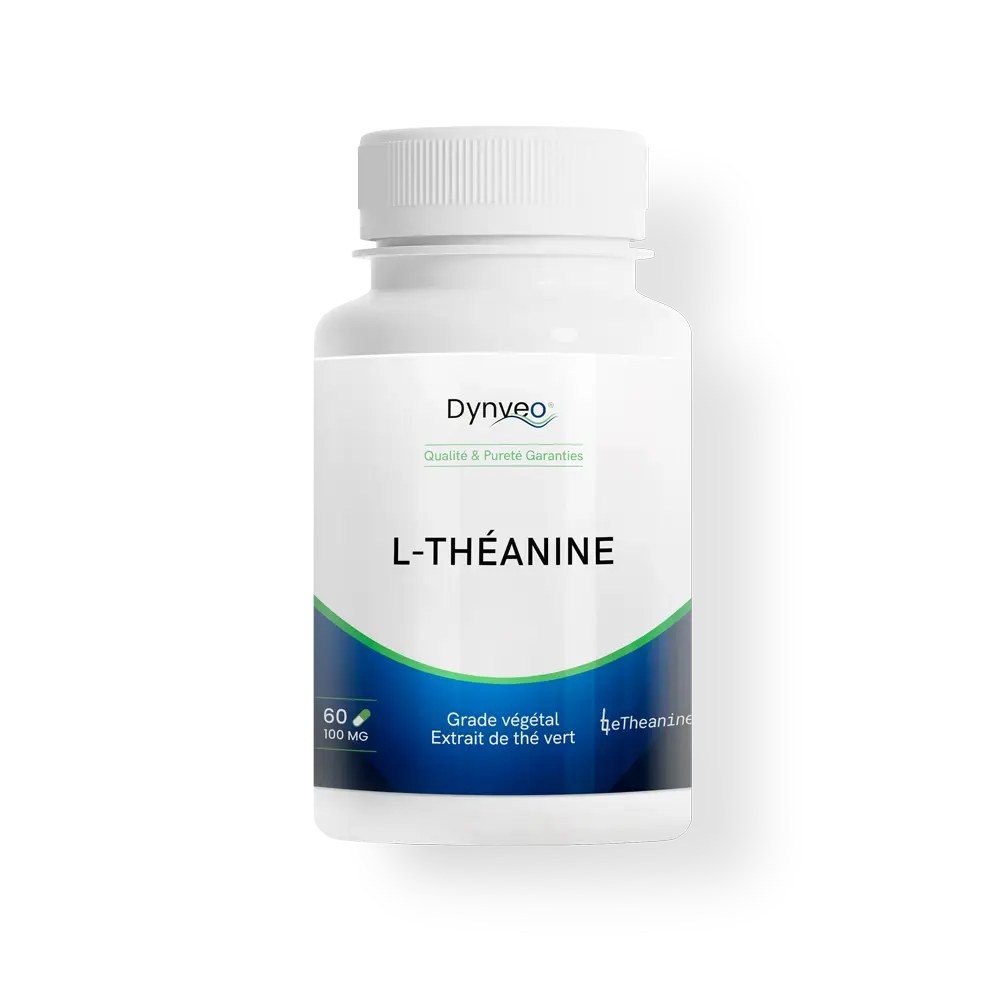
For theanine on its own, Dynveo’s L-Théanine végétale offers a clear dose and unusual traceability. Its page states:
- 250 mg of Be Theanine® green tea extract per capsule, standardized to at least 40%, i.e. 100 mg of L-theanine from plant origin, made by water infusion without solvents;
- less than 1% caffeine in the extract; no other ingredients besides the plant capsule (pullulan);
- 1 to 2 capsules a day: morning and midday for focus, or 2 in the evening for sleep; 60 capsules, 30 to 60 days;
- a published batch certificate (microbiology, active content, heavy metals, pesticides, pyrrolizidine alkaloids), HPLC assay and ISO 9001 certification; the brand highlights French manufacturing;
- €27.90 per bottle (price checked on 22/11/2026), about €0.93 a day at 200 mg, or €0.47 at 100 mg.
How does the dose compare? Two capsules give 200 mg, the most studied dose. Most trials used pure L-theanine, whereas this is a standardized extract: the theanine amount is the same, but the extract also carries other tea compounds. The studies above did not test this product. The brand reserves it for adults and advises against it in pregnancy or breastfeeding, on an empty stomach, with stomach ulcers, heart conditions or hyperthyroidism, and on the same day as other green tea products.
See Dynveo Plant-Based L-Theanine →
Partner link: we earn a commission if you order through this link, at no extra cost to you.
Frequently asked questions
What does L-theanine do?
In trials, 200 mg improves attention within the hour, modestly lowers stress and slightly improves self-rated sleep. Effects are small and trials are short.
What is the best L-theanine dose for anxiety?
Trials used 200 to 400 mg a day; effects on anxiety were inconsistent. It does not replace treatment for an anxiety disorder.
What are the side effects of L-theanine?
Rare: no serious effects in 31 trials, occasional headache. Avoid in pregnancy and breastfeeding.
When should I take L-theanine?
Before a stressful or demanding task for focus, or about an hour before bed for sleep.
Can I take L-theanine with coffee?
Yes, that is the most studied pairing, with small attention gains. Watch your total caffeine, especially in the evening.
Sources
- Gerolymos C. et al. Cognitive and affective effects of L-Theanine: meta-analysis of 31 randomized trials. Mol Psychiatry, 2026; 31(11): 6592-6602. PubMed 42410082
- Bulman A. et al. The effects of L-theanine consumption on sleep outcomes: systematic review and meta-analysis. Sleep Med Rev, 2025; 81: 102076. PubMed 40056718
- Williams J.L. et al. L-Theanine consumption and the ability to manage stress and anxiety levels: a systematic review. Plant Foods Hum Nutr, 2020; 75(1): 12-23. PubMed 31758301
- Hidese S. et al. Effects of L-Theanine Administration on Stress-Related Symptoms and Cognitive Functions in Healthy Adults. Nutrients, 2019; 11(10): 2362. PubMed 31623400
- Haskell C.F. et al. The effects of L-theanine, caffeine and their combination on cognition and mood. Biol Psychol, 2008; 77(2): 113-22. PubMed 18006208
- Owen G.N. et al. The combined effects of L-theanine and caffeine on cognitive performance and mood. Nutr Neurosci, 2008; 11(4): 193-8. PubMed 18681988
- Giesbrecht T. et al. The combination of L-theanine and caffeine improves cognitive performance and increases subjective alertness. Nutr Neurosci, 2010; 13(6): 283-90. PubMed 21040626
- Payne E.R. et al. Tea, l-Theanine or l-Theanine plus Caffeine on Cognition, Sleep, and Mood. Nutr Rev, 2025; 83(10): 1873-1891. PubMed 40314930
- Yoto A. et al. L-theanine or caffeine intake and blood pressure under physical and psychological stresses. J Physiol Anthropol, 2012; 31: 28. PubMed 23107346
- EFSA NDA Panel. Black tea and improvement of attention: evaluation of a health claim. EFSA Journal, 2018; 16(5): e05266. PubMed 32625903
- Ayakdaş G., Ağagündüz D. L-Theanine and Caffeine Contents in Tea Infusions. Foods, 2025; 14(13): 2313. PubMed 40647065