Group · Meat
Cervelas
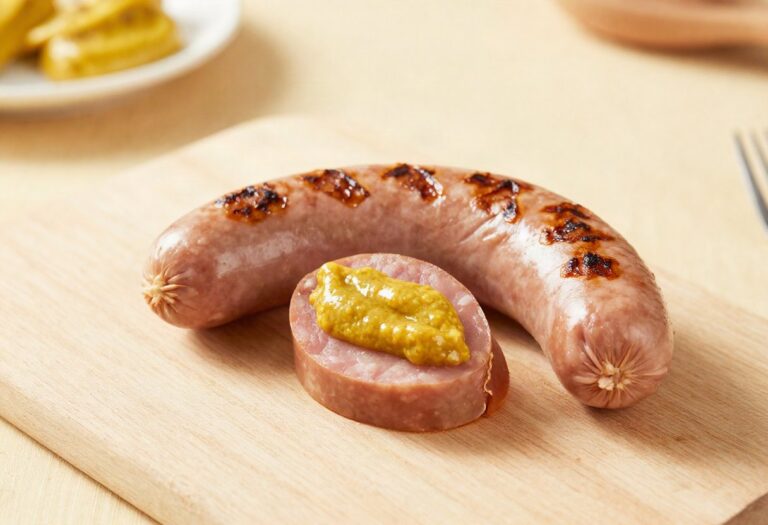
The cervelas is a cooked sausage, smoked or poached, emblematic of popular charcuterie and found in several culinary traditions, from Alsace to Switzerland and Belgium. Made from finely minced pork and beef, sometimes flavoured with garlic and spices, it is a sausage with tender flesh and a skin that turns crisp once cooked. In terms of nutrition facts, the cervelas provides 278 kcal per 100 g, with 11.9 g of protein, 1.56 g of carbohydrate and 24.8 g of fat. It is therefore a tasty cured meat but rich in fats, to be enjoyed with gusto and moderation in a balanced diet.
Macronutrient breakdown
Nutrition table per 100 g
| Calories | 278 kcal |
| Kilojoules | 1150 kJ |
| Protein | 11,9 g |
| Carbohydrate | 1,6 g |
| Fat | 24,8 g |
| Fibre | 0,4 g |
Micronutrients per 100 g
All measured nutrients, ranked by share of the daily reference intake.
- Omega-6 LA3,28 g33 %
- Phosphorus197 mg28 %
- Iodine37,9 µg25 %
- Vitamin B120,61 µg24 %
- Vitamin C18,1 mg23 %
- Vitamin B33,43 mg21 %
- Vitamin B10,21 mg19 %
- Vitamin B932,9 µg16 %
See the other 11 nutrients
- Omega-3 ALA0,27 g14 %
- Vitamin B60,17 mg12 %
- Copper0,11 mg11 %
- Zinc1 mg10 %
- Potassium187 mg9 %
- Vitamin B20,11 mg8 %
- Vitamin B50,43 mg7 %
- Magnesium20,4 mg5 %
- Calcium32,6 mg4 %
- Iron0,5 mg4 %
- Vitamin A3 µg0 %
Anses Ciqual 2025. Source: Anses, 2025, Ciqual food composition table
Tips
The cervelas can be enjoyed in many ways: grilled on the barbecue, poached in simmering water, pan-fried, or even split and baked with a cheese topping. In Alsace it becomes the famous Alsatian cervelas, split and filled with Gruyère, while cervelas salad, cut into strips with onions, vinaigrette and gherkins, remains a great classic of summer meals. To preserve its texture and limit the fat, choose gentle cooking in water rather than frying. There is a tip on this in our article on gentle cooking to preserve flavour and nutrients.
In terms of nutrition facts, the cervelas stands out for its high calorie density (278 kcal per 100 g) and its high fat content (24.8 g), mostly saturated fat. It does, however, provide a useful amount of protein (11.9 g) and remains low in carbohydrate, with a very low glycaemic index. Its salt load, typical of cured meats, calls for caution: remember to balance your plate with raw vegetables and vegetables rich in fibre, which is completely absent here.
For a reasonable portion, allow one sausage (about 80 to 100 g) served with a green salad, steamed potatoes or a ratatouille. The cervelas is happily eaten at lunchtime or at a convivial meal, but should be limited in the evening because of its high fat content.
- Storage: keep it in the fridge and eat it quickly once opened; it freezes well, raw or cooked.
- Pairings: mustard, horseradish, potato salad, cheese for gratinating.
- Variants: also worth trying are spicy saucisson or bratwurst for variety.
For active people, the cervelas provides protein useful for muscle recovery, but its fat content makes it poorly suited to a snack around exercise. It is better kept for an end-of-day meal, with leaner sources such as chicken breast preferred before or after training. When bulking, it can occasionally round off a high-calorie menu.
If you are watching your weight, include the cervelas sparingly within a well-planned balanced diet, and explore the other options in the meat family to diversify your intake.