Group · Condiments & sauces
Gherkins
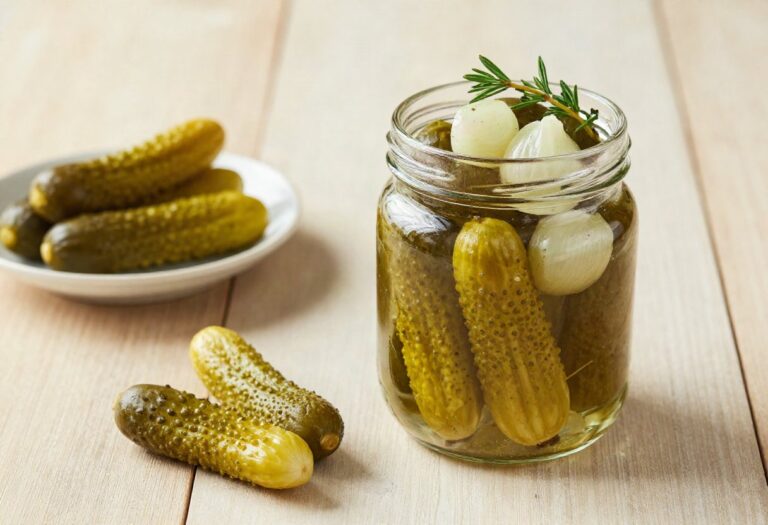
Small and crunchy, the gherkin is a young cucumber that is picked early and preserved in brine or flavoured vinegar. It comes in different forms: extra-fine, sweet and sour, with dill or tarragon, depending on French and Eastern European traditions. Very low in calories, it provides only 16 kcal per 100 g, with barely 0.78 g of carbohydrate and 1.5 g of fibre. It is a great condiment for livening up cured meats, raclette, sandwiches or cold dishes without adding to the calorie count. Its main strength is its low energy density, which makes it a handy ally if you are watching your waistline. The one drawback is its salt content, which comes from the way it is preserved and is worth keeping an eye on day to day.
Macronutrient breakdown
Nutrition table per 100 g
| Calories | 16 kcal |
| Kilojoules | 68 kJ |
| Protein | 1,1 g |
| Carbohydrate | 0,8 g |
| Fat | 0,2 g |
| Fibre | 1,5 g |
Micronutrients per 100 g
All measured nutrients, ranked by share of the daily reference intake.
- Vitamin K142,8 µg57 %
- Vitamin B10,13 mg12 %
- Calcium65 mg8 %
- Magnesium23 mg6 %
- Potassium120 mg6 %
- Vitamin B911,5 µg6 %
- Copper0,05 mg5 %
- Vitamin E0,48 mg4 %
See the other 8 nutrients
- Vitamin A30,8 µg4 %
- Phosphorus26 mg4 %
- Manganese0,06 mg3 %
- Vitamin B50,11 mg2 %
- Iron0,25 mg2 %
- Zinc0,13 mg1 %
- Vitamin B30,2 mg1 %
- Total omega-30,03 g1 %
Anses Ciqual 2025. Source: Anses, 2025, Ciqual food composition table
Tips
The gherkin is mostly eaten as a side: 2 to 4 are enough to add crunch and acidity to a plate. It goes ideally with cold meats, terrines, raclette cheese, burgers or a mixed salad. Its natural acidity, from the vinegar, stimulates the taste buds and can help structure a light meal. You can also chop it to flavour a tartare sauce or a homemade vinaigrette.
Varieties and storage. You will find classic gherkins in vinegar, sweet and sour versions such as sweet gherkins, and jars flavoured with mustard and small onions. Once opened, keep the jar in the fridge, fully submerged in its liquid, to preserve the crunchy texture. Avoid dipping a dirty fork into the brine, to limit bacterial growth.
Nutrition facts and benefits. With only 16 kcal per 100 g, the gherkin is one of the lowest-calorie condiments. It provides a little fibre (1.5 g), very little carbohydrate and almost no fat. Its glycaemic index is low. However, being kept in brine makes it high in sodium: if you are watching your blood pressure, it is best to eat it in moderation and give it a quick rinse. To go further on cutting back salt, the DASH diet offers practical ideas.
- Weight-control advantage: low calorie density, ideal for snacking guilt-free instead of fatty foods.
- Something to watch: the salt, which counts towards your daily intake.
- Freshness tip: pair it with raw vegetables or capers to vary your tangy condiments.
For active people. The gherkin is not a source of energy or protein, so it does not replace a proper snack. Its sodium content can, however, be useful after a very sweaty workout, when salt losses are significant. It remains a light flavour booster that fits well into a balanced recovery meal, alongside carbohydrate and protein.
Want to discover other low-calorie condiments to liven up your dishes? Explore the Condiments & sauces family and compare their content with the food calorie table. You will find plenty to put together tasty, well-managed plates.