Group · Fruit
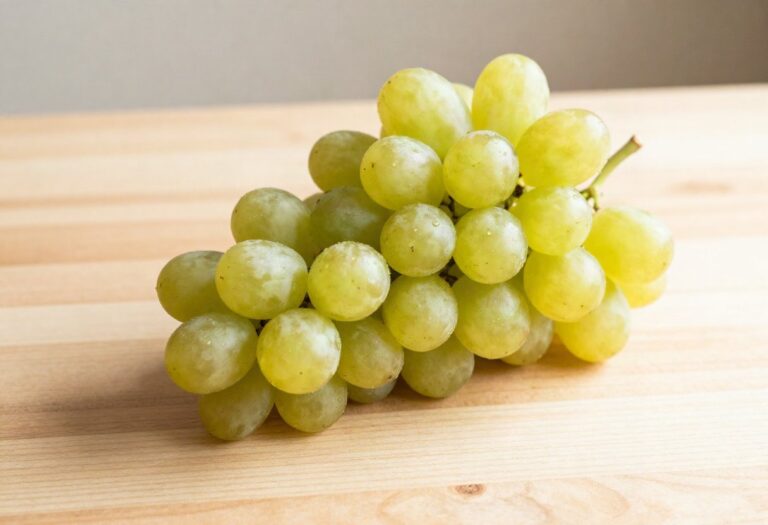
Chasselas grapes
Chasselas is a white grape with small golden berries and thin skin, grown as a table grape; the one from Moissac has a protected designation (AOP). It is also a wine grape, notably in Switzerland.
In terms of nutrition facts, raw: 77.8 kcal per 100 g, with 16.5 g of sugars, 2 g of fibre and 0.75 g of protein. It provides 150 mg of potassium, 16 mg of calcium and 4.14 mg of vitamin C per 100 g.
Macronutrient breakdown
Nutrition table per 100 g
| Calories | 78 kcal |
| Kilojoules | 329 kJ |
| Protein | 0,8 g |
| Carbohydrate | 16,9 g |
| Fat | 0,5 g |
| Fibre | 2 g |
Micronutrients per 100 g
All measured nutrients, ranked by share of the daily reference intake.
- Copper0,08 mg8 %
- Potassium150 mg8 %
- Vitamin C4,14 mg5 %
- Vitamin B20,06 mg4 %
- Vitamin B60,05 mg4 %
- Manganese0,07 mg4 %
- Phosphorus21 mg3 %
- Vitamin E0,35 mg3 %
- Vitamin B9dietary folate equivalents8,34 µg
See the other 9 nutrients
- Vitamin K12,18 µg3 %
- Vitamin B10,03 mg3 %
- Omega-6 LA0,23 g2 %
- Calcium16 mg2 %
- Magnesium7,5 mg2 %
- Vitamin B50,1 mg2 %
- Iron0,14 mg1 %
- Zinc0,07 mg1 %
- Vitamin A2,28 µg0 %
Anses Ciqual 2025. Source: Anses, 2025, Ciqual food composition table
Tips
77.8 kcal: it is the most energy-dense fresh fruit in this batch. More than a black grape, and far more than an apple. A 200 g portion provides 156 kcal and 33 g of sugars.
2 g of fibre: slightly better than black grapes. Its thin skin is easy to eat, which is not true of every variety.
You snack on them without counting. That is the real trap: unlike an apple, a bunch is eaten berry by berry, with no sense of an end. Put a portion in a bowl.
Its season is short: September and October. Out of season, what you find comes from South Africa or South America, with considerable transport.
Wash them thoroughly. Like all grapes, they are among the most heavily treated fruits. Rinse for a good while under running water, bunch by bunch.