Group · Fruit
Grape
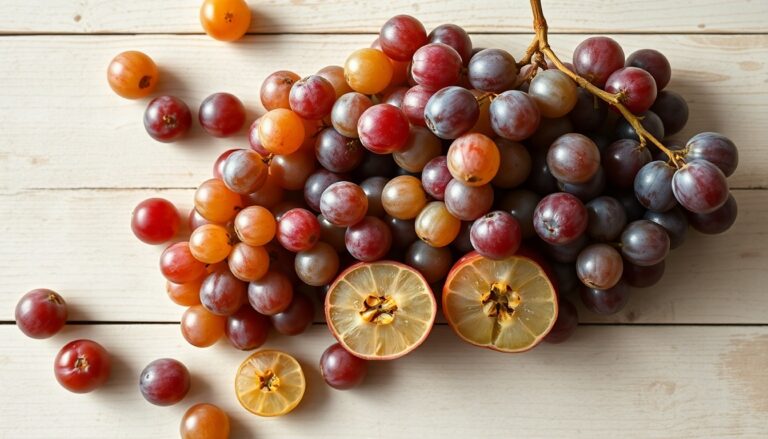
The grape is the fruit of the vine, cultivated for thousands of years and available in many varieties: white, black, rosé, with or without pips (chasselas, muscat, italia, cardinal). It is eaten fresh in bunches in autumn, but also as juice, raisins or in processed form. Sweet and juicy, it provides around 71 kcal per 100 g, quickly available natural carbohydrate, a little fibre and several antioxidants found notably in the skin and pips. Handy for nibbling, the grape earns its place in a balanced diet as a vitamin-rich snack, a fresh dessert or a fruity touch in savoury dishes and salads.
Macronutrient breakdown
Nutrition table per 100 g
| Calories | 71 kcal |
| Kilojoules | 301 kJ |
| Protein | 0,7 g |
| Carbohydrate | 16,3 g |
| Fat | 0,3 g |
| Fibre | 1,2 g |
Micronutrients per 100 g
All measured nutrients, ranked by share of the daily reference intake.
- Copper0,16 mg16 %
- Potassium193 mg10 %
- Vitamin K15,44 µg7 %
- Iodine7,45 µg5 %
- Vitamin B10,04 mg4 %
- Vitamin C3,03 mg4 %
- Manganese0,07 mg4 %
- Vitamin B60,05 mg4 %
- Vitamin B9dietary folate equivalents14,9 µg
See the other 13 nutrients
- Vitamin E0,33 mg3 %
- Phosphorus15,2 mg2 %
- Magnesium7,38 mg2 %
- Iron0,23 mg2 %
- Calcium11,2 mg1 %
- Vitamin B50,08 mg1 %
- Total omega-30,02 g1 %
- Vitamin B20,01 mg1 %
- Vitamin B30,07 mg0 %
- Omega-3 ALA0,01 g0 %
- Zinc0,03 mg0 %
- Omega-6 LA0,02 g0 %
- Vitamin A0,99 µg0 %
Anses Ciqual 2025. Source: Anses, 2025, Ciqual food composition table
Tips
With its 16.3 g of carbohydrate per 100 g, the grape is one of the sweetest fruits. A reasonable portion is around 100 to 150 g, or a small bunch. That is enough to enjoy its sweetness without weighing on the day’s calorie balance. For an overall view, you can compare its figures in the food calorie table.
Varieties and seasonality: grapes are harvested mainly from late August to October. White varieties (chasselas, muscat) are more delicate, black ones (cardinal, alphonse lavallée) fleshier. Choose firm grapes, well attached to the stalk, with a light natural white bloom (the bloom), a sign of freshness.
- Storage: keep bunches in the fridge, unwashed, in a ventilated container. Rinse them just before eating.
- Culinary uses: plain as a snack, in a fruit salad, with cheese, in savoury dishes such as chicken with grapes, or roasted in the oven to go with meat.
- Pairings: it goes well with tart fruit. Vary the pleasure with an apple or an Asian pear to combine crunch and fibre.
Key nutrients: the grape provides vitamin C, vitamin K, potassium and polyphenols concentrated in the skin of black varieties. Its fibre stays modest (1.11 g), which makes it a fruit with a relatively high glycaemic index: it is best eaten whole rather than as juice, and paired with a source of protein or good fats (yoghurt, nuts) to moderate the rise in blood sugar.
For active people: the grape is an excellent supplier of fast carbohydrate. A few grapes before a session or during prolonged effort help maintain energy, and it fits well into a recovery snack alongside a source of protein. For ideas for tasty, balanced breaks, discover our protein snack recipes.
Weight control: its sugar density calls for moderation, especially if you are watching your figure. Avoid picking at a whole bunch without realising: weigh your portion or serve yourself a small bowl. The raisin, more concentrated in calories, is even more important to measure. Eaten in moderation, the grape remains a tasty, practical fruit in the fruit family to favour in a varied diet.
Grapes and diabetes: the right portion is about twenty fresh grapes. Glycaemic index, raisins and juice are covered in our guide to grapes and diabetes.