Group · Dairy
Coulommiers
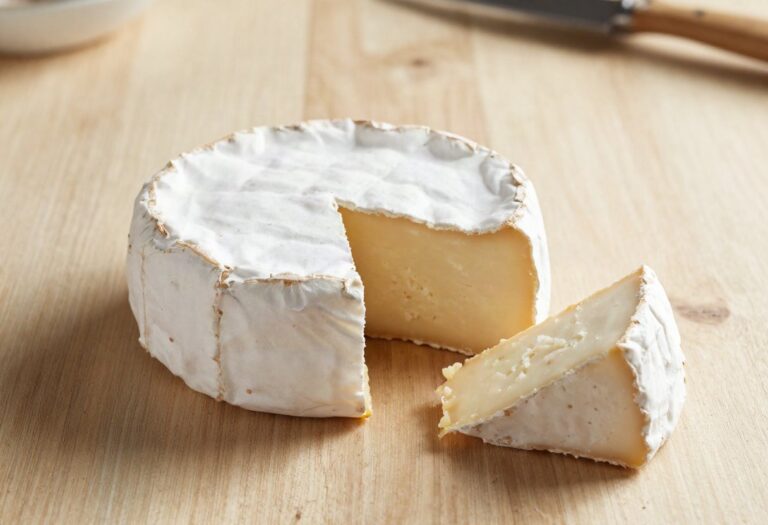
Coulommiers is a Brie-region cheese with a soft paste and bloomy rind, from the same family as brie but smaller and thicker. That thickness changes its maturing: it ripens more slowly and keeps a firm heart for longer.
In terms of nutrition facts: 280 kcal per 100 g, with 23 g of fat of which 16.1 g is saturated, and 18.4 g of protein. It provides 382 mg of calcium, 185 mg of phosphorus, 3.28 mg of zinc and 28 µg of iodine per 100 g, with 1.45 g of salt.
Macronutrient breakdown
Nutrition table per 100 g
| Calories | 280 kcal |
| Kilojoules | 1160 kJ |
| Protein | 18,4 g |
| Fat | 23 g |
| Fibre | 0,1 g |
Micronutrients per 100 g
All measured nutrients, ranked by share of the daily reference intake.
- Calcium382 mg48 %
- Zinc3,28 mg33 %
- Phosphorus185 mg26 %
- Iodine28 µg19 %
- Selenium5 µg9 %
- Potassium165 mg8 %
- Copper0,07 mg7 %
- Magnesium21,7 mg6 %
See the other 5 nutrients
- Omega-3 ALA0,11 g6 %
- Total omega-30,12 g5 %
- EPA0,01 g4 %
- Omega-6 LA0,36 g4 %
- Iron0,23 mg2 %
Anses Ciqual 2025. Source: Anses, 2025, Ciqual food composition table
Tips
382 mg of calcium is a lot for a soft cheese. It is clearly higher than Rocamadour or Langres. A 30 g portion covers 14% of the reference intake.
A 30 g portion comes to 84 kcal. That is sensible, and it is the right way to count: a whole Coulommiers weighs 350 g and is not an individual portion, whatever its shape suggests.
The rind is edible. The Penicillium camemberti that forms it is edible and contributes to the flavour. The one exception: a rind that smells of ammonia signals an over-ripe cheese, and then it is the whole cheese you should leave.
It cooks very well. Baked in its box with garlic and thyme, it becomes a sharing fondue. Served with raw vegetables rather than cured meats, the meal stays balanced.
Raw or pasteurised milk, depending on the brand. Coulommiers is not PDO, so both exist. Pregnant women should read the label, as the pasteurised version poses no problem.