Group · Dairy
Langres
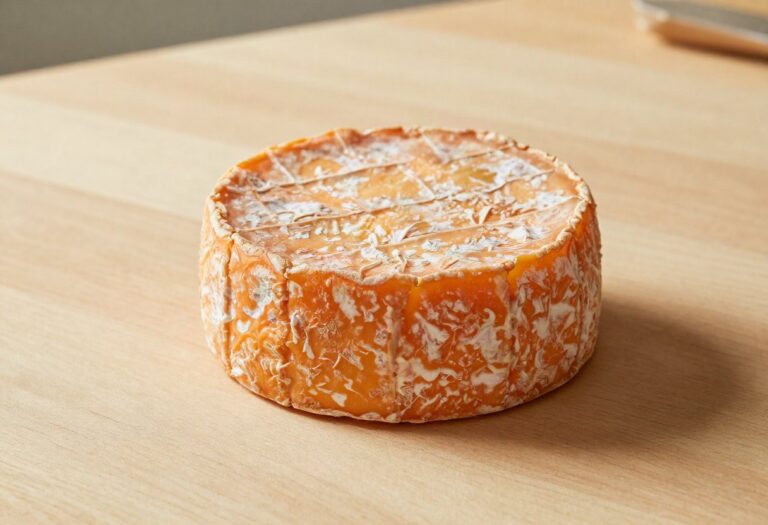
Langres is a cheese from Haute-Marne with a soft paste and washed rind, PDO, recognisable by the hollow at its top, the fontaine, formed because it is never turned during maturing. Tradition has it that Champagne or marc is poured into it.
In terms of nutrition facts: 286 kcal per 100 g, with 23.8 g of fat of which 16.9 g is saturated, and 16.4 g of protein. It provides 220 mg of phosphorus, 160 mg of calcium, 67.6 µg of vitamin B9 and 1.78 µg of vitamin B12 per 100 g, with 0.99 g of salt.
Macronutrient breakdown
Nutrition table per 100 g
| Calories | 286 kcal |
| Kilojoules | 1180 kJ |
| Protein | 16,4 g |
| Carbohydrate | 1,2 g |
| Fat | 23,8 g |
Micronutrients per 100 g
All measured nutrients, ranked by share of the daily reference intake.
- Vitamin B121,78 µg71 %
- Vitamin B20,84 mg60 %
- Vitamin B60,6 mg43 %
- Vitamin B52,18 mg36 %
- Vitamin B967,6 µg34 %
- Phosphorus220 mg31 %
- Vitamin A226 µg28 %
- Calcium160 mg20 %
See the other 12 nutrients
- Iodine30 µg20 %
- Zinc1,2 mg12 %
- Potassium140 mg7 %
- Vitamin E0,65 mg5 %
- Omega-3 ALA0,08 g4 %
- Omega-6 LA0,37 g4 %
- Magnesium12 mg3 %
- Copper0,03 mg3 %
- Vitamin K11,37 µg2 %
- Vitamin B30,1 mg1 %
- Manganese0,01 mg1 %
- Iron0,05 mg0 %
Anses Ciqual 2025. Source: Anses, 2025, Ciqual food composition table
Tips
Less salty than most washed-rind cheeses. 0.99 g per 100 g, where an Époisses or a Maroilles go much higher. That is good news for a cheese whose smell suggests the opposite.
Its smell does not announce its taste. The rind, washed with Brevibacterium linens, gives off powerful sulphur compounds, while the paste stays relatively mild and creamy. Do not judge by nose.
It keeps poorly in open air. Its damp rind dries and hardens within a few hours. Keep it in its wooden box at the bottom of the fridge, and take it out an hour before serving.
Less calcium than pressed cheeses. 160 mg per 100 g against 760 for an Abondance: soft cheeses retain their water and so concentrate minerals far less. That is the general rule for cheeses.
Raw milk most often. Not recommended for pregnant women or people with weakened immune systems, like all raw-milk washed-rind cheeses.