Group · Dairy
Faisselle
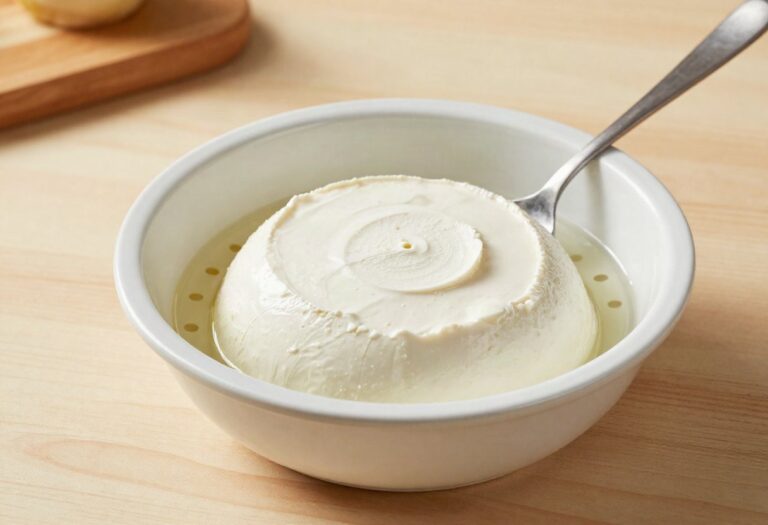
Faisselle is not a cheese but a container: the small perforated basket in which the curd drains. By extension, the word describes the fresh cheese still bathed in its whey, sold in its tub with the liquid. The values below are those of the 0% fat version.
On the nutrition side: just 36.8 kcal per 100 g, with 4.43 g of protein, 4.65 g of carbohydrate and 0.05 g of fat. It provides 120 mg of calcium and 98.2 mg of phosphorus per 100 g, and very little salt: 0.13 g.
Macronutrient breakdown
Nutrition table per 100 g
| Calories | 37 kcal |
| Kilojoules | 156 kJ |
| Protein | 4,5 g |
| Carbohydrate | 4,7 g |
| Fat | 0,1 g |
| Fibre | 0,1 g |
Micronutrients per 100 g
All measured nutrients, ranked by share of the daily reference intake.
- Vitamin B120,39 µg16 %
- Calcium120 mg15 %
- Phosphorus98,2 mg14 %
- Vitamin B20,15 mg11 %
- Potassium151 mg8 %
Anses Ciqual 2025. Source: Anses, 2025, Ciqual food composition table
Tips
It is the lowest-calorie dairy product in the database. 36.8 kcal per 100 g in the 0% version. A 100 g tub as a dessert, with fresh fruit, weighs less than an apple on its own.
Drain it or not, depending on what you are after. The whey contains some of the soluble proteins and calcium: drinking it, as is traditional, is not absurd. Draining it gives a firmer texture, close to fromage blanc.
Full-fat versions exist and are still reasonable. A faisselle made with whole milk comes to around a hundred kilocalories per 100 g, which is not excessive and gives a much tastier product.
Savoury, it replaces a sauce. With chives, garlic and pepper, it goes with potatoes or raw vegetables for almost no calories.
Its shelf life is short. As an unripened fresh cheese, it should be eaten within a few days of purchase and cannot be frozen: the texture separates irretrievably.