Group · Dairy
Goat’s cheese
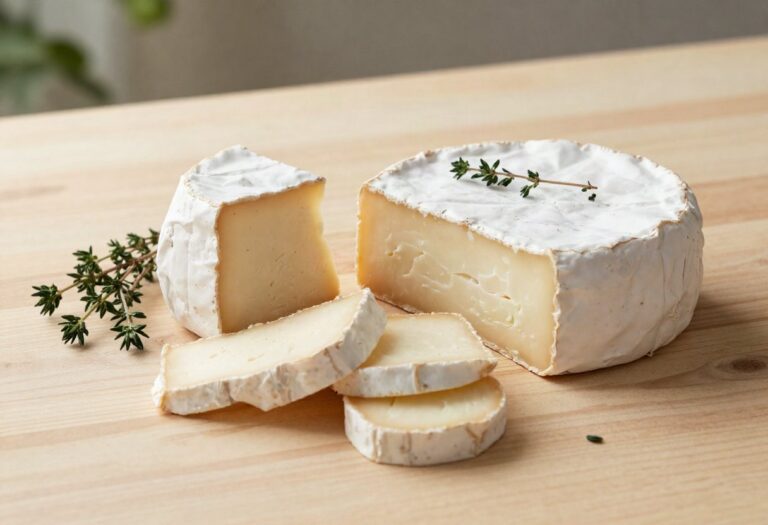
The goat’s cheese log is one of the most widely eaten cheeses in France, with a soft texture and a bloomy rind, and a flavour that is more or less pronounced depending on how long it has been matured. It provides 285 kcal per 100 g, 18.4 g of protein and 23.3 g of fat, of which 16.2 g is saturated. It can be eaten plain, on toast, warm on a salad or melted into a tart. There are other goat’s cheeses, fresh, semi-dry or dry, whose composition varies a great deal with maturing.
Macronutrient breakdown
Nutrition table per 100 g
| Calories | 285 kcal |
| Kilojoules | 1180 kJ |
| Protein | 18,4 g |
| Fat | 23,3 g |
Micronutrients per 100 g
All measured nutrients, ranked by share of the daily reference intake.
- Vitamin B976,4 µg38 %
- Vitamin B20,47 mg34 %
- Phosphorus183 mg26 %
- Calcium190 mg24 %
- Iodine30 µg20 %
- Selenium10,1 µg18 %
- Vitamin B60,16 mg11 %
- Vitamin B50,52 mg9 %
See the other 9 nutrients
- Potassium167 mg8 %
- Vitamin B31,05 mg7 %
- Zinc0,61 mg6 %
- Omega-3 ALA0,1 g5 %
- Omega-6 LA0,5 g5 %
- Magnesium12,7 mg3 %
- Vitamin E0,29 mg2 %
- Vitamin B10,02 mg2 %
- Iron0,22 mg2 %
Anses Ciqual 2025. Source: Anses, 2025, Ciqual food composition table
Tips
Nutrition facts. Per 100 g, the goat’s cheese log provides 285 kcal, 18.4 g of protein, 23.3 g of fat, 190 mg of calcium and 1.58 g of salt. A 30 g portion represents about 86 kcal, 57 mg of calcium and 0.47 g of salt. It counts as one of the two dairy products recommended per day for an adult, as explained in our guide how much cheese per day.
Comparison. Fresh goat’s cheese is lighter, while dry goat’s cheese is much more calorie-dense: see the pages for fresh goat’s cheese, semi-dry and dry. As for calcium, the log provides less than pressed cheeses such as Emmental or Comté.
Ways to eat it. In a warm goat’s cheese salad, on toast with grilled vegetables, or crumbled into a courgette soup or a quiche. Pair it with raw vegetables and wholemeal bread to balance a plate that is already rich in fat.
- Pregnancy: cheeses made from raw milk should be avoided; check the label, and choose cheeses made from pasteurised milk or cooked right through. See our guide to eating during pregnancy.
- Watching your weight and salt: with 285 kcal and 1.58 g of salt per 100 g, a 30 g portion is enough to flavour a dish.
To compare with other cheeses, explore the dairy products family.