Group · Dairy
Fresh goat’s cheese
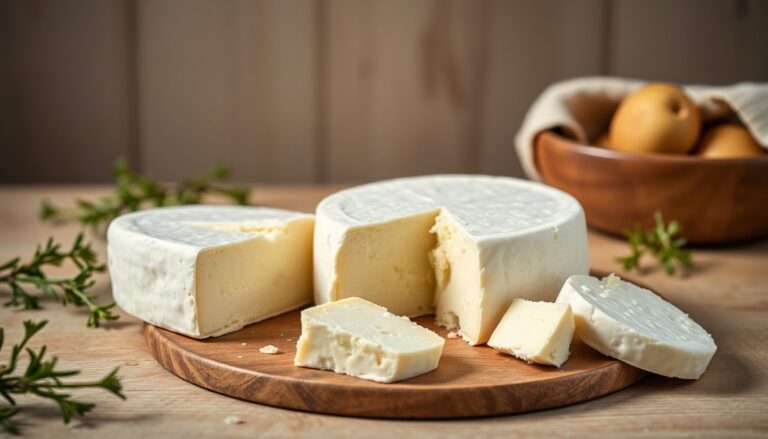
Fresh goat’s cheese is a mild, creamy dairy product made from curdled and lightly drained goat’s milk. Softer and less matured than dry or semi-dry goat’s cheese, it stands out for its melting texture and fresh taste, sometimes slightly tangy. It is sold as logs, crottins, faisselle or small discs, plain or flavoured with herbs, pepper or honey. At around 194 kcal per 100 g, it provides good protein (11.7 g) and very few carbohydrates, while being a source of calcium. Valued in a balanced diet, it suits a salad, a snack with drinks or a slice of toast equally well.
Macronutrient breakdown
Nutrition table per 100 g
| Calories | 194 kcal |
| Kilojoules | 804 kJ |
| Protein | 11,7 g |
| Carbohydrate | 2,5 g |
| Fat | 15,2 g |
| Fibre | 0,1 g |
Micronutrients per 100 g
All measured nutrients, ranked by share of the daily reference intake.
- Vitamin B20,4 mg29 %
- Vitamin B947 µg24 %
- Phosphorus157 mg22 %
- Calcium170 mg21 %
- Iodine29,5 µg20 %
- Vitamin A128 µg16 %
- Selenium5,95 µg11 %
- Potassium159 mg8 %
See the other 10 nutrients
- Omega-3 ALA0,1 g5 %
- Vitamin B50,25 mg4 %
- Zinc0,4 mg4 %
- Vitamin B30,59 mg4 %
- Vitamin B60,05 mg3 %
- Magnesium11,9 mg3 %
- Vitamin E0,37 mg3 %
- Iron0,26 mg2 %
- Omega-6 LA0,14 g1 %
- EPA0 g1 %
Anses Ciqual 2025. Source: Anses, 2025, Ciqual food composition table
Tips
Fresh goat’s cheese has a thousand uses. You can crumble it over a warm salad, spread it on wholemeal bread, slip it into an omelette or melt it lightly over roasted vegetables. To enjoy its nutrition facts without overdoing it, aim for a portion of around 30 to 40 g, or one to two slices. Its richness in protein and low carbohydrate content make it an interesting cheese, but its 15.2 g of fat per 100 g is a reminder to eat it in moderation if you are watching your weight.
- Varieties and seasonality: fresh goat’s cheese is ideally eaten in spring and summer, when the milk is most flavourful. You can vary things with semi-dry goat’s cheese or dry goat’s cheese, which are more matured and more pronounced.
- Tasty pairings: honey, walnuts, figs, tomatoes, courgettes or rocket bring out its freshness. A touch of herbs (chives, thyme, mint) lifts its mildness.
- Storage: keep it in the fridge, well wrapped, and use it quickly as it is lightly matured and therefore delicate.
Nutritionally, fresh goat’s cheese provides calcium, phosphorus and B vitamins. Its digestibility is often considered gentler than that of some cow’s milk cheeses, which appeals to many food lovers. For a light meal, pair it with seasonal vegetables, which provide fibre and vitamins that the cheese alone does not contain.
For active people: with nearly 11.7 g of protein per 100 g, fresh goat’s cheese can round out a recovery snack or a meal aimed at gaining mass. Spread it on wholemeal bread with a few slices of tomato to combine protein and carbohydrates after exercise. If you are looking for other protein-rich ideas, take a look at lighter 0% fromage blanc, or explore our protein snack ideas.
To place this food among the other dairy options, browse the dairy products family and compare the calories and benefits according to your goals. If you are slimming, favour small amounts and combine it with fibre-rich foods for a filling, balanced meal.