Group · Fruit
Longan
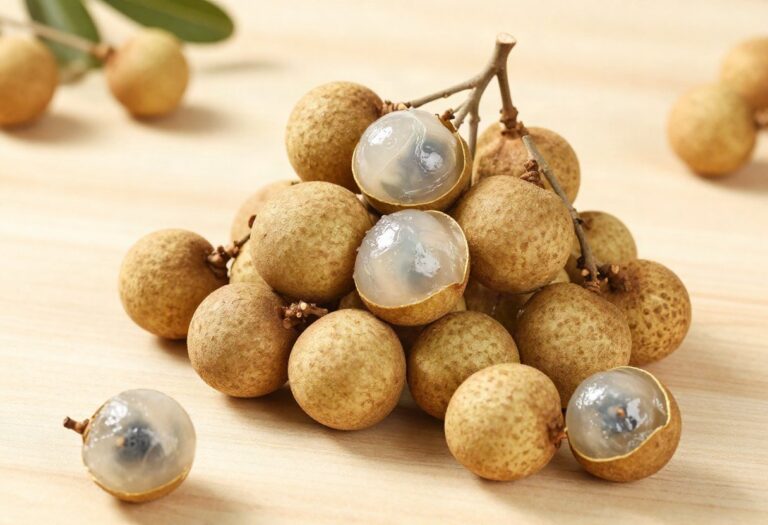
The longan, or dragon’s eye, is a small Asian fruit with a beige shell and translucent flesh, a cousin of the lychee. Its Chinese name comes from the black stone visible through the pulp, which looks like a pupil.
In terms of nutrition facts, raw flesh provides 60 kcal per 100 g, with 15.14 g of carbohydrate, 1.31 g of protein and 1.1 g of fibre. Its standout figure is vitamin C: 84 mg per 100 g, or 105% of the reference intake. It also provides 266 mg of potassium.
Macronutrient breakdown
Nutrition table per 100 g
| Calories | 60 kcal |
| Kilojoules | 251 kJ |
| Protein | 1,4 g |
| Carbohydrate | 15,2 g |
| Fat | 0,1 g |
| Fibre | 1,1 g |
Micronutrients per 100 g
All measured nutrients, ranked by share of the daily reference intake.
- Vitamin C84 mg105 %
- Copper0,17 mg17 %
- Potassium266 mg13 %
- Vitamin B20,14 mg10 %
- Phosphorus21 mg3 %
- Vitamin B10,03 mg3 %
- Magnesium10 mg3 %
- Manganese0,05 mg3 %
See the other 4 nutrients
- Vitamin B30,3 mg2 %
- Iron0,13 mg1 %
- Zinc0,05 mg1 %
- Calcium1 mg0 %
USDA FoodData Central (SR Legacy)
Tips
84 mg of vitamin C: one portion covers your daily need. It is well ahead of the orange and ranks among the best fruits in our database on this measure.
Fresh and dried are two different foods. Dried longan, widely used in Chinese medicine and in sweet soups, concentrates its sugars like any dried fruit: its energy content is several times higher.
It is less sweet than lychee. It has 15.14 g of carbohydrate and a muskier, less floral taste. That is a notable difference if you find lychee cloying.
Its shell cracks open between your fingers. A squeeze is enough, unlike the shell of the rambutan. The stone then comes out easily.
In the UK it is mostly found tinned. Tinned longans come in syrup, so they contain added sugar: drain and rinse them. Fresh ones turn up in Asian grocers from July to September.