Group · Dairy
Powdered milk
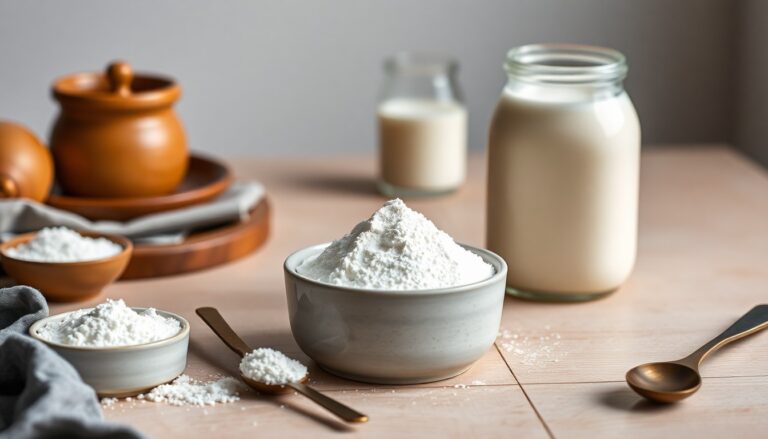
Powdered milk is made by dehydrating liquid milk, a process that removes almost all the water and leaves only a fine, concentrated powder. It comes in several forms: whole, semi-skimmed or skimmed milk powder, and even instant versions that dissolve in a moment. Practical and easy to store, it keeps for a long time away from moisture. Very concentrated, it provides around 508 kcal per 100 g, with plenty of protein (26 g) and calcium. Useful in cooking and baking, it also helps out active people. Properly measured, it fits easily into a balanced, varied diet.
Macronutrient breakdown
Nutrition table per 100 g
| Calories | 508 kcal |
| Kilojoules | 2130 kJ |
| Protein | 26 g |
| Carbohydrate | 42 g |
| Fat | 26,2 g |
Micronutrients per 100 g
All measured nutrients, ranked by share of the daily reference intake.
- Vitamin B123,12 µg125 %
- Calcium964 mg121 %
- Phosphorus730 mg104 %
- Vitamin B21,4 mg100 %
- Potassium1260 mg63 %
- Vitamin B52,84 mg47 %
- Zinc3,56 mg36 %
- Vitamin A267 µg33 %
See the other 15 nutrients
- Iodine41 µg27 %
- Vitamin B60,36 mg26 %
- Vitamin B10,28 mg25 %
- Selenium14 µg25 %
- Magnesium88,7 mg24 %
- Vitamin B944,1 µg22 %
- Vitamin D0,72 µg14 %
- Omega-3 ALA0,2 g10 %
- Vitamin C7,55 mg9 %
- Copper0,06 mg6 %
- Vitamin E0,68 mg6 %
- Omega-6 LA0,56 g6 %
- Iron0,6 mg4 %
- Vitamin B30,67 mg4 %
- Manganese0,06 mg3 %
Anses Ciqual 2025. Source: Anses, 2025, Ciqual food composition table
Tips
Powdered milk is usually reconstituted at 10 to 13 g of powder per 100 ml of water, which gives you liquid milk at the strength you want. Mix it with lukewarm water to avoid lumps, or add it straight into your recipes. It is a great ally in baking (brioches, custards, milk breads), in béchamel sauces and in smoothies, where it adds creaminess and richness without adding volume.
Nutrition facts and benefits: with 26 g of protein, 42 g of carbohydrates (mostly lactose) and 26.2 g of fat per 100 g, whole milk powder is a concentrate of energy. It provides calcium, phosphorus, potassium and B vitamins. Its high calorie density comes from the absence of water: once reconstituted, it comes close to whole milk or semi-skimmed milk, depending on the version you choose. To limit fat, opt for a skimmed powder, closer to the profile of skimmed milk.
- Portions: a few spoonfuls are enough. In dehydrated form, a large amount quickly adds up to a lot of calories.
- Storage: keep the bag or tin tightly sealed, in a dry place away from heat and light.
- Pairings: ideal in porridge, homemade yoghurt, coffee or a hot drink.
For active people: powdered milk is useful for boosting a snack with protein and carbohydrates, especially when you are trying to gain mass. Add some to a shaker, a bowl of oat flakes or a protein snack to increase calorie intake without having to eat a large volume. After exercise, milk proteins (casein and whey) contribute to muscle recovery. That said, it is not a substitute for supplements: if you want a targeted intake, read up on how to use protein powder.
Weight control: watch the calorie density. Whole milk powder is rich in fat and lactose, and therefore in sugars. If you are slimming, choose the skimmed version and weigh your quantities rather than measuring by eye. Also avoid sweetened or flavoured milk powders, which are higher in calories. To compare with other options, explore the dairy products family and their nutrition facts so you can choose what best suits your needs.