Group · Condiments & sauces
Béchamel sauce
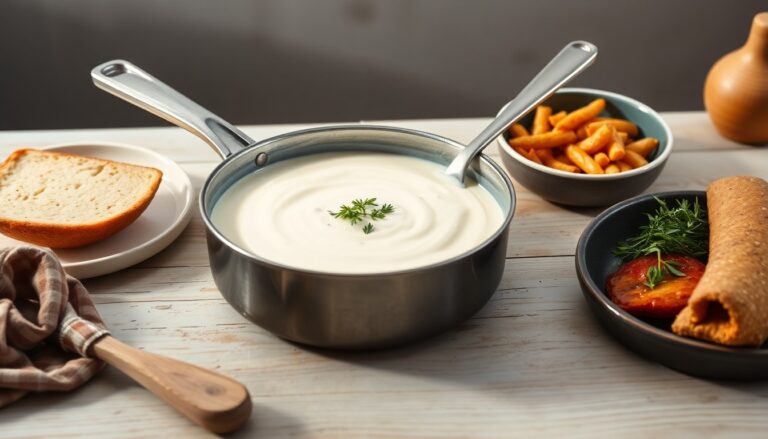
Béchamel is one of the mother sauces of French cooking, made from a roux (butter and flour) into which milk is stirred. Creamy and thick enough to coat, it is the base of many dishes: gratins, lasagne, croque-monsieur, chicory and ham bake or soufflés. There are lighter variants made with semi-skimmed milk, versions enriched with cheese (Mornay) or flavoured with nutmeg. With around 105 kcal per 100 g, béchamel provides carbohydrates from the flour, fat from the butter and a little protein from the milk. Its creamy texture makes it a comforting classic, to be eaten in moderation in a balanced, varied diet.
Macronutrient breakdown
Nutrition table per 100 g
| Calories | 105 kcal |
| Kilojoules | 435 kJ |
| Protein | 2,6 g |
| Carbohydrate | 6,2 g |
| Fat | 7,4 g |
| Fibre | 1,3 g |
Micronutrients per 100 g
All measured nutrients, ranked by share of the daily reference intake.
- Iodine25 µg17 %
- Calcium82,3 mg10 %
- Vitamin B20,12 mg9 %
- Vitamin A65,7 µg8 %
- Vitamin B120,17 µg7 %
- Potassium126 mg6 %
- Phosphorus33 mg5 %
- Omega-6 LA0,46 g5 %
See the other 10 nutrients
- Vitamin B50,27 mg5 %
- Vitamin B60,05 mg3 %
- Zinc0,27 mg3 %
- Magnesium7,52 mg2 %
- Total omega-30,05 g2 %
- Copper0,02 mg2 %
- Vitamin B30,27 mg2 %
- Omega-3 ALA0,03 g2 %
- Manganese0,02 mg1 %
- Iron0,1 mg1 %
Anses Ciqual 2025. Source: Anses, 2025, Ciqual food composition table
Tips
Béchamel is made in a saucepan: you melt the butter, add the flour to make a white roux, then pour in the milk gradually, whisking to avoid lumps. Season with salt, pepper and a pinch of nutmeg. For a lighter version, use semi-skimmed milk, reduce the amount of butter, or replace part of the flour with cornflour.
Nutrition facts and calories: with 96 kcal, 6.2 g of carbohydrate, 7.4 g of fat and 2.56 g of protein per 100 g, béchamel is moderately calorific, but the total climbs quickly depending on the amount of butter and cheese added. It contains no fibre. Its value rests mainly on the calcium from the milk and on its binding role in cooking.
How to eat it:
- In sensible amounts on vegetable gratins to make them more indulgent without drowning the food;
- As a binder for lasagne, layered with a homemade bolognese sauce;
- Flavoured with nutmeg, grated cheese or a little mustard to lift the taste;
- Prepared in advance as part of batch cooking and kept for 2 to 3 days in the fridge, with cling film pressed onto the surface to stop a skin forming.
For weight control: béchamel remains a sauce with a notable energy density once it is enriched. If you are watching your waistline, choose a lighter version, use it sparingly and pair it with vegetables rather than fatty starchy foods. You can discover lighter alternatives such as tomato sauce, which is lower in fat. To compare intakes, the food calorie table is a good reference.
For active people: béchamel provides carbohydrates and a little milk protein, which are useful in a post-exercise meal focused on recovery, for example a wholewheat pasta gratin. However, its fat content makes it unsuitable just before training. When gaining mass, it can be used to make a dish more energy-dense; when cutting, it is better to limit it. To find out more about balancing meals around sport, see our guide to fitness nutrition.
Finally, do not hesitate to explore the whole condiments and sauces family to vary your accompaniments according to the dish and your goals.