Group · Fruit
Purple plums
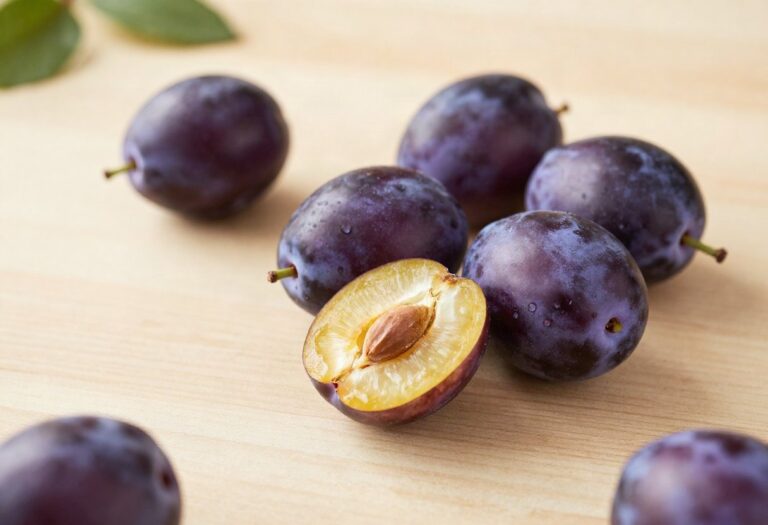
Purple plums cover the purple-skinned varieties (quetsche, president, stanley) whose yellow flesh comes away from the stone. They are the late-summer plums, the ones used for tarts and for prunes.
In terms of nutrition facts, stoned and raw: 46.4 kcal per 100 g, with 9.6 g of carbohydrates, all of them sugars, 1.94 g of fibre and 0.8 g of protein. It contains 86 g of water.
Macronutrient breakdown
Nutrition table per 100 g
| Calories | 46 kcal |
| Kilojoules | 196 kJ |
| Protein | 0,8 g |
| Carbohydrate | 9,6 g |
| Fat | 0,1 g |
| Fibre | 2 g |
Tips
46.4 kcal: noticeably lighter than a greengage. That one rises to 69 kcal. Purple plums are among the least sweet in the family (see the greengage).
A mild laxative effect, and it is real. Sorbitol and fibre work together. Multiplied when dried: that is the whole principle of the prune.
Its skin carries the anthocyanins. The purple pigments are concentrated in the skin, never in the yellow flesh. A peeled plum loses most of its polyphenols.
It is made for cooking. Its stone comes away and its flesh holds together: it is the plum of Alsatian tarts and clafoutis, where a mirabelle falls apart.
The white bloom is a good sign. This natural film protects the fruit and shows it has been little handled. Do not rub it off before eating.