Group · Vegetables
Radicchio
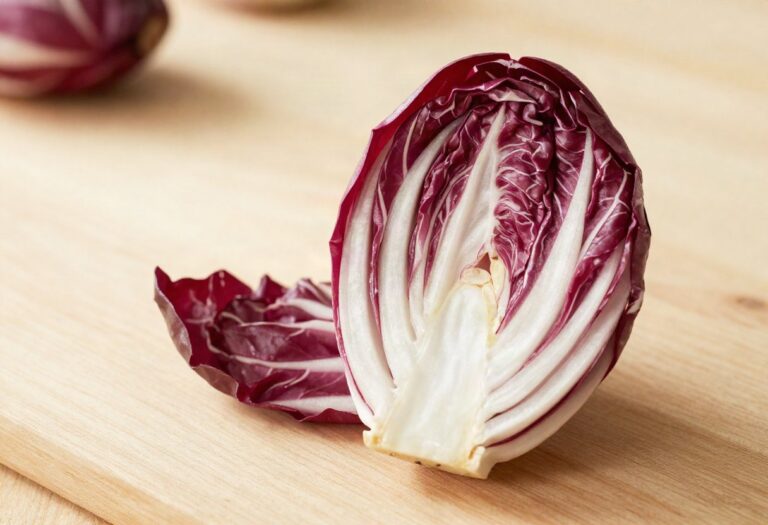
Radicchio, or red chicory, is an Italian chicory with purple leaves veined with white. Its pronounced bitterness sets it clearly apart from mild salad leaves, and it can be cooked raw or grilled.
In terms of nutrition facts, raw it provides 18.9 kcal per 100 g, with 3 g of fibre and 1.4 g of protein. It provides 180 mg of potassium, 36 mg of calcium and 10 mg of vitamin C per 100 g, and contains 94 g of water.
Macronutrient breakdown
Nutrition table per 100 g
| Calories | 19 kcal |
| Kilojoules | 79 kJ |
| Protein | 1,4 g |
| Carbohydrate | 1,6 g |
| Fat | 0,1 g |
| Fibre | 3 g |
Micronutrients per 100 g
All measured nutrients, ranked by share of the daily reference intake.
- Vitamin C10 mg13 %
- Potassium180 mg9 %
- Vitamin B10,07 mg6 %
- Vitamin B60,07 mg5 %
- Calcium36 mg5 %
- Phosphorus30 mg4 %
- Vitamin B20,05 mg4 %
- Iron0,3 mg2 %
- Vitamin B9dietary folate equivalents13 µg
See the other 2 nutrients
- Zinc0,2 mg2 %
- Vitamin B30,3 mg2 %
Anses Ciqual 2025. Source: Anses, 2025, Ciqual food composition table
Tips
3 g of fibre for 18.9 kcal: the best ratio of any salad leaf. Twice as much as an iceberg lettuce. Its thick, firm leaves contain much more substance.
Its bitterness comes from intybin. This compound stimulates bile secretion: bitterness at the start of a meal has a real digestive function, long known.
Grilled, it turns mild. Halved and seared for two minutes on each side on a very hot grill, its bitterness fades markedly and a caramelised flavour appears. It is the best way to win people over.
Sweetness balances bitterness. Pear, walnuts, honey and balsamic vinegar are the classic Italian pairings, and they are not just for show.
It keeps well. A week in the vegetable drawer, unlike tender-leaved salads. Its tight structure protects it.