Group · Dairy
Saint-Marcellin
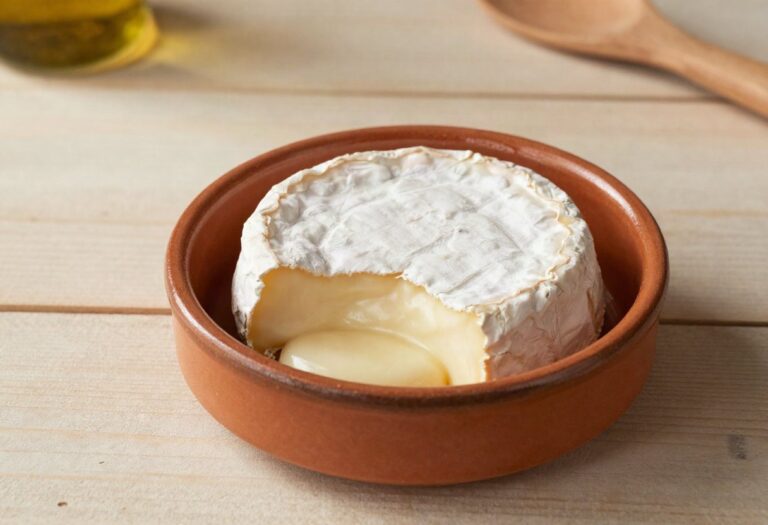
Saint-Marcellin is a small soft cheese from the Dauphiné, with protected geographical indication (PGI), historically made from goat’s milk and now almost always from cow’s milk. Sold in an earthenware dish, it is eaten either young and firm or well matured and runny.
In terms of nutrition facts: 280 kcal per 100 g, with 24.3 g of fat of which 18.1 g is saturated, and 14.8 g of protein. It provides 210 mg of phosphorus, 140 mg of calcium, 93.4 µg of vitamin B9 and 1.83 µg of vitamin B12 per 100 g, with only 1.08 g of salt.
Macronutrient breakdown
Nutrition table per 100 g
| Calories | 280 kcal |
| Kilojoules | 1160 kJ |
| Protein | 14,8 g |
| Fat | 24,3 g |
Micronutrients per 100 g
All measured nutrients, ranked by share of the daily reference intake.
- Vitamin B121,83 µg73 %
- Vitamin B20,91 mg65 %
- Vitamin B993,4 µg47 %
- Vitamin B52,49 mg42 %
- Vitamin B60,53 mg38 %
- Phosphorus210 mg30 %
- Vitamin A201 µg25 %
- Calcium140 mg18 %
See the other 13 nutrients
- Vitamin B31,53 mg10 %
- Potassium180 mg9 %
- EPA0,02 g8 %
- Zinc0,54 mg5 %
- Vitamin E0,61 mg5 %
- Copper0,04 mg4 %
- Total omega-30,09 g4 %
- Omega-3 ALA0,07 g4 %
- Magnesium12 mg3 %
- Omega-6 LA0,3 g3 %
- Vitamin K12,15 µg3 %
- Manganese0,01 mg1 %
- Iron0,05 mg0 %
Anses Ciqual 2025. Source: Anses, 2025, Ciqual food composition table
Tips
1.08 g of salt: among the lowest of the soft cheeses. Markedly less than a Chaource at 1.9 g. A 40 g portion provides 0.43 g of salt.
One Saint-Marcellin weighs 80 g. That is 224 kcal: a portion for two, served with a salad and country bread.
93.4 µg of vitamin B9 per 100 g. That is 47% of the reference intake. Bloomy-rind cheeses are the best-supplied cheeses for folate, produced by the surface flora.
Warm, it becomes a dish. Ten minutes at 180 °C in its dish, over potatoes or toasted wholemeal bread: it is the local custom, and it also takes care of the raw milk question.
Raw or pasteurised milk, depending on the producer. The PGI allows both. Pregnant women should check the label, or eat it hot.