Group · Vegetables
Spring onion
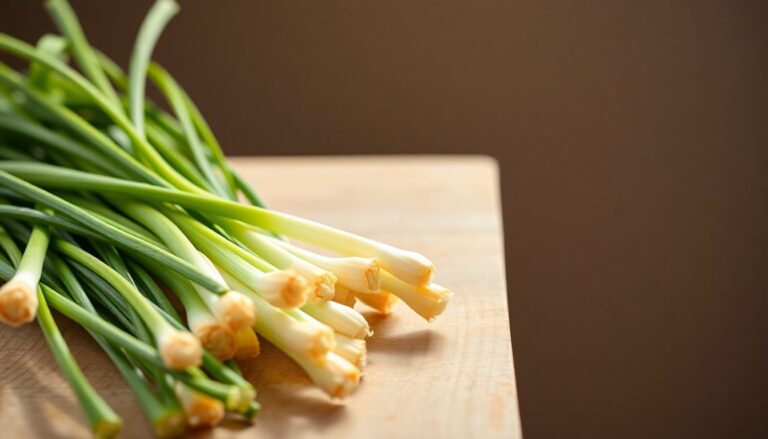
The spring onion, also called scallion, green onion or new onion, is recognisable by its small white bulb topped with long, hollow green stems. Harvested young, it belongs to the Allium family, like the common onion or the leek. Its flavour, milder and fresher than that of the mature onion, makes it a versatile ingredient in the kitchen. With only 28 kcal per 100 g, it fits easily into a balanced diet. It provides fibre (3.1 g), a little plant protein and a good range of vitamins and minerals. Raw or cooked, as a garnish or a condiment, the spring onion lifts dishes while staying light, ideal for seasoning without weighing things down.
Macronutrient breakdown
Nutrition table per 100 g
| Calories | 28 kcal |
| Kilojoules | 117 kJ |
| Protein | 1,2 g |
| Carbohydrate | 3,6 g |
| Fat | 0,3 g |
| Fibre | 3,1 g |
Micronutrients per 100 g
All measured nutrients, ranked by share of the daily reference intake.
- Manganese0,36 mg18 %
- Potassium260 mg13 %
- Vitamin C7,38 mg9 %
- Calcium55 mg7 %
- Iron0,85 mg6 %
- Vitamin K14,03 µg5 %
- Vitamin B60,07 mg5 %
- Phosphorus26 mg4 %
- Vitamin B9dietary folate equivalents40,5 µg
See the other 8 nutrients
- Copper0,03 mg3 %
- Magnesium11 mg3 %
- Vitamin B30,41 mg3 %
- Vitamin B50,14 mg2 %
- Zinc0,21 mg2 %
- Vitamin A11,4 µg1 %
- Omega-3 ALA0,02 g1 %
- Omega-6 LA0,08 g1 %
Anses Ciqual 2025. Source: Anses, 2025, Ciqual food composition table
Tips
The spring onion can be eaten raw or cooked, and you can use the whole plant: the white bulb, more fragrant, and the green stems, milder. Slice it thinly to scatter over a salad, a soup, an omelette or a stir-fry just before serving, to keep its freshness and aromas. Quick cooking over a high heat (sautéed, steamed) preserves its nutrients better than long cooking: you can draw on the principles of gentle cooking to preserve flavour.
Nutritional values and benefits: with around 28 kcal per 100 g, the spring onion has a low calorie density and a useful amount of fibre, helpful for digestion and fullness. It provides vitamin C, vitamin K, folate (vitamin B9) and the sulphur compounds characteristic of the allium family. Its glycaemic index is moderate and its 3.56 g of carbohydrate per 100 g make it a light vegetable, perfect for seasoning with no guilt.
- Smart pairings: combine it with crunchy vegetables such as cucumber or radishes for fresh, low-calorie salads.
- Storage: keep it in the fridge, roots in a little water or wrapped in a damp cloth, and eat it within a few days of buying.
- Portion: a few stems are enough to flavour a dish; there is no need to overdo it to enjoy its taste.
For active people: the spring onion is not a source of energy in itself, but it lifts the taste of healthy dishes without adding fat or unnecessary salt. Add it to a vegetable sauté with rice and chicken for a balanced recovery meal, or to a complete, protein-rich salad. It fits perfectly into a balanced diet and into batch cooking to lift dishes prepared in advance.
Weight control: light and tasty, the spring onion is an ally for seasoning without empty calories. Beware of the fatty sauces or frying that sometimes go with it: it is often the seasoning that weighs, not the vegetable. To vary your plant-based condiments, explore the other members of the vegetables family, such as the regular onion or the leek, with complementary profiles.