Group · Fats & oils
Wheat germ oil
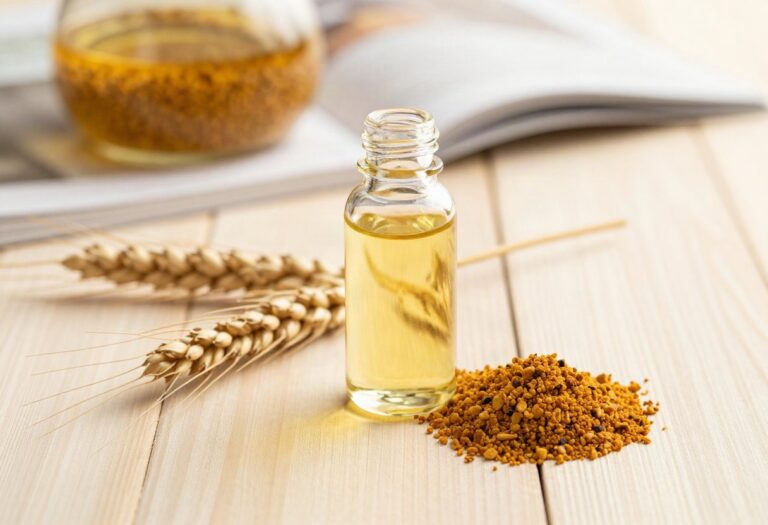
Wheat germ oil is a precious vegetable oil, obtained from the germ of the wheat grain, the most nutrient-rich part of the cereal. Golden to amber in colour with a pronounced, slightly cereal-like taste, it stands out among fats and oils for its remarkable vitamin E content, a natural antioxidant. Like all oils, it provides 885 kcal and 100 g of fat per 100 g, with no protein or carbohydrate. It is most often found in small bottles, sometimes in capsules as a supplement. Delicate and sensitive to heat, it is best enjoyed raw, as a drizzle, to enrich a balanced diet without spoiling it.
Macronutrient breakdown
Nutrition table per 100 g
| Calories | 900 kcal |
| Kilojoules | 3700 kJ |
| Fat | 100 g |
Micronutrients per 100 g
All measured nutrients, ranked by share of the daily reference intake.
- Vitamin E149 mg1242 %
- Omega-6 LA46,9 g469 %
- Omega-3 ALA5,91 g296 %
- Vitamin K124,7 µg33 %
Anses Ciqual 2025. Source: Anses, 2025, Ciqual food composition table
Tips
Wheat germ oil is eaten above all cold. Its richness in polyunsaturated fatty acids makes it very sensitive to heat: avoid heating or frying it, because cooking degrades its nutritional qualities and spoils its taste. Keep it for dressing, drizzled over a salad, steamed vegetables or a smooth soup just before serving, or blended with a more neutral oil to soften its characteristic flavour.
In terms of nutrition facts, it is a 100% fat oil, and therefore high in calories: allow about 90 kcal per tablespoon. One to two teaspoons a day are more than enough to enjoy its benefits without weighing down your energy balance. It is particularly renowned for its concentration of vitamin E, essential fatty acids (omega-6 and a little omega-3) and provitamins. If you are watching your weight, keep in mind that all oils have a high calorie density: moderation remains the key, even for so-called healthy oils.
Storage deserves particular attention. Very sensitive to oxidation, wheat germ oil quickly goes rancid. Keep it in the fridge, away from light, in its tightly closed opaque bottle, and use it within a few weeks of opening. An acrid or bitter smell means it is no longer good.
- Winning pairings: pumpkin seeds, walnuts, avocado, lemon juice for lively vinaigrettes.
- Alternating: vary your oils day to day to balance your fatty acid intake.
- Dosage: a small amount is enough thanks to its intense taste.
For active people, this oil can top up an energy-rich diet during a bulking phase, added raw to a dish of starchy foods or vegetables. It provides dense calories and vitamin E, which fits an approach built on nuts and seeds and healthy fats. For protein needs, top up instead with suitable foods or see fitness nutrition.
If you are comparing the calories and profiles of different oils, explore the other options in the fats and oils family, such as rapeseed oil or olive oil, to diversify your dressings sensibly.