Group · Fish
Yellowfin tuna
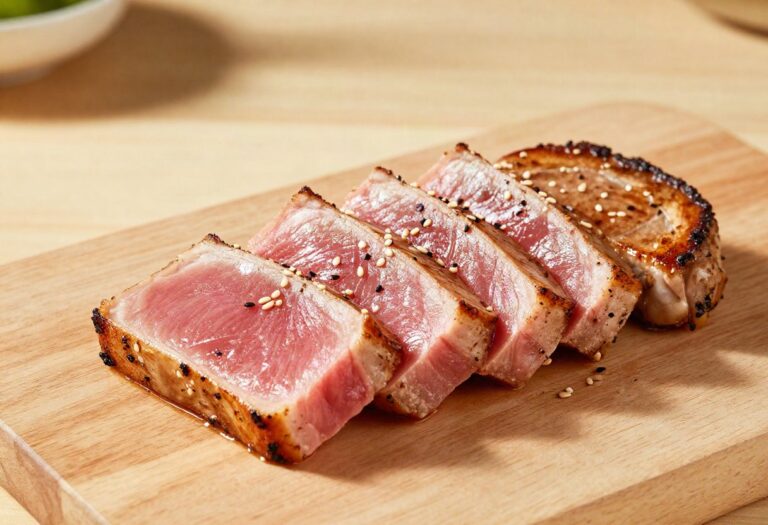
Yellowfin tuna, also known as yellow-finned tuna or albacore in French, is a sea fish appreciated for its firm, pink and flavourful flesh. You can find it fresh as a loin or steak, frozen, and also tinned. It is one of the most prized fish in cooking, from carpaccio to tataki and grills. Nutritionally, yellowfin tuna stands out for its exceptional protein content (nearly 25 g per 100 g) and low fat, at only 112 kcal per 100 g. With no carbohydrates, it fits easily into a balanced diet, whether you want to vary your sources of lean protein or take care of your waistline.
Macronutrient breakdown
Nutrition table per 100 g
| Calories | 112 kcal |
| Kilojoules | 476 kJ |
| Protein | 25 g |
| Carbohydrate | 1 g |
| Fat | 1 g |
Micronutrients per 100 g
All measured nutrients, ranked by share of the daily reference intake.
- Selenium79,6 µg145 %
- Vitamin B123,44 µg138 %
- Vitamin B313,5 mg84 %
- Vitamin B60,97 mg69 %
- Vitamin D2,3 µg46 %
- Phosphorus257 mg37 %
- DHA0,09 g35 %
- Vitamin A195 µg24 %
See the other 19 nutrients
- Potassium410 mg21 %
- Iodine23,7 µg16 %
- Vitamin B10,14 mg13 %
- Magnesium40,8 mg11 %
- Copper0,09 mg9 %
- Vitamin B50,47 mg8 %
- Vitamin B20,1 mg7 %
- Iron0,98 mg7 %
- Vitamin E0,72 mg6 %
- EPA0,01 g5 %
- Vitamin B98,5 µg4 %
- Total omega-30,1 g4 %
- Vitamin C2,6 mg3 %
- Zinc0,23 mg2 %
- Manganese0,02 mg1 %
- Calcium7,77 mg1 %
- Vitamin K10,1 µg0 %
- Omega-3 ALA0 g0 %
- Omega-6 LA0,01 g0 %
Anses Ciqual 2025. Source: Anses, 2025, Ciqual food composition table
Tips
Yellowfin tuna can be cooked in a thousand ways. Seared in a pan for a few minutes on each side, it stays pink and tender in the centre, in the style of tataki. You can also prepare it as carpaccio, as a very fresh tartare, marinated in lime and olive oil, or grilled on the barbecue. To preserve its nutritional values and texture, choose gentle, short cooking: overcooked, tuna becomes dry. A portion of 120 to 150 g suits a main meal perfectly.
In terms of key nutrients, yellowfin tuna provides high-quality complete protein, omega-3 fatty acids, vitamin B12, vitamin D, selenium, phosphorus and potassium. With 1 g of carbohydrates and only 0.94 g of fat per 100 g, it has a moderate calorie density and an excellent protein-to-calorie ratio. That is a plus for anyone watching their weight or building a balanced diet.
For active people, yellowfin tuna is a great ally. Its protein supports recovery and the maintenance of muscle mass after exercise. Paired with a source of carbohydrates such as brown rice, sweet potatoes or other starchy foods, it makes a complete, filling post-workout meal. When cutting or getting lean, its near-absence of fat and carbohydrates makes it an ideal lean protein. To top up your intake, you can take inspiration from protein snack ideas suited to your goals.
A few practical tips:
- Buy the freshest tuna you can, with shiny flesh and no strong smell, and eat it quickly.
- Keep fresh fish in the fridge and eat it within 24 to 48 hours, or freeze it straight away.
- Vary your side dishes: green vegetables, salad, pulses or cereals for a balanced dish.
- Go easy on tinned yellowfin tuna in oil, which is higher in calories than the version in brine or spring water.
Like all large marine predators, tuna can concentrate heavy metals, so it is sensible to alternate it with other fish such as cod or trout. To explore other options, browse the fish family and put together varied menus throughout the week.