Hyaluronic acid: benefits, supplements vs serum, what the studies show
The short answer
Hyaluronic acid is a molecule your body makes itself: it holds water in the skin and lubricates the joints. It is used in three ways. As a serum or cream, it hydrates the skin surface, and one trial found a small effect on wrinkles with low molecular weight forms. As a supplement, a few 4 to 12 week trials at 120 to 200 mg a day found slightly better hydration and shallower wrinkles, but they are small and often run by manufacturers, and a meta-analysis found no clear effect on elasticity. As an injection, it is a medical procedure: effective as a filler, with rare but sometimes serious complications in the face, and a disputed benefit in the knee.
This article is for information and does not replace medical advice. Before any injection, or if you are pregnant, breastfeeding or take medication, talk to your doctor.
What is hyaluronic acid?
Hyaluronic acid (sodium hyaluronate in its salt form) is a long sugar molecule found in connective tissues: skin, cartilage, joint fluid and the eye. Its key property is that it binds a lot of water, which keeps skin plump and joints gliding.
Products differ mainly by molecular weight, measured in daltons (Da) or kilodaltons (kDa): large molecules stay on the surface as a moisturising film, small ones penetrate a little better. Most hyaluronic acid today is made by bacterial fermentation, not from animals.
| Use | Expected effect | Strength of evidence |
|---|---|---|
| Serum, cream | Surface hydration, fine lines | A few trials, mainly on hydration |
| Pills (supplement) | Hydration and wrinkles from within | Small positive trials, often industry-funded; meta-analysis inconclusive on elasticity |
| Facial filler | Wrinkles, lips, volume | Immediate visible effect; medical procedure with risks |
| Knee injection | Osteoarthritis pain | Small benefit, clinically irrelevant in large trials |
Hyaluronic acid serum and cream: what the studies show
In a German trial (Pavicic et al., 2011), 76 women aged 30 to 60 applied a 0.1% hyaluronic acid cream twice a day for 60 days around one eye and a plain cream around the other. All hyaluronic acid creams (50 to 2,000 kDa) improved hydration and elasticity, but wrinkle depth only dropped with the small molecules (50 and 130 kDa).
A hyaluronic acid serum is a good moisturiser, not a “filler in a bottle”. Apply it to clean, slightly damp skin, then seal it with a moisturiser.
Hyaluronic acid supplements: benefits according to studies
Can a swallowed molecule reach the skin? Part of it is broken down in the gut and the mechanism is debated, yet several placebo-controlled trials measured an effect:
| Study | Participants and dose | Result |
|---|---|---|
| Michelotti et al., 2021 | 60 women with mild to moderate skin ageing; 200 mg a day of ExceptionHYAL Star for 28 days | Hydration +10.6%, wrinkle depth -18.8%, wrinkle volume -17.6%, elasticity and firmness +5.1% |
| Hsu et al., 2021 | 40 adults aged 35 to 64; 120 mg a day for 12 weeks | Wrinkles, hydration, water loss and elasticity improved vs placebo. Three authors employed by the manufacturer (Kewpie) |
| Dolečková et al., 2025 | 150 adults; 60 or 120 mg a day for 12 weeks | At 120 mg: better hydration and elasticity, shallower eye wrinkles; smaller effect at 60 mg. Authors employed by the manufacturer (Contipro) |
| Yang et al., 2025 (meta-analysis) | 40 trials of supplements for skin photoaging | Benefit for collagen and some polyphenols; no significant benefit for hyaluronic acid on photoaging and elasticity |
Individual trials are positive, but small, short, based on instrument measurements and often run or funded by ingredient makers; the broader meta-analysis does not confirm a clear effect. Certainty is low. If you try it, stick to the studied doses and reassess after one or two months. For joint support, better-studied options are in our best joint supplement comparison; to compare capsules at the same dose, see our best hyaluronic acid capsules comparison.
Hyaluronic acid injections: face, lips and knee
Fillers. Cross-linked hyaluronic acid injected under the skin fills wrinkles and lips for several months. Bruising and swelling for a few days are common. A 2026 review (Lowe) notes that serious complications are uncommon, but accidental injection into an artery can cause skin death, scarring, vision loss and even stroke. Choose a trained doctor, and seek urgent care if the skin turns pale, very painful or purple, or your vision blurs.
Knee injections. The Rutjes et al. meta-analysis (2012) pooled 89 trials and 12,667 adults. The pain benefit became clinically irrelevant in the 18 large blinded trials, and serious adverse events were 41% more frequent than with controls. Discuss these figures with your doctor.
Hyaluronic acid side effects and who should avoid it
- Serum or cream: very well tolerated; rare irritation, often from other ingredients.
- Pills: no notable side effects in trials of up to 12 weeks, and the Yang meta-analysis found supplements safe over that period. No long-term data, and none in pregnancy or breastfeeding: avoid in those cases.
- Fillers: bruising and swelling; rarely arterial blockage, tissue death or vision loss.
- Knee injections: painful flare-ups; more serious adverse events in trials.
How to take hyaluronic acid supplements
- Dose: 120 to 200 mg a day, as studied. No trial shows extra benefit above that.
- How long: 4 to 12 weeks in trials; stop if you see no difference after one or two months.
- When: any time of day, with water.
- Bigger levers: sunscreen, no smoking, sleep. Vitamin C contributes to normal collagen formation: see foods high in vitamin C such as kiwi fruit.
Hyaluronic acid or collagen? Hyaluronic acid holds water; collagen is the protein that structures the skin. See our guide collagen benefits, types and food sources.
Novoma: hyaluronic acid at the studied dose, made in France
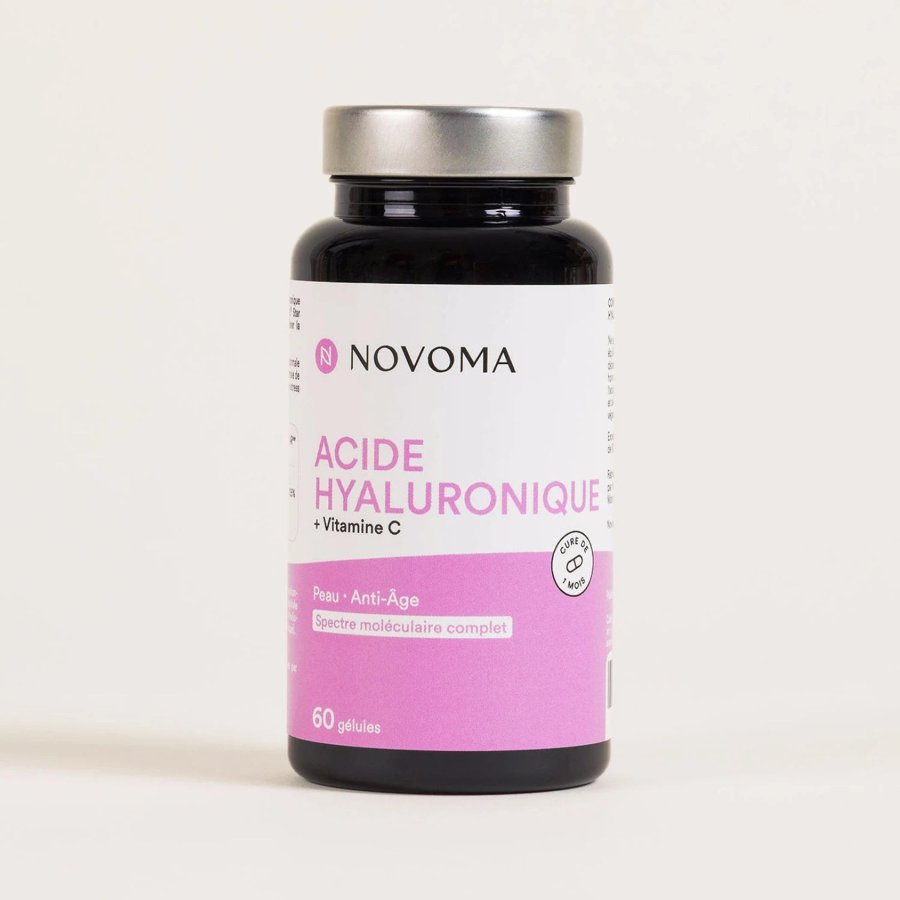
Novoma is a French supplement brand. Its Hyaluronic Acid capsules have a rare strength: they use the very ingredient of the Michelotti trial, at the same dose:
- 200 mg of ExceptionHYAL Star hyaluronic acid a day, made by biofermentation (sourced from Italy);
- plus 100 mg of vitamin C (Quali-C);
- short ingredient list: sodium hyaluronate, vitamin C, rice starch and a vegetable capsule; suitable for vegetarians and vegans;
- 2 capsules a day with water, at any time; 60 capsules, a one-month supply;
- made in France according to the product page, GMO- and gluten-free;
- €24.90 per bottle at the regular price (checked on 22/11/2026), about €0.83 a day.
How does the dose compare? 200 mg is exactly the dose of the 28-day trial in 60 women, and slightly above the 120 mg of the 12-week trials: a formula consistent with the research. Trial results, with their limits, do not guarantee the effect of any single product. The brand reserves it for adults, advises against it in pregnancy and breastfeeding, and recommends medical advice if you take medication or have a chronic condition.
Partner link: we earn a commission if you order through this link, at no extra cost to you.
To compare other capsules, see our best hyaluronic acid capsules comparison.
Frequently asked questions
What are the benefits of hyaluronic acid?
It holds water. In a serum it hydrates the skin surface; as a supplement, small trials show slightly better hydration and wrinkles, with low certainty; as a filler, it restores volume.
Do hyaluronic acid supplements work?
Possibly a little: trials at 120 to 200 mg a day are positive but small and often manufacturer-funded, and a larger meta-analysis does not confirm a clear effect.
What are the side effects of hyaluronic acid?
Almost none for serums and pills in short trials. Fillers commonly cause bruising and swelling, and rarely serious complications if injected into an artery.
Who should not take hyaluronic acid pills?
Pregnant or breastfeeding women and under-18s, for lack of safety data. Ask your doctor if you have a chronic condition or take medication.
How do you use hyaluronic acid serum?
Morning and evening, a few drops on clean, slightly damp skin, then a moisturiser, and sunscreen in the morning.
Sources
- Pavicic T. et al. Efficacy of cream-based novel formulations of hyaluronic acid of different molecular weights in anti-wrinkle treatment. J Drugs Dermatol, 2011; 10(9): 990-1000. PubMed 22052267
- Michelotti A. et al. Oral intake of a new full-spectrum hyaluronan improves skin profilometry and ageing: a randomized, double-blind, placebo-controlled clinical trial. Eur J Dermatol, 2021; 31(6): 798-805. PubMed 34933842
- Hsu T.F. et al. Oral Hyaluronan Relieves Wrinkles and Improves Dry Skin: A 12-Week Double-Blinded, Placebo-Controlled Study. Nutrients, 2021; 13(7): 2220. PubMed 34203487
- Dolečková I. et al. Oral sodium hyaluronate improves skin hydration, barrier function and signs of aging: a randomized, double-blind, placebo-controlled trial in 150 healthy adults. Sci Rep, 2025; 16(1): 2941. PubMed 41422283
- Yang Q. et al. Effectiveness of dietary supplements for skin photoaging in healthy adults: a systematic review and meta-analysis of randomized controlled trials. Front Med, 2025; 12: 1582946. PubMed 40761858
- Rutjes A.W. et al. Viscosupplementation for osteoarthritis of the knee: a systematic review and meta-analysis. Ann Intern Med, 2012; 157(3): 180-91. PubMed 22868835
- Lowe S. Hyaluronic Acid Dermal Filler-Associated Vascular Occlusion: A Review of Prevention and Management Strategies. J Cosmet Dermatol, 2026; 25(5): e70884. PubMed 42087426