Lactase enzyme pills: how to take them, who needs them and dosage per meal
The short answer
Lactase is the enzyme that breaks lactose, the sugar in milk, into glucose and galactose. Lactase pills help people who digest lactose poorly: you take them with the first bite of a meal that contains dairy, at a dose of at least 4,500 units per meal. They only work on the lactose eaten at the same time, so there is no point taking them as a course. They are well tolerated, but useless for a milk protein allergy, which is a different condition. Before taking them every day, make sure lactose really is the culprit: many people who think they are lactose intolerant are not, when tested.
This article is for information and does not replace medical advice. Ongoing diarrhea, weight loss, blood in your stool or new symptoms after 50: see a doctor first.
What is lactase?
Lactase (beta-galactosidase) is made by the lining of the small intestine. Infants have plenty of it; in many adults, production drops after weaning, a genetic trait called lactase non-persistence. In people of European descent, lactase persistence mostly depends on a single gene variant (LCT -13910) (Misselwitz et al., 2019).
Without enough lactase, undigested lactose reaches the colon, where bacteria ferment it: gas, bloating, cramps, diarrhea. Supplement lactase is almost always fungal, made by fermenting the mold Aspergillus oryzae.
For how lactase compares with other enzymes, see our guide to digestive enzymes. Here we focus on lactase pills: who needs them, how much and when.
Lactase deficiency, intolerance or allergy?
| What it is | Does lactase help? | |
|---|---|---|
| Lactose malabsorption | Your gut digests lactose poorly, but you may have no symptoms | Not needed without symptoms |
| Lactose intolerance | Malabsorption plus symptoms after lactose, not after placebo | Yes, its main use |
| Secondary lactase deficiency | Temporary loss after a gut infection or small bowel disease | As a stopgap; treat the cause |
| Milk protein allergy | Immune reaction to casein or whey | No: avoid dairy |
Testing: the hydrogen breath test (you drink lactose, often 25 g, then hydrogen in your breath is measured for a few hours), a genetic test (shows your genes, not your symptoms), or a 2 to 4-week elimination and reintroduction. Self-diagnosis is unreliable: of 148 people who said they were lactose intolerant, only 81 (55%) had a positive breath test, and just 45 were confirmed after a blinded placebo challenge (Rocco et al., 2021). If dairy is not clearly the trigger, other fermentable sugars may be: see our low FODMAP diet guide.
Do lactase pills work?
- Portincasa et al., 2008: in 109 intolerant adults, a single dose of Aspergillus oryzae lactase cut symptom scores by 76% (low dose) and 88% (standard dose);
- Baijal and Tandon, 2021: in a double-blind crossover trial of 47 adults, chewable lactase tablets improved symptoms and reduced breath hydrogen by 55% over 3 hours;
- Shaukat et al., 2010 (36 randomized trials): most adults with lactose malabsorption tolerate 12 to 15 g of lactose at once, about one cup of milk.
These are single-dose lab tests with a large lactose load. In real life, the benefit is more modest, because lactose is only one of several poorly absorbed sugars (Misselwitz et al., 2019). In the EU, lactase carries an authorized health claim for improving lactose digestion from 4,500 FCC units per meal, the reference dose EFSA uses in its opinions.
How to take lactase pills: dosage per meal
- Timing: just before or with the first bite. Taken an hour earlier or after the meal, it does nothing. For a long meal, take a second dose midway.
- Units: labels use FCC or ALU (acid lactase units, Food Chemicals Codex). Aim for at least 4,500 units per dairy meal.
- Adjust to the meal: aged cheese such as Comté has almost no lactose; a 125 g yogurt has about 4 g; a 150 ml glass of milk about 7 g; a creamy, cheesy dinner often more than 12 g, worth two doses.
- Test it: start with one dose on a typical meal; if symptoms persist, double it before giving up. No change at double dose suggests lactose is not the only problem.
- Drops: added to milk and left in the fridge as directed, the same principle as lactose-free milk.
- Children: most brands advise against it under 3; ask your pediatrician.
You can take lactase with every dairy meal: it is not absorbed and is not habit-forming. Regular small amounts of lactose may also improve tolerance in some people, through adaptation of colon bacteria (Misselwitz et al., 2019).
Lactase side effects and safety
- No notable side effects in trials;
- milk protein allergy: lactase offers no protection;
- galactosemia: lactase releases galactose, so it is not a solution;
- diabetes: no added sugar, just the glucose and galactose you would absorb from normally digested lactose;
- missed diagnosis: intolerance that appears suddenly in adulthood can come from infection, celiac disease or IBD. Get new or worsening symptoms checked;
- pregnancy and breastfeeding: it acts in the gut, but ask your doctor or midwife.
Lactose-free products and calcium
Lactose-free milk is milk with lactase already added: under 0.2 g of lactose per 100 g, but 2.26 g of galactose, with the same calcium as regular milk (Ciqual). The real risk of cutting out dairy is calcium: a review of 13 studies found clearly lower calcium intakes in adults with lactose intolerance, with uncertain effects on bone (Almalki et al., 2026). Keep aged cheeses like Parmesan, try kefir and yogurt, and add fortified plant milks, tofu, sardines with bones and leafy greens. Our lactose-free diet guide and foods high in calcium give the numbers.
Dynveo: an acid lactase at 5,000 ALU per capsule
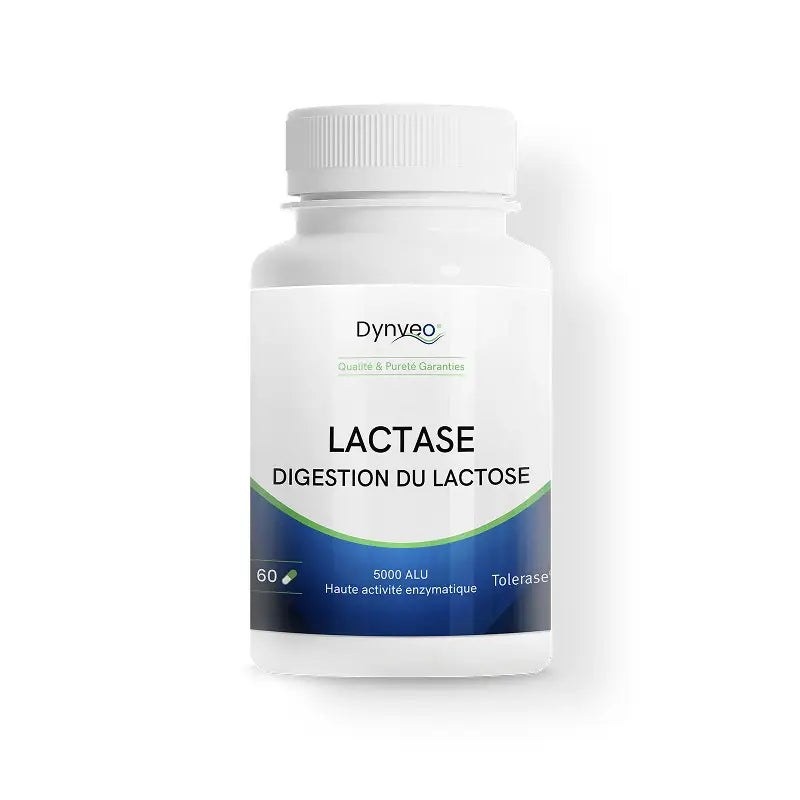
If lactose really is your issue, Dynveo’s Lactase Naturelle 5,000 ALU matches the research: a single enzyme, dosed above the EU threshold, taken only when needed. The product page lists:
- 5,000 ALU per capsule of Tolérase L® lactase from Aspergillus oryzae, the same source as in the Portincasa trial;
- an “acid” lactase active at pH 3.5 to 5.5, so it can start working in the stomach;
- 1 capsule before a meal with lactose, 2 for a very rich one;
- a short formula: lactase, acacia fiber and a plant-based pullulan capsule, no animal ingredients; may contain traces of gluten (under 20 ppm);
- a European raw material, packed in the brand’s own lab in Teyran, France, with a published batch certificate (microbiology, heavy metals);
- €15.90 for 60 capsules (price checked on 22/11/2026), about €0.27 per meal.
How does the dose compare? One capsule clears the 4,500-unit threshold and roughly matches the low dose in the Portincasa trial (4,625 ALU by the brand’s conversion); two capsules exceed the standard dose (7,700 ALU). The trial did not test this product, and results depend on your sensitivity and the lactose in your meal. Not recommended under 3.
Partner link: we earn a commission if you order through this link, at no extra cost to you.
Frequently asked questions
What is the lactase enzyme?
The enzyme in your small intestine that splits lactose into glucose and galactose. When you make too little, lactose ferments in the colon and causes symptoms.
Lactase vs lactose: what’s the difference?
Lactose is the sugar in milk; lactase is the enzyme that digests it.
How many lactase pills should I take?
There is no daily dose, only a per-meal dose: at least 4,500 units with each dairy meal, doubled for a very rich one.
Do lactase pills have side effects?
None of note in trials. The main risk is taking them for the wrong problem, such as a milk allergy or another digestive condition.
What is lactase persistence?
The genetic ability to keep making lactase into adulthood, common in Northern Europe and much rarer elsewhere.
Sources
- Misselwitz B. et al. Update on lactose malabsorption and intolerance: pathogenesis, diagnosis and clinical management. Gut, 2019; 68(11): 2080-2091. PubMed 31427404
- Rocco A. et al. Blinded Oral Challenges with Lactose and Placebo Accurately Diagnose Lactose Intolerance: A Real-Life Study. Nutrients, 2021; 13(5): 1653. PubMed 34068318
- Portincasa P. et al. Beneficial effects of oral tilactase on patients with hypolactasia. Eur J Clin Invest, 2008; 38(11): 835-44. PubMed 19021701
- Baijal R., Tandon R.K. Effect of lactase on symptoms and hydrogen breath levels in lactose intolerance. JGH Open, 2021; 5(1): 143-148. PubMed 33490624
- Shaukat A. et al. Systematic review: effective management strategies for lactose intolerance. Ann Intern Med, 2010; 152(12): 797-803. PubMed 20404262
- Almalki A.H. et al. Calcium, Vitamin D, and Phosphorus Levels and Bone Health in Adults with Lactose Intolerance: A Systematic Review. Nutr Rev, 2026. PubMed 42770947
- EFSA NDA Panel. Bifidobacterium animalis subsp. lactis Bi-07 and lactose digestion: evaluation of a health claim. EFSA Journal, 2020; 18(7): e06198. PubMed 32742434