Olive leaf extract and tea: benefits, blood pressure and side effects
The short answer
Olive leaf (Olea europaea) is rich in oleuropein, a polyphenol specific to the olive tree. As a concentrated olive leaf extract, it lowered blood pressure in several trials: about -11 mmHg systolic in people with mild hypertension at 1,000 mg a day, close to a low dose of captopril. Results are not consistent, though, and blood sugar data are mixed. In Europe, olive leaf is a traditional herbal medicine to help the kidneys eliminate water. It is generally well tolerated, but it can add to blood pressure and diabetes medication.
This article is for information and does not replace medical advice. High blood pressure needs medical follow-up: do not stop your treatment for a tea.
What is olive leaf? Oleuropein and other compounds
The olive tree is best known for its fruit and olive oil, but its leaves hold other compounds. The main one is oleuropein, a secoiridoid that makes the leaf, and untreated green olives, bitter. It partly breaks down into hydroxytyrosol, a well-studied antioxidant.
- Olive leaf tea: dried leaves infused or simmered; the traditional form, but the oleuropein in a cup is unknown and varies;
- olive leaf extract capsules: concentrated and often standardised (for example 136 mg of oleuropein a day in a UK trial); the form used in most trials.
What the European monograph says (EMA)
| Point | What the EMA says |
|---|---|
| Status | Traditional use: based on long-standing use, as trials were judged insufficient |
| Indication | Promote renal elimination of water in mild water retention, after a doctor has ruled out serious disease |
| Infusion | 6 to 10 g of dried leaves per dose, up to 3 times a day (6 to 30 g a day) |
| Decoction | 5 g dried (or 10 g fresh) leaves in 150 ml of water, simmered down to 100 ml, morning and evening |
| Duration | 2 to 4 weeks; see a doctor if symptoms last more than a week |
| Contraindication | Conditions requiring reduced fluid intake (severe heart or kidney disease) |
| Age, pregnancy | Not recommended under 18, in pregnancy or breastfeeding (lack of data) |
| Side effects, interactions | None known or reported |
The EMA did not accept a blood pressure or blood sugar indication: those uses rest on the trials below.
Olive leaf extract benefits for blood pressure
| Study | People and dose | Blood pressure result |
|---|---|---|
| Susalit 2011 | Stage 1 hypertension; extract 500 mg twice a day, 8 weeks, vs captopril | -11.5 / -4.8 mmHg, vs -13.7 / -6.4 mmHg on captopril (no significant difference) |
| Lockyer 2017 | 60 men with high-normal blood pressure; extract (136 mg oleuropein), 6 weeks | -3.3 / -2.4 mmHg over 24 hours vs control |
| Stevens 2021 | 77 overweight adults; extract 500 mg a day, 8 weeks | No difference vs placebo |
| Lachovicz 2025 (meta-analysis) | 3 studies, 248 people with high or high-normal blood pressure | -6 mmHg systolic; -11.5 / -4.7 mmHg in studies at 1,000 mg a day |
The signal is real in people whose blood pressure is already high, with concentrated extracts. But the meta-analysis has only 3 studies of variable quality, mostly comparing before and after. In overweight people without hypertension, the Stevens trial found nothing. Online you will see headlines calling olive leaf extract “debunked”: the truth is in between, a modest effect in some people, not a cure.
What about olive leaf tea? An Algerian study (Affane et al., 2025) followed 220 people with hypertension for 6 weeks: those drinking olive leaf tea morning and evening had lower blood pressure from week 2. But it was observational, with no randomisation or placebo, and the tea was not analysed. The authors call for standardised preparations.
Diet has proven large-scale effects: see our DASH diet guide and foods high in potassium.
Olive leaf and blood sugar
- In 79 adults with type 2 diabetes, 500 mg of extract a day for 14 weeks lowered HbA1c and fasting insulin vs placebo (Wainstein et al., 2012).
- In 46 overweight men, 12 weeks of extract improved insulin sensitivity by 15% vs placebo, with no change in weight, body composition or blood pressure (de Bock et al., 2013).
- However, a meta-analysis of 12 trials (Álvares et al., Nutrition Reviews, 2024) found no clear benefit on fasting glucose and said studies were too different to conclude.
Possible interest, weak evidence. Our best blood sugar supplement comparison covers better-studied options. Weight loss and sleep are common questions too, but we found no trial showing an effect on either.
Olive leaf and the Mediterranean diet
Olive leaf is part of Mediterranean tradition, but it is not what explains the benefits of the Cretan diet: olive oil, vegetables, pulses, fish and moderation do. A tea can go along with that way of eating, not replace it. Black garlic is another Mediterranean-friendly food often asked about for heart health.
Olive leaf extract side effects and interactions
The EMA lists no known side effects for the tea and powdered leaf, and extracts were well tolerated in trials. Precautions come from its effects:
- blood pressure drugs: an extract can lower blood pressure almost as much as low-dose captopril; combined with treatment, it could push it too low (dizziness, fatigue). Talk to your doctor and monitor your readings;
- diabetes drugs: the HbA1c effect seen in one trial could add to treatment;
- kidneys and heart: the EMA contraindicates it when fluid intake must be limited (severe heart or kidney disease) and advises medical advice in heart disease or kidney impairment;
- pregnancy, breastfeeding, under 18: not recommended, for lack of data.
The EMA reports no interactions, but it did not assess the concentrated extracts used for blood pressure: caution is still wise.
How to make olive leaf tea (and when to drink it)
- Infusion: pour hot, not boiling, water over dried leaves, cover and steep about 10 minutes, then strain. The EMA’s traditional dose is 6 to 10 g of leaves per cup.
- Decoction: 5 g of dried leaves in 150 ml of water, simmered down to 100 ml, morning and evening (EMA).
- Fresh leaves: the EMA uses double, 10 g, as a decoction; wash them and only use leaves from untreated trees.
- When to drink it: morning or daytime; as it promotes water elimination, an evening cup may wake you at night.
- Duration: 2 to 4 weeks, per traditional use.
Nutrition•pro: pure olive leaf tea
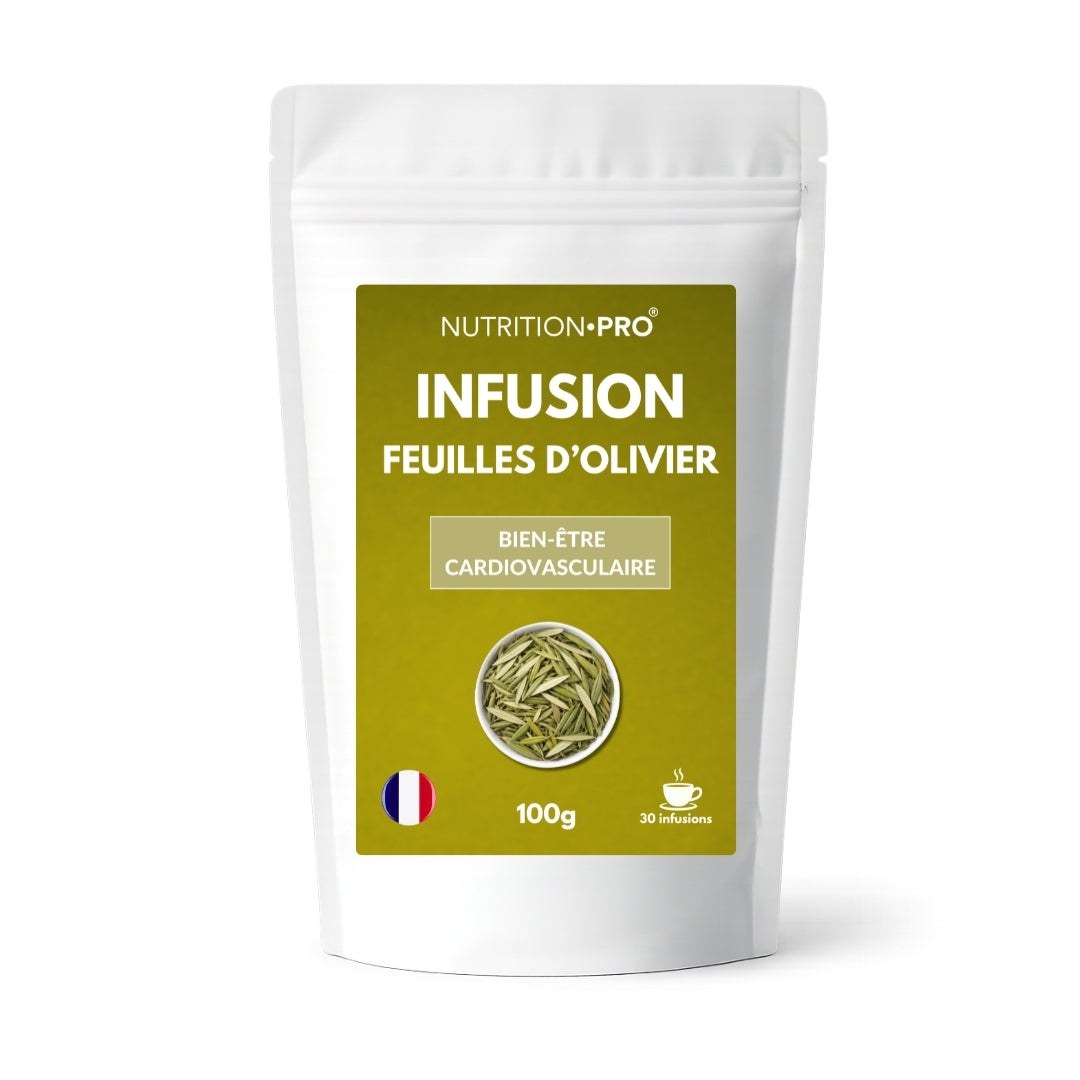
Nutrition•pro is a French brand based in Paris. Its Olive Leaf Tea keeps things simple:
- 100% olive leaves (Olea europaea), loose, no additives: a single, easy-to-identify ingredient;
- slowly dried leaves in a 100 g bag, about 30 cups according to the pack;
- suggested use: 1 level tablespoon (about 3 g) per 200 to 250 ml of water at 90 to 95 °C, 8 to 10 minutes covered, 1 to 2 cups a day, ideally in the morning;
- 15 to 30 days of tea per bag;
- €11.99 per bag (price checked on 22/11/2026), about €0.40 a cup.
How does this dose compare? At 3 to 6 g of leaves a day, this is a gentle preparation, below the European traditional range (6 to 30 g a day for water elimination). The blood pressure drops above came from concentrated extracts; a tea is not equivalent, and its blood pressure effect has not been shown in trials. It is a pleasant, lightly herbal drink to go with a Mediterranean-style diet. If you take blood pressure or diabetes medication, check with your doctor before drinking it daily, as the label also advises.
Promo code: SEOCONSULTINGSL for 10% off your order, €10.79 per bag, about €0.36 a cup (as of 22/11/2026).
See Nutrition•pro Olive Leaf Tea →
Partner link: we earn a commission if you order through this link, at no extra cost to you.
Frequently asked questions
What is olive leaf extract good for?
Concentrated extracts lowered blood pressure in several trials in people with hypertension, and sometimes improved blood sugar markers. Evidence remains limited.
What are the side effects of olive leaf extract?
The EMA knows of none. The main risk is blood pressure or blood sugar dropping too low when combined with medication.
What are the benefits of olive leaf tea?
Traditional use to help the kidneys eliminate water. A small observational study suggests lower blood pressure, but no controlled trial has confirmed it.
When should I drink olive leaf tea?
Morning or daytime, since it promotes water elimination.
Does olive leaf help with weight loss?
No trial shows it. A 12-week study found no change in weight or body composition.
Sources
- EMA, Committee on Herbal Medicinal Products. European Union herbal monograph on Olea europaea L., folium. EMA/HMPC/359238/2016, 31/01/2017. ema.europa.eu
- Susalit E. et al. Olive (Olea europaea) leaf extract effective in patients with stage-1 hypertension: comparison with Captopril. Phytomedicine, 2011; 18(4): 251-8. PubMed 21036583
- Lockyer S. et al. Impact of phenolic-rich olive leaf extract on blood pressure, plasma lipids and inflammatory markers: a randomised controlled trial. Eur J Nutr, 2017; 56(4): 1421-1432. PubMed 26951205
- Lachovicz R. et al. Efficacy of Olive Leaf Extract in Improving Blood Pressure in Pre-Hypertensive and Hypertensive Individuals: A Systematic Review and Meta-Analysis. Phytother Res, 2025. PubMed 40325976
- Stevens Y. et al. The effect of olive leaf extract on cardiovascular health markers: a randomized placebo-controlled clinical trial. Eur J Nutr, 2021; 60(4): 2111-2120. PubMed 33034707
- Affane F. et al. Health status, risk factors and effects of olive leaf extract infusion (Olea europaea L.) on blood pressure in a hypertensive population. Rocz Panstw Zakl Hig, 2025; 76(4): 323-333. PubMed 42145281
- Wainstein J. et al. Olive leaf extract as a hypoglycemic agent in both human diabetic subjects and in rats. J Med Food, 2012; 15(7): 605-10. PubMed 22512698
- de Bock M. et al. Olive (Olea europaea L.) leaf polyphenols improve insulin sensitivity in middle-aged overweight men. PLoS One, 2013; 8(3): e57622. PubMed 23516412
- Álvares A.A. et al. Olive leaf extract effect on cardiometabolic risk factors: a systematic review and meta-analysis of randomized clinical trials. Nutr Rev, 2024; 82(12): 1710-1725. PubMed 38287654