Passionflower: benefits for sleep and anxiety, side effects and dosage
The short answer
Passionflower (Passiflora incarnata) is a climbing plant whose aerial parts are used, as tea or extract, for stress and sleep. The European Medicines Agency (EMA) recognises it as a traditional herbal medicine to relieve mild symptoms of mental stress and aid sleep, based on long-standing use rather than strong clinical evidence. Small trials suggest benefits for anxiety and sleep, but there are too few to draw firm conclusions. Side effects: the EU monograph lists none known, but advises against use in pregnancy, breastfeeding and under 12, and warns it may impair driving. And medicinal passionflower is not the passion fruit plant.
This article is for information and does not replace medical advice. If anxiety or insomnia persists, or you take medication or are pregnant, talk to your doctor.
What is passionflower?
Passion flowers are a large genus of vines with striking blooms. In herbal medicine one species counts: Passiflora incarnata, native to North America (also called maypop or purple passionflower). Its aerial parts (stems, leaves and flowers) are dried and used as tea, powder or extract.
Not the same as passion fruit. Passion fruit comes from another species, Passiflora edulis. It is a fruit, not a sleep herb, and the studies below do not apply to it. Enjoy it fresh or in a mango passion fruit smoothie.
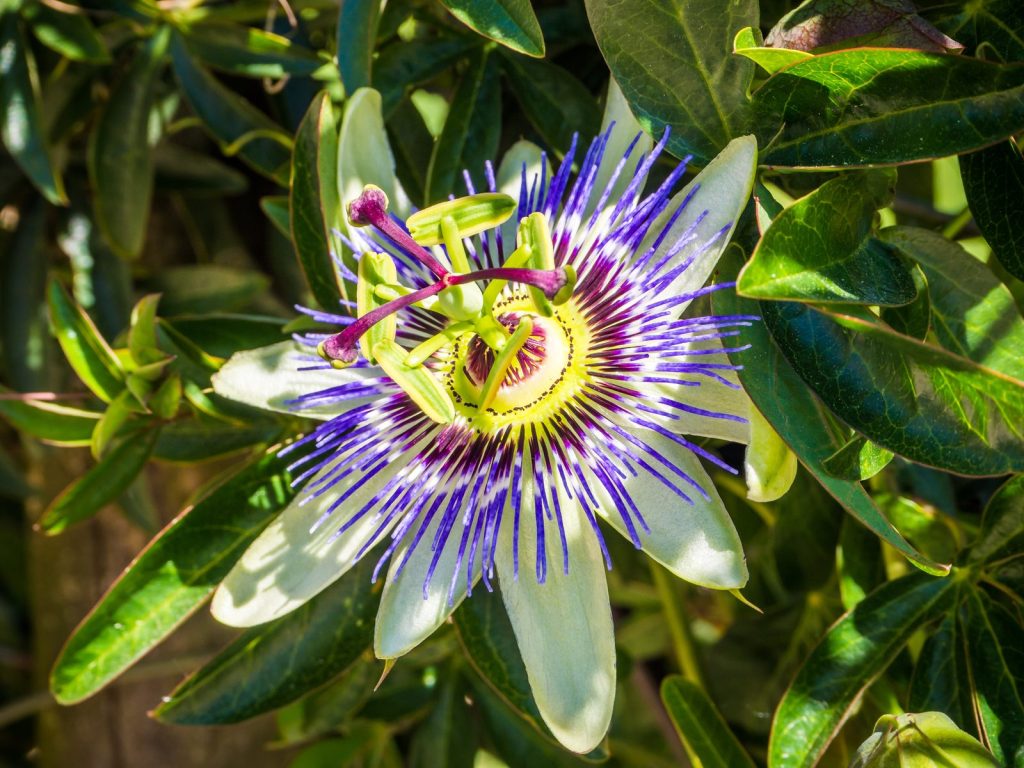
Garden passionflowers. The vine grown on fences is often blue passionflower (Passiflora caerulea), a vigorous climber. It is neither the medicinal species nor the one grown for fruit: don’t eat ornamental passionflower fruit or brew its leaves; buy passionflower sold for herbal use.
Passionflower benefits: what the studies show
Passionflower for anxiety
The Cochrane review (Miyasaka et al., 2007) found only 2 trials with 198 participants in anxiety disorders, too few to draw any conclusion. One of them (Akhondzadeh et al., 2001) compared a passionflower extract (45 drops a day) with the benzodiazepine oxazepam in 36 patients with generalised anxiety for 4 weeks: similar efficacy, faster onset with oxazepam, but more impact on work performance. A small pilot trial without placebo.
A later review (Janda et al., 2020) gathered 9 trials lasting 1 to 30 days. Most reported lower anxiety, less clearly with mild symptoms, and no notable side effects on memory or mental function. Several looked at anxiety before a procedure, such as dental surgery.
Passionflower for sleep
| Study | Participants and form | Result |
|---|---|---|
| Ngan and Conduit, 2011 | 41 healthy young adults, one cup of passionflower tea a day for 7 days, vs placebo | Better rated sleep quality; the other 5 sleep-diary measures did not change |
| Lee et al., 2020 | 110 adults with insomnia disorder, extract for 2 weeks, vs placebo | Total sleep time +23 minutes on average (vs no change), measured in a sleep lab; no difference on other measures |
The direction is consistent, but the evidence is thin: few, short trials with different preparations. Passionflower is not a proven insomnia treatment; regular sleep times, less screen time and, for lasting insomnia, behavioural therapy work better. See also foods that help you sleep and our guide to diet and stress management.
Passionflower side effects and who should avoid it
The EMA monograph (2014) lists no known side effects, no reported interactions and no overdose cases, and the trials above found no notable adverse effects. That is not zero risk: long-term studies are scarce and reproductive toxicity tests have not been done.
| Situation | EU monograph advice |
|---|---|
| Pregnancy and breastfeeding | Safety not established: not recommended |
| Children under 12 | Not enough data: not recommended |
| Driving, machinery | May impair alertness: don’t drive if you feel drowsy |
| Allergy to the plant | The only formal contraindication |
| Symptoms lasting over 2 weeks or worsening | See a doctor |
With sleeping pills, anti-anxiety drugs or alcohol? No interaction is reported, but all can cause drowsiness: don’t combine them without your doctor’s advice. And with blends, check every ingredient, since each has its own risks.
Passionflower dosage
The EU monograph sets these doses for adults and adolescents over 12:
| Form | Single dose | How often |
|---|---|---|
| Tea | 1 to 2 g of dried herb in 150 ml of boiling water | 1 to 4 times a day |
| Powdered herb | 0.5 to 2 g | 1 to 4 times a day |
| Liquid extracts | 0.3 to 4 ml depending on the extract | up to 3 to 5 times a day |
| Dry extracts | equivalent to the matching tea or liquid extract | per label |
- For sleep: one dose in the evening, about an hour before bed. In Ngan’s trial, it was one cup of tea a night.
- How long does it take? Trials measured effects after 1 week (tea), 2 weeks (insomnia) or 4 weeks (anxiety). No improvement after 2 weeks: see a doctor.
- Extract or tea? Both are covered. For a dry extract, look for the extraction ratio, otherwise you can’t tell how much herb it equals.
Novoma: a passionflower sleep formula made in France
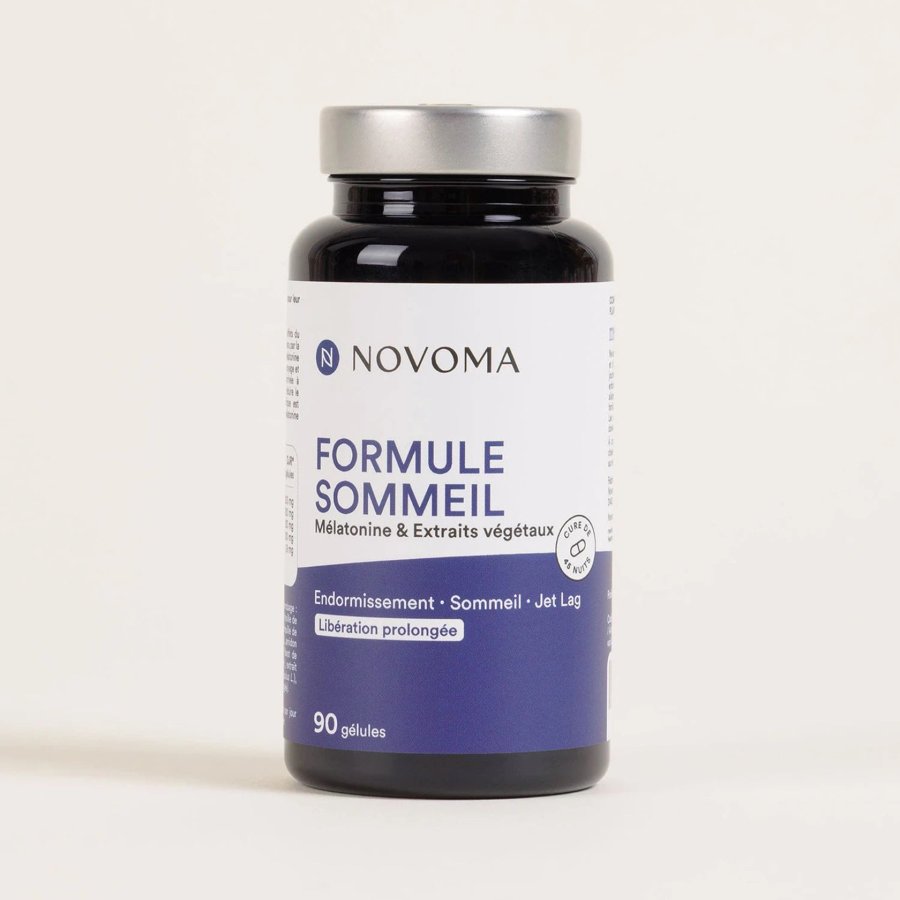
Among our partners’ evening formulas, Novoma’s Sleep Formula contains the most passionflower. The brand states on the product page that it is made in France. The label shows:
- passionflower extract (Passiflora incarnata): 200 mg a day;
- with lemon balm 200 mg (standardised to over 5% rosmarinic acid), California poppy 150 mg and hops 100 mg;
- and 1.9 mg of prolonged-release melatonin (Melotime);
- 2 capsules in the evening, one hour before bed;
- 90 capsules, i.e. 45 nights, then a few weeks’ break according to the brand;
- €23.90 per bottle at regular price (checked on 22/11/2026), about €0.53 a night.
How does the dose compare? The label does not give the passionflower extraction ratio, so the 200 mg cannot be converted into grams of dried herb and compared with the monograph’s 0.5 to 2 g per dose. The trials above studied passionflower alone, so they do not apply as such to a blend. The formula’s real strength is combining evening herbs at doses of several hundred milligrams, where many blends use only a few dozen.
Note: it contains melatonin, a hormone with its own precautions. The brand advises against it in pregnancy and breastfeeding and with a personal or family history of hormone-dependent cancer. Ask your doctor if you take medication or a sleeping pill. For passionflower alone, a passionflower tea stays closest to the studies.
Partner link: we earn a commission if you order through this link, at no extra cost to you.
To compare with other options, see our best sleep supplement comparison.
Frequently asked questions
What are the benefits of passionflower?
It is traditionally used for mild stress and to aid sleep, a use recognised by the EMA. A few small trials show lower anxiety and slightly better sleep, but the evidence is limited.
Is passion flower tea good for sleep?
One week of a nightly cup improved rated sleep quality in a small trial of healthy adults. It may help mild sleep troubles; it is not an insomnia treatment.
What are the side effects of passionflower?
None are listed in the EU monograph, but it can cause drowsiness and impair driving. Avoid it in pregnancy, breastfeeding and under 12.
Can you take passionflower every day?
Yes for a few weeks at monograph doses. If symptoms last more than 2 weeks or get worse, see a doctor.
Is passionflower the same as passion fruit?
No. Passion fruit comes from Passiflora edulis; medicinal passionflower is Passiflora incarnata. Don’t eat fruit from ornamental passionflowers.
Sources
- EMA, Committee on Herbal Medicinal Products. Community herbal monograph on Passiflora incarnata L., herba. EMA/HMPC/669740/2013, 25 March 2014. ema.europa.eu
- Miyasaka L.S. et al. Passiflora for anxiety disorder. Cochrane Database Syst Rev, 2007; (1): CD004518. PubMed 17253512
- Akhondzadeh S. et al. Passionflower in the treatment of generalized anxiety: a pilot double-blind randomized controlled trial with oxazepam. J Clin Pharm Ther, 2001; 26(5): 363-7. PubMed 11679026
- Janda K. et al. Passiflora incarnata in Neuropsychiatric Disorders: A Systematic Review. Nutrients, 2020; 12(12): 3894. PubMed 33352740
- Ngan A., Conduit R. A double-blind, placebo-controlled investigation of the effects of Passiflora incarnata (passionflower) herbal tea on subjective sleep quality. Phytother Res, 2011; 25(8): 1153-9. PubMed 21294203
- Lee J. et al. Effects of Passiflora incarnata Linnaeus on polysomnographic sleep parameters in subjects with insomnia disorder. Int Clin Psychopharmacol, 2020; 35(1): 29-35. PubMed 31714321