Yerba mate: benefits, caffeine content and is it good for you?
The short answer
Yerba mate is an infusion of the dried leaves of Ilex paraguariensis, a South American holly. Above all it is a caffeinated drink: a 150 ml (5 oz) cup provides roughly 40 to 80 mg of caffeine, between green tea and coffee. So caffeine limits apply: the European Food Safety Authority (EFSA) considers up to 400 mg a day safe for healthy adults, 200 mg at once, and 200 mg a day in pregnancy, from all sources. Is yerba mate good for you? For most adults, yes in moderation, with one key caveat: temperature. The International Agency for Research on Cancer (IARC) classifies drinks consumed above 65 °C (149 °F) as probably carcinogenic for the oesophagus, while mate drunk warm or cold is not classifiable. Smoke-drying can also leave polycyclic aromatic hydrocarbons (PAHs) in the leaves.
This article is for information and does not replace medical advice. If you are pregnant, have a heart condition, anxiety, insomnia or take medication, ask your doctor about your caffeine intake.
What is yerba mate?
Yerba mate is made from the dried, crushed leaves of a tree grown in Brazil, Argentina and Paraguay. It is traditionally sipped from a gourd through a filtering metal straw, the bombilla, refilled with water through the day (chimarrão in Brazil), or cold as tereré. The leaf usually contains 1 to 2% caffeine (dry matter), some theobromine and plenty of polyphenols, mainly caffeoylquinic acids (the chlorogenic acid family found in coffee) and rutin. Hot infusions extract more of them than cold ones.
Yerba mate vs matcha? Two different plants: matcha is powdered green tea (Camellia sinensis) drunk whole, mate is a brewed holly leaf. See matcha benefits, caffeine and side effects.
Yerba mate caffeine: how much per cup vs coffee?
| Drink (150 ml / 5 oz) | Caffeine |
|---|---|
| Brewed yerba mate | 42 to 82 mg |
| Coffee | 42 to 121 mg |
| Green tea | 12 to 52 mg |
Actual content depends on how much leaf you use, steeping time and water. In Najman’s study, a second brew of the same leaves gave less caffeine, and 70 °C water extracted more than boiling water. With a gourd refilled all day, caffeine falls with each refill, but it still adds up.
| Situation | EFSA level | Cups of mate (40 to 80 mg) |
|---|---|---|
| Healthy adult, per day | Up to 400 mg | About 5 to 10 cups, counting all other caffeine |
| Healthy adult, single dose | Up to 200 mg | 2 to 5 cups at once |
| Pregnancy and breastfeeding | Up to 200 mg a day | 2 to 5 cups, with no coffee or tea on top |
| Children and teens | 3 mg per kg of body weight a day | Not as a regular drink |
| Sleep | 100 mg may disturb sleep in some adults near bedtime | No mate in the evening if you sleep poorly |
To add up your day, see how much coffee per day is safe, plus our coffee and tea nutrition pages, and foods that help you sleep.
Yerba mate benefits: what the evidence shows
The alertness people feel comes mostly from caffeine. A 2007 review (Heck and de Mejia) lists many studied effects (cholesterol, liver, antioxidant capacity, weight), but the human trials we found are few and small, and we found none on immunity or digestion.
Weight loss: the most cited trial (Kim et al., 2015) gave 30 Korean adults with obesity either mate capsules (3 g a day) or placebo for 12 weeks. The mate group lost more body fat and waist-to-hip ratio, with no notable side effects. Interesting, but 15 people per group, using capsules rather than the drink. For what works, see how to lose weight healthily.
Is yerba mate bad for you? Heat, PAHs and cancer
Observational studies link heavy mate drinking in South America to oesophageal and mouth cancers. A meta-analysis of 9 studies and 1,565 cases (Andrici and Eslick, 2013) found a 2.6-fold higher risk of oesophageal squamous cell carcinoma, higher in heavy drinkers; another of 4 studies (Dasanayake et al., 2010) found a doubled risk for the mouth and pharynx. These studies cannot separate the drink from how it is drunk.
IARC (2016): it’s the heat. IARC classified drinking very hot beverages above 65 °C as probably carcinogenic (Group 2A), whatever the drink. Mate is traditionally drunk at about 70 °C. Mate drunk at temperatures that are not very hot was not classifiable (Group 3), like coffee. A risk assessment (Okaru et al., 2018) agrees: PAH exposure from mate, coffee or tea is a very low risk, while very hot drinking temperature is a real one; in some regions mate is drunk at 70 to 85 °C.
PAHs depend on drying. Mate leaves are often smoke-dried. A review of 10 studies (Oranuba et al., 2019) found high levels in dry leaves, with benzo[a]pyrene often above 25 ng/g, but only 1 to 50% passes into the infusion. In Brazilian brands (Golozar et al., 2012), levels varied by brand, batch and process, and the sample dried without smoke contact had the least benzo[a]pyrene. In 15 mates sold in Europe (Górka et al., 2025), Brazilian samples had the lowest PAH levels and no pesticide residues.
- do not drink it scalding: let it cool, or have it cold as tereré;
- pregnancy and breastfeeding: keep total caffeine under 200 mg a day (see our pregnancy diet guide);
- heart rhythm problems, high blood pressure, anxiety, insomnia: caffeine can make them worse;
- children and teens: not as a regular drink;
- medication: ask your doctor or pharmacist; EFSA’s caffeine opinion does not cover drug combinations;
- stacking stimulants: mate, coffee, energy drinks and pre-workout add up.
How to drink yerba mate
- In a cup: 1 tablespoon of leaves, water at 70 to 80 °C (158 to 176 °F), not boiling, steep 3 to 5 minutes, strain.
- Let it cool: 70 to 80 °C water is already above 65 °C. Wait a few minutes, especially with a bombilla, which sends the liquid straight into your mouth.
- Tereré: brewed with cold water and ice, it sidesteps the heat issue.
- Count your caffeine: at 40 to 80 mg a cup, 3 to 4 cups a day still leave room for a coffee under 400 mg.
- Morning or early afternoon rather than evening.
Nutrition•pro: organic green yerba mate from Brazil, dried without smoke
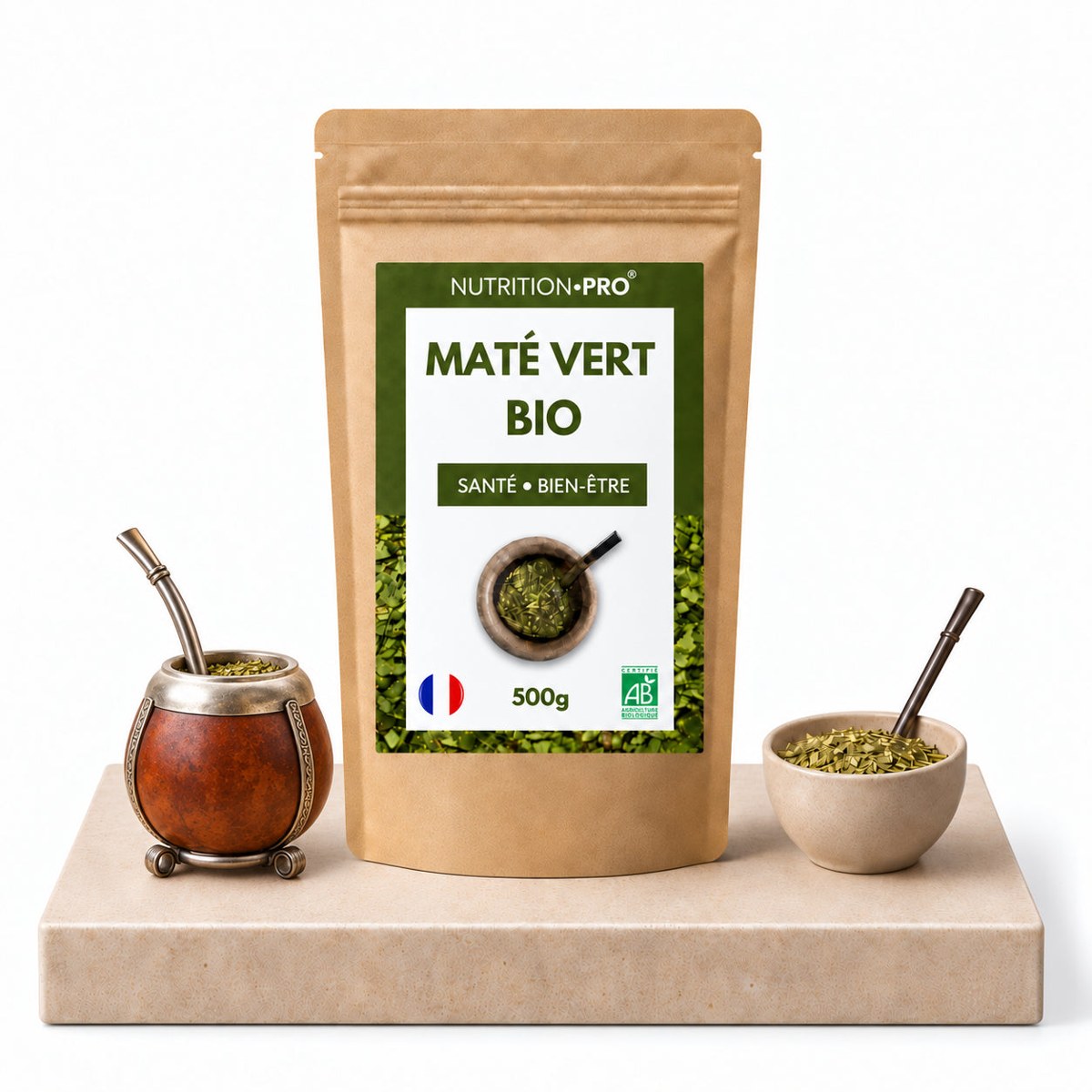
Nutrition•pro is a French brand based in Paris. Its organic yerba mate addresses the key issue above, PAHs:
- origin: 100% organic green mate leaves from Brazil;
- hot-air dried, without contact with smoke, according to the brand, which presents it as a way to avoid PAH formation; this matches the research, where the smoke-free sample (Golozar) had the least benzo[a]pyrene and Brazilian mates (Górka) were the least contaminated;
- organic, plain leaf, no flavouring or additives;
- suggested preparation: 1 tablespoon per cup, water at 70 to 80 °C, not boiling, 3 to 5 minutes, or cold over ice;
- 500 g bag; at about 5 g per cup, roughly 100 cups;
- €19.99 per bag (price checked on 22/11/2026), about €0.20 a cup on that basis.
It is a leaf to brew, not a concentrated extract: caffeine depends on how you prepare it, within the ranges above. The weight-loss trial used 3 g a day in capsules, a different form. The brand’s own warnings match EFSA’s: moderate with heart problems, anxiety or insomnia, limit in pregnancy and breastfeeding, ask a doctor if you take medication, avoid boiling water. Add IARC’s advice: let it cool before you drink.
Promo code: SEOCONSULTINGSL for 10% off your order: €17.99 per 500 g bag, about €0.18 a cup (as of 22/11/2026).
See Nutrition•pro organic yerba mate →
Partner link: we earn a commission if you order through this link, at no extra cost to you.
Frequently asked questions
Is yerba mate good for you?
In moderation, for healthy adults: it provides caffeine and polyphenols. Keep total caffeine under 400 mg a day and do not drink it scalding hot.
How much caffeine is in yerba mate?
About 40 to 80 mg per 150 ml (5 oz) cup, often a little less than coffee and a little more than green tea.
Does yerba mate help with weight loss?
Not proven. One small 12-week trial with capsules showed less body fat. The brand itself does not sell it as a slimming product.
Is yerba mate safe to drink every day?
Yes for most healthy adults, within EFSA caffeine limits and below 65 °C. Avoid large amounts in pregnancy and if you are sensitive to caffeine.
What is the difference between yerba mate and matcha?
Matcha is powdered green tea drunk whole; mate is a brewed South American holly leaf. Caffeine per cup is in a similar range.
Sources
- Loomis D. et al. (IARC Monograph Working Group). Carcinogenicity of drinking coffee, mate, and very hot beverages. Lancet Oncol, 2016; 17(7): 877-878. PubMed 27318851. IARC press release No. 244, 15 June 2016: iarc.who.int
- Okaru A.O. et al. Comparative oesophageal cancer risk assessment of hot beverage consumption (coffee, mate and tea). BMC Cancer, 2018; 18(1): 236. PubMed 29490609
- Andrici J., Eslick G.D. Maté consumption and the risk of esophageal squamous cell carcinoma: a meta-analysis. Dis Esophagus, 2013; 26(8): 807-16. PubMed 22891687
- Dasanayake A.P. et al. Maté drinking and oral and oro-pharyngeal cancer. Oral Oncol, 2010; 46(2): 82-6. PubMed 20036605
- Golozar A. et al. Significant variation in the concentration of carcinogenic polycyclic aromatic hydrocarbons in yerba maté samples by brand, batch, and processing method. Environ Sci Technol, 2012; 46(24): 13488-93. PubMed 23101992
- Oranuba E. et al. Polycyclic aromatic hydrocarbons as a potential source of carcinogenicity of mate. J Environ Sci Health C, 2019; 37(1): 26-41. PubMed 30596334
- Górka A. et al. Assessment of heavy metals, PAHs, and pesticide levels in yerba mate on the European market. Environ Sci Pollut Res Int, 2025; 32(2): 603-616. PubMed 39695037
- Kim S.Y. et al. Anti-obesity effects of Yerba Mate: a randomized, double-blind, placebo-controlled clinical trial. BMC Complement Altern Med, 2015; 15: 338. PubMed 26408319
- Najman K. et al. Changes in the physicochemical and bioactive properties of Yerba Mate depending on the brewing conditions. Molecules, 2024; 29(11): 2590. PubMed 38893465
- Heck C.I., de Mejia E.G. Yerba Mate Tea (Ilex paraguariensis): a comprehensive review. J Food Sci, 2007; 72(9): R138-51. PubMed 18034743
- EFSA, NDA Panel. Scientific Opinion on the safety of caffeine. EFSA Journal, 27 May 2015, doi 10.2903/j.efsa.2015.4102. Summary: efsa.europa.eu