Pre-workout: what it does, side effects and is it bad for you?
The short answer
Pre-workout is a powder you drink 20 to 60 minutes before training, usually built around caffeine plus other ingredients such as citrulline, beta-alanine, betaine, taurine or tyrosine. What it actually does comes mostly from the caffeine: at 3 to 6 mg per kilogram of body weight, it clearly improves endurance, strength and power in many studies. The other ingredients have smaller effects, or only at specific doses. Is pre-workout bad for you? Not for a healthy adult who sticks to one serving: the European Food Safety Authority (EFSA) considers 200 mg of caffeine in one go and 400 mg a day from all sources safe for healthy adults. Go beyond that, or stack pre-workout with coffee and energy drinks, and side effects (racing heart, jitters, poor sleep) become common.
This article is for information and does not replace medical advice. If you have a heart condition, high blood pressure, are pregnant or take medication, talk to your doctor before using pre-workout.
What is pre-workout?
It is a powdered supplement mixed with water before exercise, sold for energy, focus, “pump” and muscular endurance. There is no standard recipe: every brand mixes its own.
One study analysed the labels of the 100 best-selling pre-workouts (Jagim et al., Nutrients, 2019). They had 18 ingredients on average, and 44% of ingredients sat in “proprietary blends” with no amount disclosed. The most common:
| Ingredient | Found in | Average amount per serving |
|---|---|---|
| Beta-alanine | 87% of products | 2.0 g |
| Caffeine | 86% | 254 mg |
| Citrulline | 71% | 4.0 g |
| Tyrosine | 63% | 348 mg |
| Taurine | 51% | 1.3 g |
| Creatine | 49% | 2.1 g |
The authors found the average beta-alanine dose below the effective dose, and caffeine near the low end of the effective range for a 70 kg (154 lb) person. A long label guarantees nothing: what matters is the dose of each ingredient. Be wary of undisclosed blends and of products bought outside regular retail, where potent stimulants such as DMAA turn up.
What does pre-workout do? The evidence, ingredient by ingredient
Caffeine: the best-proven ingredient
A review of 21 meta-analyses (Grgic et al., British Journal of Sports Medicine, 2020) concluded that caffeine improves aerobic endurance, strength, muscular endurance, power, jumping and speed, with mostly moderate quality evidence and larger effects for endurance. Most participants were young men.
The International Society of Sports Nutrition position stand (Guest et al., 2021) puts the effective dose at 3 to 6 mg/kg, possibly as low as 2 mg/kg, while very high doses (9 mg/kg) bring many side effects without extra benefit. The most studied timing is 60 minutes before exercise, and caffeinated pre-workouts do improve performance. Responses vary a lot with genetics and habitual intake. To count your daily caffeine, see how much coffee per day is safe.
Citrulline malate: a few extra reps
A meta-analysis of 8 placebo-controlled trials (Vårvik et al., 2021, 137 people) found that 6 to 8 g of citrulline malate 40 to 60 minutes before training added about 3 reps (+6.4%) on sets taken to failure: a small effect. Another meta-analysis (Aguiar and Casonatto, 2022, 4 trials) found no effect on maximal strength.
Betaine: needs daily use
A meta-analysis of 17 studies (Zawieja et al., 2024, 317 people) found a moderate effect on maximal strength, mainly lower body, and possibly vertical jump, but only after at least 7 days of daily use. No effect on upper-body strength, sprint power or muscular endurance.
Nitrates: a small boost for recreational athletes
Across 80 studies (Senefeld et al., 2020), nitrate supplementation improved performance, but the effect was objectively small, and absent in highly trained endurance athletes and in women-only studies. Beetroot is the best-known food source.
Beta-alanine and the rest
Beta-alanine causes the harmless tingling many people feel after pre-workout. Taurine, tyrosine and carnitine have thinner performance data. Creatine works by building up over weeks, not as a one-off: see how to take creatine.
Is pre-workout bad for you? Side effects and safety
In a survey of 872 regular users (Jagim et al., Nutrients, 2019), 54% reported side effects, including skin reactions, heart rhythm problems and nausea, more often in women. 14% took two or more servings at once and 18% used it more than once a day. The authors advise one serving at most and no stacking with other caffeinated products.
| Situation | EFSA safety level |
|---|---|
| Healthy adult, single dose | Up to 200 mg (about 3 mg/kg), including less than 2 hours before intense exercise |
| Healthy adult, per day | Up to 400 mg (about 5.7 mg/kg), spread over the day |
| Pregnancy and breastfeeding | Up to 200 mg a day from all sources |
| Children and teens | 3 mg per kg of body weight a day |
| Sleep | 100 mg may disturb sleep in some adults, especially near bedtime |
A 200 mg scoop already reaches the single-dose level: a coffee or energy drink right before training pushes you over. Skip pre-workout if you are pregnant or breastfeeding, under 18, have a heart rhythm problem, high blood pressure, anxiety or insomnia, and ask your doctor or pharmacist if you take medication. For evening sessions, think about sleep: see foods that help you sleep.
How to take pre-workout
- When: 20 to 60 minutes before training.
- How much: one serving, never more. Try half a serving the first time.
- Count your caffeine: coffee, tea, soda and energy drinks all add up. Stay under 400 mg a day and 200 mg at once.
- How long does pre-workout last? The caffeine effect lasts several hours, which is why a late-afternoon dose can still affect sleep.
- Food first: pre-workout provides almost no energy. See what to eat before and after exercise and hydration for sports performance.
Non-stim or caffeine-free pre-workout? A sensible choice for evening training or caffeine sensitivity, but you lose the best-proven ingredient: what remains (citrulline, nitrates) has small effects.
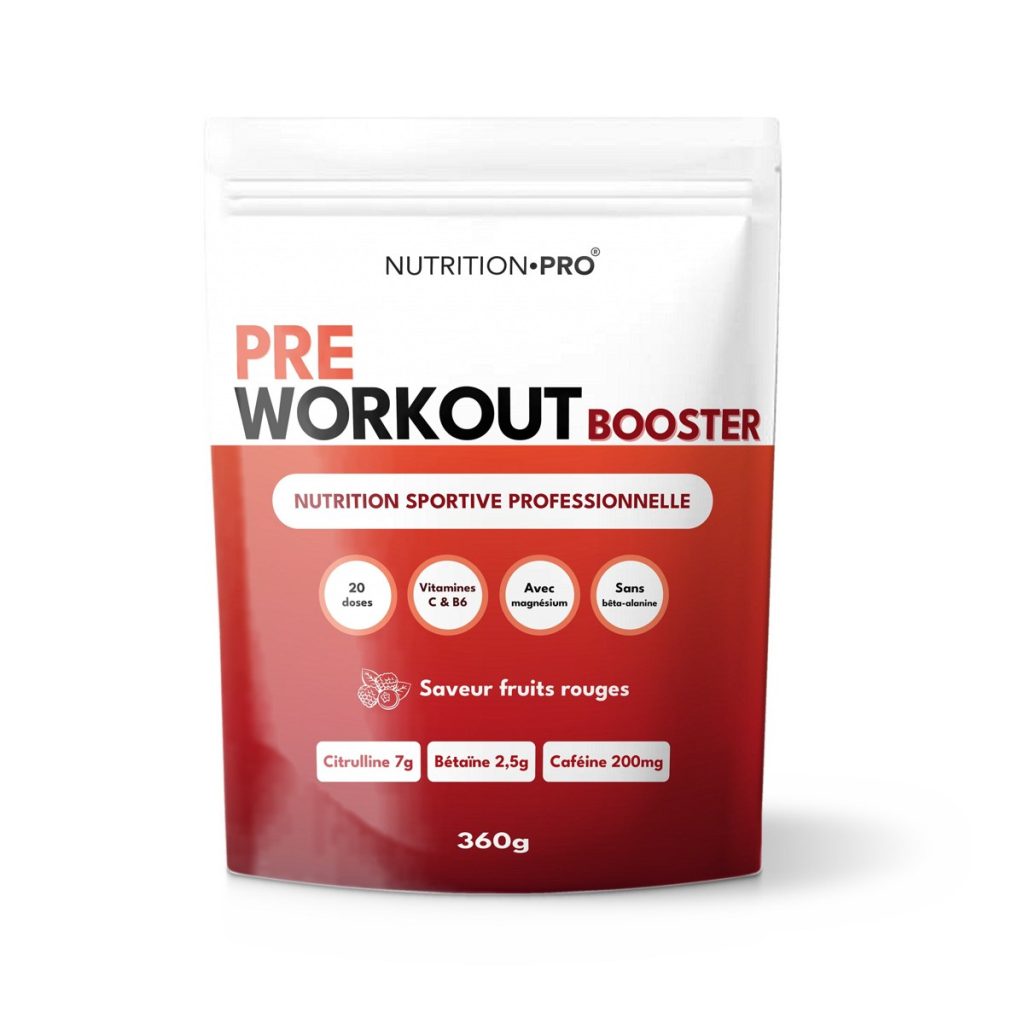
Nutrition•pro: a fully disclosed Pre Workout Booster
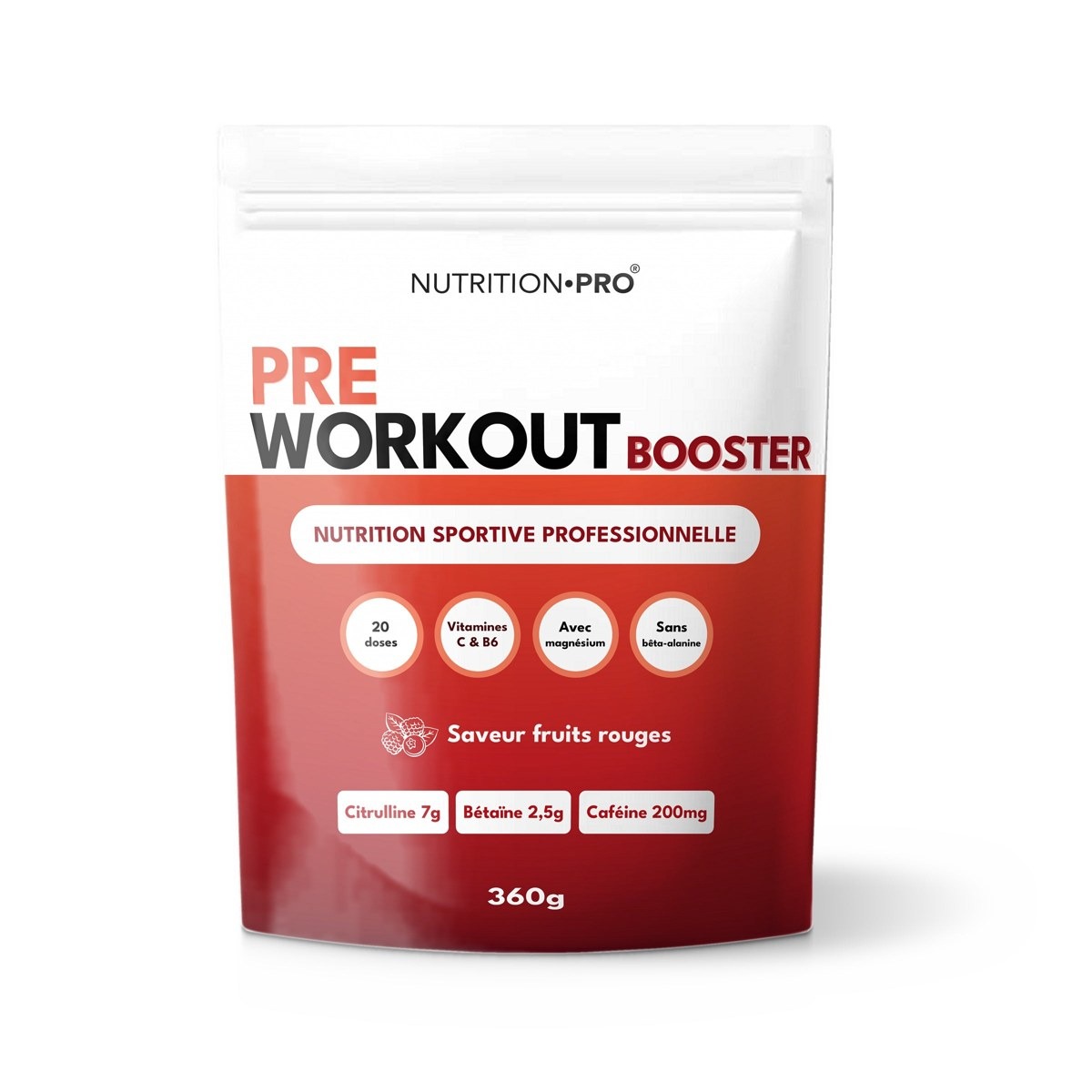
Nutrition•pro is a French brand based in Paris, which says it designs and makes its formulas in France. Its Pre Workout Booster has a rare strength in this category: no proprietary blend, every dose is on the label, so it can be checked against the research.
| Per 18 g serving | Pre Workout Booster | Research benchmark |
|---|---|---|
| Caffeine | 200 mg | 3 to 6 mg/kg (ISSN); 200 mg per dose max (EFSA). About 2.9 mg/kg at 70 kg |
| Citrulline malate | 7 g | 6 to 8 g (Vårvik 2021): within range |
| Betaine anhydrous | 2.5 g | Strength effect measured after 7+ days of use |
| Nitrate-source extract | 1 g, incl. 250 mg nitrates | Small effect, mainly in recreational athletes |
| Taurine, acetyl-L-tyrosine, acetyl-L-carnitine | 1 g each | Secondary ingredients, limited data |
| L-theanine (green tea extract) | 200 mg | Often paired with caffeine |
| Rhodiola extract | 150 mg | See our rhodiola guide |
| Vitamin C, vitamin B6, magnesium | 80 mg, 2 mg, 56.3 mg | Standard nutrient amounts |
| Beta-alanine | None | No tingling |
Our take: caffeine sits right at the EFSA single-dose level and below the market average (254 mg), an effective dose for many adults without overdoing it. Citrulline matches the studied dose, which is far from the norm (4 g on average). No beta-alanine means no tingling. Betaine and nitrates come with the caveats above. For rhodiola, see rhodiola rosea benefits and side effects.
- sugar-free powder, red berry flavour (sweetener: sucralose);
- one 18 g scoop in 250 to 300 ml of cold water, 20 to 30 minutes before training, one serving a day max, on training days only;
- the brand advises a half serving the first time and no late-day use;
- 360 g bag, 20 servings;
- €39.99 per bag (price checked on 22/11/2026), about €2.00 per session.
The brand’s own warnings match EFSA’s: not for children, teens, pregnant or breastfeeding women or caffeine-sensitive people; do not combine with other caffeinated products; ask a health professional if you take medication or have a cardiovascular condition.
Promo code: SEOCONSULTINGSL for 10% off your order, €35.99 per bag, about €1.80 per session (as of 22/11/2026).
See Nutrition•pro Pre Workout Booster →
Partner link: we earn a commission if you order through this link, at no extra cost to you.
Looking for long-term gains instead? Our best creatine comparison can help.
Frequently asked questions
What is pre-workout?
A powdered supplement taken before training, usually caffeine plus ingredients like citrulline, beta-alanine, betaine or taurine. Formulas vary widely.
What does pre-workout do?
Mainly it boosts energy and focus through caffeine, which improves endurance, strength and power. Citrulline may add a few reps. It is not essential: a coffee and a good meal do part of the job.
Is pre-workout bad for you?
Not for healthy adults using one serving with a known caffeine content and no stacking. Avoid it in pregnancy, under 18 and with heart problems, and avoid undisclosed blends or DMAA.
How long does pre-workout last?
The caffeine effect lasts several hours. EFSA notes that even 100 mg can disturb sleep in some adults close to bedtime.
Why does pre-workout make you tingle?
That is beta-alanine. The tingling is harmless and fades; products without beta-alanine do not cause it.
Sources
- EFSA, NDA Panel. Scientific Opinion on the safety of caffeine. EFSA Journal, 27 May 2015, doi 10.2903/j.efsa.2015.4102. Summary: efsa.europa.eu
- Guest N.S. et al. International society of sports nutrition position stand: caffeine and exercise performance. J Int Soc Sports Nutr, 2021; 18(1): 1. PubMed 33388079
- Grgic J. et al. Wake up and smell the coffee: caffeine supplementation and exercise performance, an umbrella review of 21 published meta-analyses. Br J Sports Med, 2020; 54(11): 681-688. PubMed 30926628
- Vårvik F.T. et al. Acute Effect of Citrulline Malate on Repetition Performance During Strength Training. Int J Sport Nutr Exerc Metab, 2021; 31(4): 350-358. PubMed 34010809
- Aguiar A.F., Casonatto J. Effects of Citrulline Malate Supplementation on Muscle Strength in Resistance-Trained Adults. J Diet Suppl, 2022; 19(6): 772-790. PubMed 34176406
- Zawieja E. et al. Effects of chronic betaine supplementation on exercise performance. J Sports Sci, 2024; 42(22): 2131-2144. PubMed 39514262
- Senefeld J.W. et al. Ergogenic Effect of Nitrate Supplementation: A Systematic Review and Meta-analysis. Med Sci Sports Exerc, 2020; 52(10): 2250-2261. PubMed 32936597
- Jagim A.R. et al. Common Ingredient Profiles of Multi-Ingredient Pre-Workout Supplements. Nutrients, 2019; 11(2): 254. PubMed 30678328
- Jagim A.R. et al. Common Habits, Adverse Events, and Opinions Regarding Pre-Workout Supplement Use Among Regular Consumers. Nutrients, 2019; 11(4): 855. PubMed 31014016