Group · Dairy
Blue cheese
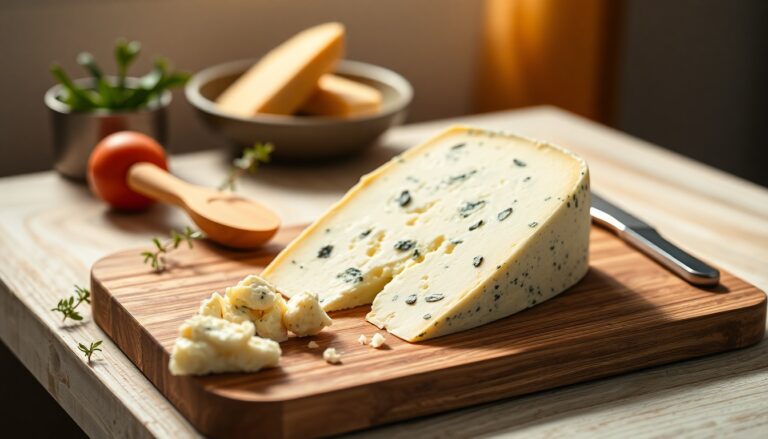
Blue cheese is a large family of veined cheeses, recognisable by their blue-green veins formed by a mould (Penicillium) introduced into the curd. Bleu d’Auvergne, bleu des Causses, Fourme d’Ambert or Gorgonzola: each has its own texture, intensity and more or less robust character. Made from cow’s milk (sometimes sheep’s), blue cheese stands out for its powerful flavour, its salty edge and its richness in fat. At around 342 kcal per 100 g, it is a generous cheese, to be enjoyed in small amounts. Well integrated, it brings protein, calcium and plenty of flavour to a balanced, indulgent diet.
Macronutrient breakdown
Nutrition table per 100 g
| Calories | 342 kcal |
| Kilojoules | 1420 kJ |
| Protein | 20,2 g |
| Carbohydrate | 2,4 g |
| Fat | 29 g |
| Fibre | 0,1 g |
Micronutrients per 100 g
All measured nutrients, ranked by share of the daily reference intake.
- Calcium551 mg69 %
- Phosphorus301 mg43 %
- Vitamin B20,55 mg39 %
- Vitamin B120,85 µg34 %
- Vitamin B954,8 µg27 %
- Zinc2,69 mg27 %
- Iodine27,1 µg18 %
- Vitamin B50,66 mg11 %
See the other 7 nutrients
- Omega-3 ALA0,19 g10 %
- Copper0,07 mg7 %
- Selenium3,73 µg7 %
- Potassium126 mg6 %
- Magnesium18,1 mg5 %
- Omega-6 LA0,35 g4 %
- Iron0,3 mg2 %
Anses Ciqual 2025. Source: Anses, 2025, Ciqual food composition table
Tips
Blue cheese is a cheese with character, enjoyed above all for its aromatic intensity. There is no need to eat a lot: a portion of 25 to 30 g is more than enough to flavour a dish or complete a cheeseboard. In terms of nutrition facts, the figures to remember are around 342 kcal, 20.2 g of protein, only 2.34 g of carbohydrates and 29 g of fat per 100 g. Its high calorie density and salt content call for moderation, especially if you are slimming.
As for cooking uses, blue cheese suits many recipes:
- crumbled over a green salad with walnuts and a light vinaigrette;
- melted into a sauce to go with pasta or a steak;
- added to a gratin, a quiche or a savoury tart;
- paired with a pear, figs or a little honey for a sweet and salty contrast.
For storage, keep it in the bottom of the fridge, wrapped in its original paper or a suitable sheet, and take it out 30 minutes before eating to bring out its aromas. Avoid sealing it in tight cling film, which spoils its veined paste.
Blue cheese is among the cheeses rich in protein and calcium, two useful nutrients for the body. If you like veined cheeses, you can vary things with Roquefort, another great classic, or discover milder cheeses such as Camembert. To explore the full diversity of this category, browse the dairy products family.
For active people: blue cheese provides useful protein, but its high fat and sodium content make it more of an occasional food, not well suited to a post-workout snack. During recovery or when gaining mass, favour more digestible, less salty sources such as 0% fromage blanc, or complete your intake with protein snack ideas. Blue cheese fits better into a balanced meal, in a small amount, for the pleasure of its taste.
Weight control: with nearly 342 kcal per 100 g and a very low glycaemic index (low carbohydrate content), blue cheese does not affect blood sugar, but its fat content remains considerable. Weigh your portion, serve it with vegetables or fresh fruit, and limit the bread that goes with it. Well measured, it remains a tasty ally of an indulgent but sensible diet.