Group · Dairy
Roquefort
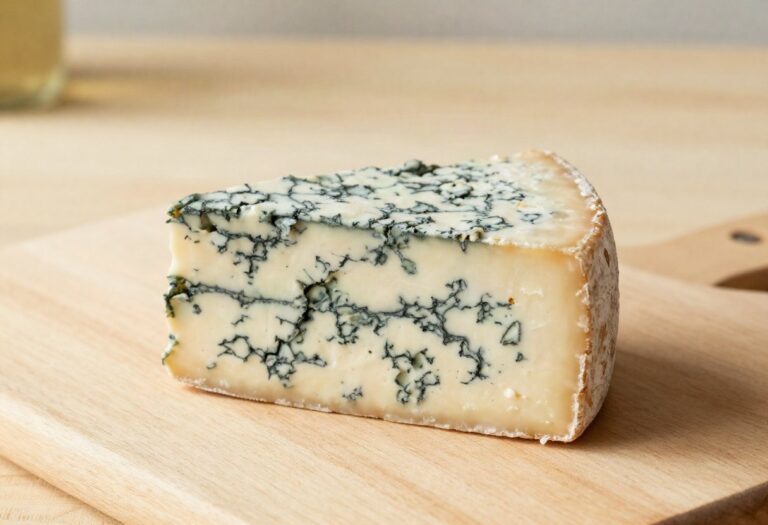
Roquefort is an emblematic blue cheese from the south of France, made from sheep’s milk and matured in the famous caves of Roquefort-sur-Soulzon. Recognisable by its blue-green marbling, which comes from Penicillium roqueforti, it has a creamy, crumbly texture and a strong, salty, slightly sharp flavour. In terms of nutrition facts, it provides 384 kcal per 100 g, with 19.1 g of protein and 33.9 g of fat, making it a rich, full-flavoured cheese. Its concentration of calcium and good-quality protein makes it worthwhile, to be enjoyed in small amounts as part of a balanced diet for its unique intensity of flavour.
Macronutrient breakdown
Nutrition table per 100 g
| Calories | 384 kcal |
| Kilojoules | 1590 kJ |
| Protein | 19,1 g |
| Carbohydrate | 2 g |
| Fat | 33,9 g |
Micronutrients per 100 g
All measured nutrients, ranked by share of the daily reference intake.
- Calcium660 mg83 %
- Phosphorus392 mg56 %
- Vitamin B20,67 mg48 %
- Iodine51,2 µg34 %
- Vitamin B120,57 µg23 %
- Zinc1,83 mg18 %
- Vitamin B929,1 µg15 %
- Omega-3 ALA0,23 g12 %
See the other 12 nutrients
- Total omega-30,26 g10 %
- Vitamin B50,62 mg10 %
- Magnesium31,9 mg9 %
- EPA0,02 g8 %
- Vitamin B60,08 mg6 %
- Potassium115 mg6 %
- Omega-6 LA0,52 g5 %
- Vitamin B30,73 mg5 %
- Vitamin B10,04 mg4 %
- Copper0,02 mg2 %
- Manganese0,02 mg1 %
- Iron0,1 mg1 %
Anses Ciqual 2025. Source: Anses, 2025, Ciqual food composition table
Tips
Roquefort is enjoyed above all for its character. A sensible portion of 20 to 30 g is plenty to enjoy its flavour benefits without weighing down your calorie count. Its high fat and sodium content calls for moderation, especially if you are watching your weight or blood pressure.
- How to eat roquefort: crumbled over a salad, melted into a sauce to go with pasta or meat, or simply on a slice of wholemeal bread. It pairs wonderfully with walnuts, pears, grapes and a drizzle of honey.
- Storage: keep it wrapped in its original paper at the bottom of the fridge, and take it out 30 minutes before eating to bring out its aromas.
- Cooking: it melts quickly, which is perfect for a creamy sauce, but avoid very high temperatures, which amplify the bitterness.
Nutritionally, roquefort provides complete protein (19.1 g per 100 g), calcium, phosphorus and B vitamins. Its carbohydrate content is almost nil and, like most cheeses, it contains no fibre. Its glycaemic index is very low. However, its high calorie density and richness in saturated fat and salt need attention if you are trying to lose weight.
If you are looking for lighter everyday alternatives, turn to 0% fat fromage blanc or a low-fat plain yoghurt, which offer protein with much less fat. To compare other blue cheeses, take a look at blue cheese, which is milder than roquefort. You can also explore the whole dairy products family to vary your sources of calcium.
For active people: roquefort provides protein that helps muscle recovery, but its high fat and sodium content makes it a poor choice just before exercise. Keep it for an evening meal or an occasional cheeseboard instead. When bulking up, a small amount can enrich a dish with good-quality calories, whereas when cutting it is better to choose fresh cheeses. To optimise your protein intake, round out your diet with varied sources, as in this article on nutrition for fitness.
In short, roquefort is an indulgent treat to enjoy in moderation: a small amount, plenty of flavour, and a real richness in minerals.
If you have diabetes: this cheese contains only traces of carbohydrate. For portion size, salt and saturated fat, see our guide to cheese and diabetes.