Group · Drinks
Water
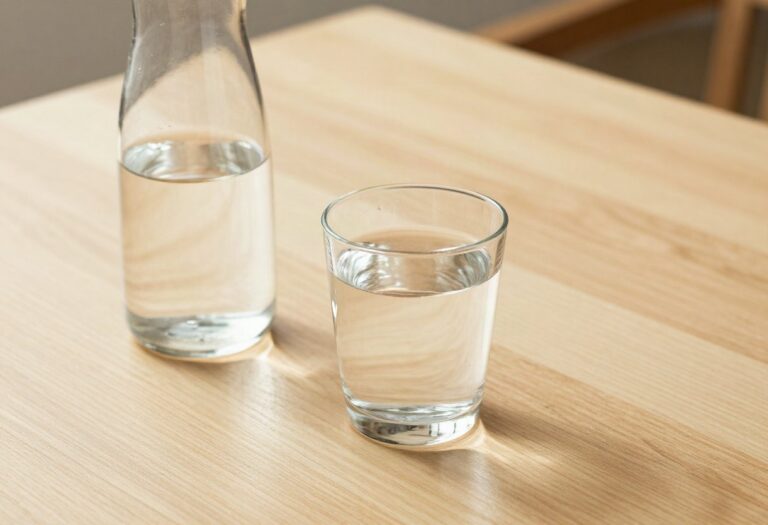
Water is the only truly essential food, and the only one that provides no energy: 0 kcal per 100 g, and no protein, carbohydrate or fat. It makes up about 60% of an adult’s body weight and plays a part in all its functions: carrying nutrients, regulating temperature and removing waste.
Tap water provides small amounts of minerals: about 7.13 mg of calcium and 0.99 mg of magnesium per 100 g, varying widely with local hardness. Its salt content is negligible (0.0076 g per 100 g).
Macronutrient breakdown
Nutrition data unavailable.
Nutrition table per 100 ml
Micronutrients per 100 ml
All measured nutrients, ranked by share of the daily reference intake.
- Copper0,02 mg2 %
- Calcium7,13 mg1 %
- Magnesium0,99 mg0 %
- Iron0,03 mg0 %
- Zinc0,01 mg0 %
- Manganese0 mg0 %
- Potassium0,73 mg0 %
Anses Ciqual 2025. Source: Anses, 2025, Ciqual food composition table
Tips
How much should you drink? French guidelines put needs at around 1 to 1.5 litres of drink a day for a sedentary adult, with the rest of the intake coming from food. These needs go up with heat, physical activity, fever and breastfeeding. Our hydration calculator gives a personalised guide.
Tap water or bottled water? Nutritionally, the difference lies in the minerals, not the calories: all waters are 0 kcal. Some mineral waters are rich in calcium or magnesium and can top up your intake; others are very low in minerals.
The real lever for weight loss. Replacing sugary drinks with water is one of the most effective and simplest changes: a cola provides around 130 kcal per 33 cl glass, whereas water provides none. See also our guide on hidden sugar.
For sportspeople. During exercise lasting less than an hour, water alone is enough. Beyond that, or in great heat, sodium losses can justify a sports drink. Drinking regularly in small amounts is more effective than drinking a lot at once.