Group · Fish
Pollock (cooked)
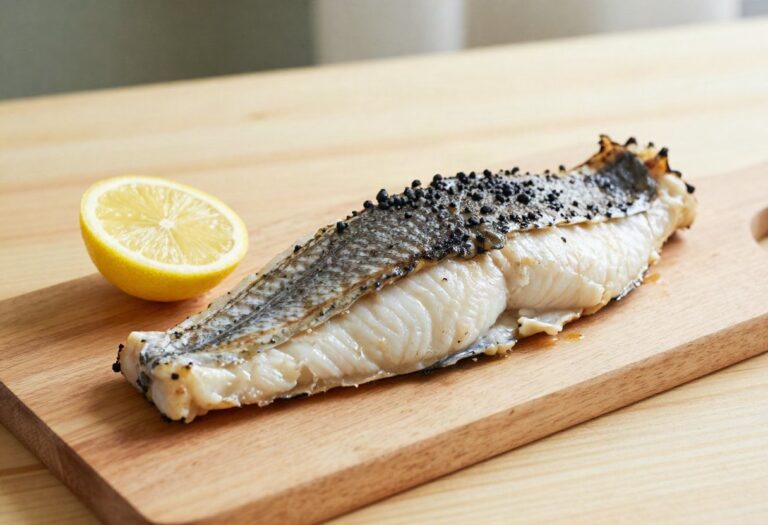
Pollock (saithe) is a North Atlantic fish, a cousin of cod, with firm white flesh that comes apart in large flakes. It is one of the most accessible white fish in France, often sold as loin or fillets, fresh or frozen.
On nutrition facts, cooked, it shows 99.7 kcal per 100 g for 23.1 g of protein and only 0.81 g of fat. It provides 23.8 µg of selenium, 152 mg of phosphorus and 2.1 µg of vitamin B12 per 100 g, the latter alone covering 84% of the reference intake.
Macronutrient breakdown
Nutrition table per 100 g
| Calories | 100 kcal |
| Kilojoules | 423 kJ |
| Protein | 23,1 g |
| Fat | 0,9 g |
Micronutrients per 100 g
All measured nutrients, ranked by share of the daily reference intake.
- DHA0,3 g120 %
- Vitamin B122,1 µg84 %
- Selenium23,8 µg43 %
- EPA0,07 g30 %
- Phosphorus152 mg22 %
- Total omega-30,39 g15 %
- Vitamin E1,7 mg14 %
- Potassium224 mg11 %
See the other 14 nutrients
- Magnesium36 mg10 %
- Iodine12 µg8 %
- Vitamin B915,2 µg8 %
- Copper0,06 mg6 %
- Zinc0,63 mg6 %
- Vitamin B60,08 mg6 %
- Vitamin B20,08 mg6 %
- Vitamin B10,06 mg5 %
- Vitamin B30,8 mg5 %
- Calcium37,5 mg5 %
- Iron0,4 mg3 %
- Vitamin B50,14 mg2 %
- Vitamin A9,25 µg1 %
- Manganese0,01 mg1 %
Anses Ciqual 2025. Source: Anses, 2025, Ciqual food composition table
Tips
One of the best protein-to-calorie ratios in the database. 23.1 g of protein for under 100 kcal: for the same amount of protein, it provides fewer calories than chicken breast. It is the typical food for a period when you are watching your energy intake without wanting to lose muscle mass.
But it is not an oily fish. With 0.81 g of fat, it provides almost no long-chain omega-3. The Anses recommendations (two portions of fish a week, one of them oily) are not met by pollock alone: sardines or mackerel fill that role.
It dries out quickly, its only flaw. Its lean flesh does not cope well with prolonged cooking. Eight to ten minutes in the oven at 180 °C for a 150 g loin, or three minutes a side in a frying pan. It is cooked when the flesh turns opaque, not when it crumbles.
It needs an accompaniment that brings some fat. A lemony yoghurt sauce, a few olives, a drizzle of olive oil to finish: this is what makes a lean fish satisfying, and it all stays very reasonable.
Buying tip. Pollock is among the species whose European stocks are generally better managed than those of cod. A sustainable fishing label on the packaging remains the simplest guide.
Sources
Average nutrition values per 100 g, given for guidance (spices and condiments are eaten in small amounts; values vary by brand and preparation).