Group · Starchy foods
Tabbouleh
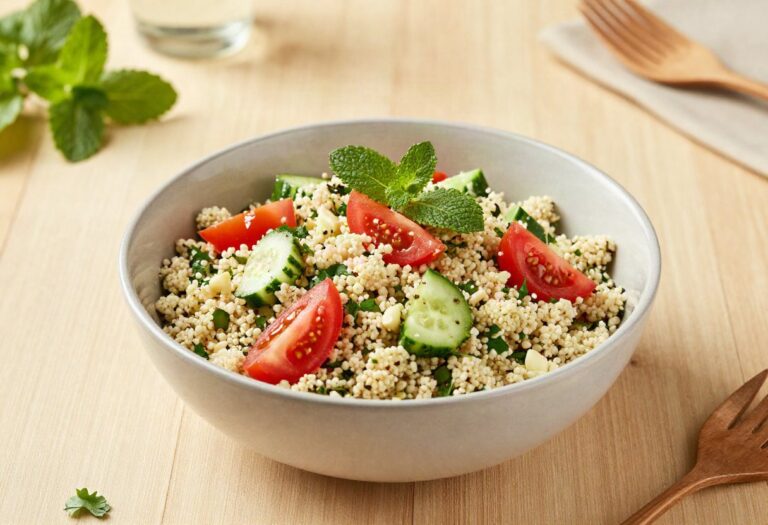
Tabbouleh as it is known in France (couscous semolina, tomato, cucumber, mint and lemon) is an adaptation. The original Lebanese tabbouleh is above all a salad of chopped parsley, in which bulgur plays only a secondary role. The difference in composition between the two is considerable.
On the nutrition side, the pre-packed version provides 179 kcal per 100 g, with 23.7 g of carbohydrate, 6.7 g of fat, 4.88 g of protein and 2.5 g of fibre. It also contains 1 g of salt per 100 g. The fat comes from the dressing oil: the semolina itself contains almost none.
Macronutrient breakdown
Nutrition table per 100 g
| Calories | 179 kcal |
| Kilojoules | 753 kJ |
| Protein | 4,9 g |
| Carbohydrate | 23,7 g |
| Fat | 6,7 g |
| Fibre | 2,5 g |
Micronutrients per 100 g
All measured nutrients, ranked by share of the daily reference intake.
- Manganese0,4 mg20 %
- Omega-3 ALA0,34 g17 %
- Copper0,16 mg16 %
- Vitamin K110,6 µg14 %
- Phosphorus80 mg11 %
- Omega-6 LA1,1 g11 %
- Potassium210 mg11 %
- Vitamin E1,26 mg11 %
See the other 12 nutrients
- Vitamin B10,09 mg8 %
- Vitamin C6,27 mg8 %
- Vitamin B914,5 µg7 %
- Magnesium25 mg7 %
- Zinc0,65 mg7 %
- Iron0,88 mg6 %
- Vitamin B50,26 mg4 %
- Vitamin B60,05 mg4 %
- Vitamin B30,5 mg3 %
- Calcium24 mg3 %
- Vitamin B20,02 mg2 %
- Vitamin A12,4 µg2 %
Anses Ciqual 2025. Source: Anses, 2025, Ciqual food composition table
Tips
Oil makes up a third of the calories. Plain cooked wheat semolina has almost no fat; shop-bought tabbouleh has 6.7 g per 100 g, seven times more. Made at home with two spoonfuls of olive oil for six people, it drops considerably, without losing flavour, as long as you go heavy on the lemon.
Reverse the proportions. This is the most useful advice for this dish: less semolina, much more parsley, mint, tomato and cucumber. You get the Lebanese tabbouleh, which is far richer in fibre and vitamins for the same volume.
The semolina does not need cooking. It swells in the lemon juice and the water from the tomatoes, in twenty minutes in the fridge. This is the traditional method, and it gives a much better texture than semolina pre-cooked in hot water.
It is easy to top up with protein. Chickpeas or feta turn it into a main dish rather than a starter. The cereal and pulse combination covers the amino acids that semolina alone does not provide.
Storage. Twenty-four hours in the fridge, no more: the vegetables release their water and the semolina goes soggy. A tabbouleh made the day before can be rescued with a little lemon and fresh herbs at the last moment.