Group · Condiments & sauces
Tzatziki
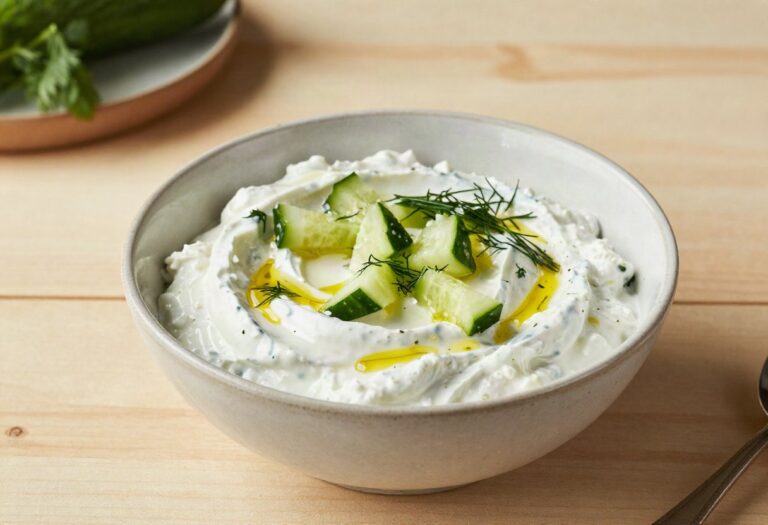
Tzatziki combines strained yoghurt, grated and squeezed cucumber, garlic, olive oil and often mint or dill. It is a Greek meze, served cold with pitta bread, raw vegetables or grilled meats.
On the nutrition side, the pre-packed version provides 138 kcal per 100 g, with 10.9 g of fat, 6.06 g of protein and 3.8 g of carbohydrate. It also provides 88 mg of calcium and 0.88 g of salt per 100 g. The fat comes from the oil and the yoghurt: the proportion of the two changes everything, as explained below.
Macronutrient breakdown
Nutrition table per 100 g
| Calories | 138 kcal |
| Kilojoules | 571 kJ |
| Protein | 6,1 g |
| Carbohydrate | 3,8 g |
| Fat | 10,9 g |
Micronutrients per 100 g
All measured nutrients, ranked by share of the daily reference intake.
- Omega-3 ALA0,93 g47 %
- Vitamin K121,4 µg29 %
- Vitamin B120,59 µg24 %
- Vitamin E2,45 mg20 %
- Omega-6 LA1,95 g20 %
- Phosphorus100 mg14 %
- Vitamin B20,19 mg14 %
- Calcium88 mg11 %
See the other 13 nutrients
- Vitamin B31,54 mg10 %
- Potassium150 mg8 %
- Vitamin B914,8 µg7 %
- Vitamin B10,05 mg4 %
- Vitamin B50,24 mg4 %
- Vitamin B60,05 mg3 %
- Zinc0,32 mg3 %
- Magnesium8,8 mg2 %
- Manganese0,04 mg2 %
- Vitamin A10,8 µg1 %
- Copper0,01 mg1 %
- Iron0,09 mg1 %
- Vitamin C0,51 mg1 %
Anses Ciqual 2025. Source: Anses, 2025, Ciqual food composition table
Tips
10.9 g of fat is not inevitable. Made with a reduced-fat Greek yoghurt and just one spoonful of olive oil per bowl, a homemade tzatziki comes out considerably lower. Industrial versions load up on oil for texture and shelf life.
Squeeze the cucumber, properly. Grated, salted for ten minutes and then wrung out by hand: this is the step that makes the difference between a sauce and a soup. A runny tzatziki tempts you to add oil to rescue it, and that is where the calories come in.
It is a good replacement for mayonnaise or white sauce. In a sandwich, on a homemade kebab or with falafels, it brings the freshness of a sauce for a fraction of the fat. This is its best nutritional use.
It gets people eating raw vegetables. Sticks of carrot, cucumber and pepper: a dip that people like genuinely changes the amount of vegetables eaten, especially with children.
Storage. Homemade, two to three days in the fridge at most: the cucumber keeps releasing its water and the garlic becomes much stronger. It is better to make it in small quantities, as it takes only ten minutes.