Group · Condiments & sauces
Mayonnaise
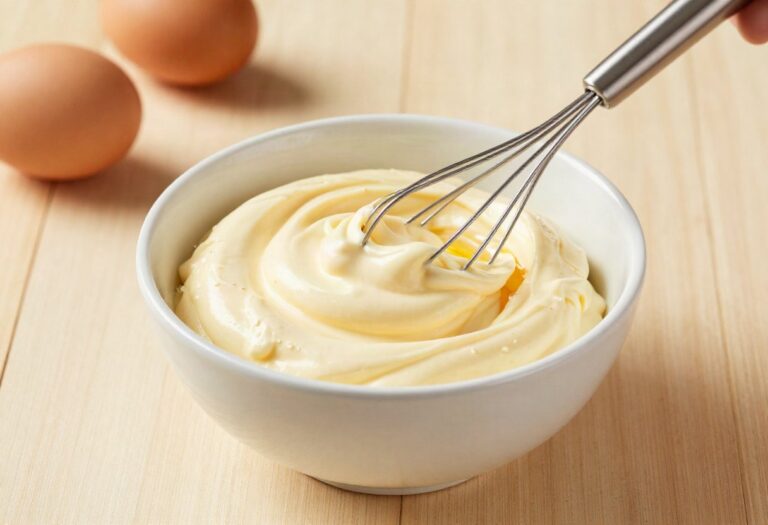
Mayonnaise is an emulsified sauce made from oil, egg yolk and vinegar or lemon juice, often livened up with mustard. Creamy and rich, it goes with raw vegetables, chips, fish, hard-boiled eggs and sandwiches. It comes as a classic shop-bought version, homemade or light, with recipes sometimes flavoured with garlic, herbs or curry. Nutritionally, it is above all a source of fat: with around 692 kcal per 100 g, it is among the most calorific condiments. Its carbohydrate and protein remain low, and it contains no fibre. Its energy density makes it a sauce to use in moderation in a balanced diet.
Macronutrient breakdown
Nutrition table per 100 g
| Calories | 692 kcal |
| Kilojoules | 2850 kJ |
| Protein | 1,4 g |
| Carbohydrate | 3,5 g |
| Fat | 74,5 g |
| Fibre | 0,3 g |
Micronutrients per 100 g
All measured nutrients, ranked by share of the daily reference intake.
- Omega-3 ALA6 g300 %
- Total omega-36,18 g247 %
- Omega-6 LA13,3 g133 %
- Vitamin K175 µg100 %
- Iodine30 µg20 %
- Vitamin B120,39 µg16 %
- Vitamin B50,23 mg4 %
- Phosphorus23 mg3 %
See the other 10 nutrients
- Iron0,34 mg2 %
- Copper0,02 mg2 %
- Vitamin B60,03 mg2 %
- Calcium17,6 mg2 %
- Magnesium6,42 mg2 %
- Vitamin A11,8 µg1 %
- Potassium28,1 mg1 %
- Zinc0,13 mg1 %
- Manganese0,02 mg1 %
- Vitamin B30,14 mg1 %
Anses Ciqual 2025. Source: Anses, 2025, Ciqual food composition table
Tips
Mayonnaise is enjoyed above all for its creaminess and its role as a flavour enhancer. Here are a few tips to enjoy it without unbalancing your plate.
- The portion: a teaspoon (about 10 g) already provides nearly 70 kcal. It is better to measure with a spoon than to dollop it freehand, especially if you are watching your weight.
- The pairings: it traditionally goes with eggs mimosa, shellfish, cold roast beef, chips and gherkins. To lighten a sandwich, replace part of the mayonnaise with plain fromage blanc or mustard.
- Homemade vs shop-bought: homemade mayonnaise lets you control the quality of the oil and the amount of salt. Remember to use very fresh eggs and to eat it quickly.
In terms of nutrition facts, mayonnaise is dominated by fat (nearly 74.5 g per 100 g). Its carbohydrate and protein content is negligible, and it provides neither fibre nor micronutrients in any notable amount. It is therefore a treat condiment, not a nutritious food as such. To reduce the calorie intake, turn to light mayonnaise, which contains markedly less fat, or to other lighter condiments such as mustard and vinegar.
Slimming tips: with its high energy density, mayonnaise should be eaten in moderation when you aim to lose weight. One trick is to mix it with plain Greek yoghurt for a sauce that is lighter, higher in protein and just as creamy. Also watch composed sauces such as tartare sauce, which derive from it and remain fatty.
For active people: mayonnaise provides a lot of calories for very little protein, which makes it a poor recovery choice. When gaining muscle cleanly, it is better to favour good sources of fat and protein rather than a condiment empty of micronutrients. A little mayonnaise is still fine to make a meal more appetising, but keep an eye on quantities. To organise yourself, you can compare the sauces in the condiments and sauces family and adjust your portions to your needs.
Storage: once opened, the jar keeps in the fridge and should be eaten within the stated time. Homemade mayonnaise, being more fragile, should be used within two to three days.