Group · Cereals & grains
Puffed wheat
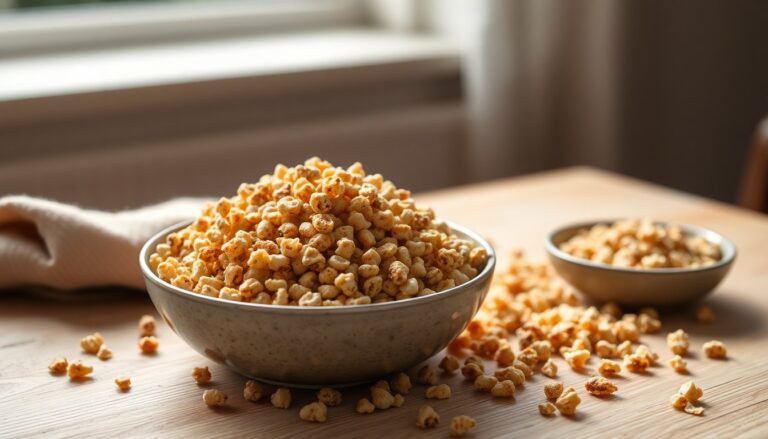
Puffed wheat is a breakfast cereal made by heating wheat grains under pressure, which makes them swell and gives them their characteristic light, crispy texture. With no added sugar in its plain version, it stands out for its simplicity and its interesting nutritional density. At around 378 kcal per 100 g, it provides mostly carbohydrate (80.5 g), a good share of plant protein (7.32 g) and a useful amount of fibre (4.4 g). You can find it plain or frosted, in a bowl with milk, with yoghurt or as a topping. Light on the scales thanks to its volume of air, it fits easily into a balanced diet, at breakfast or as a snack.
Macronutrient breakdown
Nutrition table per 100 g
| Calories | 378 kcal |
| Kilojoules | 1600 kJ |
| Protein | 7,4 g |
| Carbohydrate | 80,5 g |
| Fat | 2 g |
| Fibre | 4,4 g |
Micronutrients per 100 g
All measured nutrients, ranked by share of the daily reference intake.
- Omega-6 LA0,48 g5 %
- Omega-3 ALA0,02 g1 %
Anses Ciqual 2025. Source: Anses, 2025, Ciqual food composition table
Tips
Puffed wheat is best enjoyed at breakfast, in a bowl of milk, plant-based drink or plain yoghurt. Its lightness is deceptive: because it takes up a lot of volume for very little weight, a sensible portion is between 30 and 40 g. Weigh your amounts at first, as it is easy to pour twice as much without realising. For a filling, tasty bowl, combine it with fresh fruit, a few nuts and seeds and a touch of honey depending on your needs.
Nutrition facts and benefits. Plain puffed wheat has a good profile: complex carbohydrates for energy, around 7.32 g of plant protein and 4.4 g of fibre per 100 g, which help digestion and fullness. Bear in mind that its glycaemic index is often high, as puffing weakens the starch: pair it with a source of protein (dairy, fromage blanc) or healthy fats to slow absorption and curb cravings.
- Varieties: plain, or frosted and sweetened. Choose the version with no added sugar if you are watching your weight, and compare it with frosted puffed wheat, which is higher in calories.
- Storage: in an airtight container, away from moisture, to keep it crispy.
- Uses: in homemade muesli, as a topping on stewed fruit, or in homemade energy bars.
For active people. Rich in carbohydrates, puffed wheat is a good source of energy before moderate exercise or during carb loading. For recovery, pair it with a source of protein: Greek yoghurt, fromage blanc or a post-workout shaker to support muscle repair. To find out more about eating for training, see our guide to fitness nutrition.
Weight control. At nearly 378 kcal per 100 g, puffed wheat is a relatively calorie-dense cereal, even though a standard portion provides few calories. The real trap lies in sweetened versions and add-ons (honey, sugar, large amounts of whole milk). Go for the plain version, measured portions and low-sugar accompaniments. To compare with other options, explore the cereals family and discover oats, whose glycaemic index is generally lower. Eaten sensibly, puffed wheat can be part of a balanced, energising breakfast every day.