Group · Vegetables
Chinese cabbage
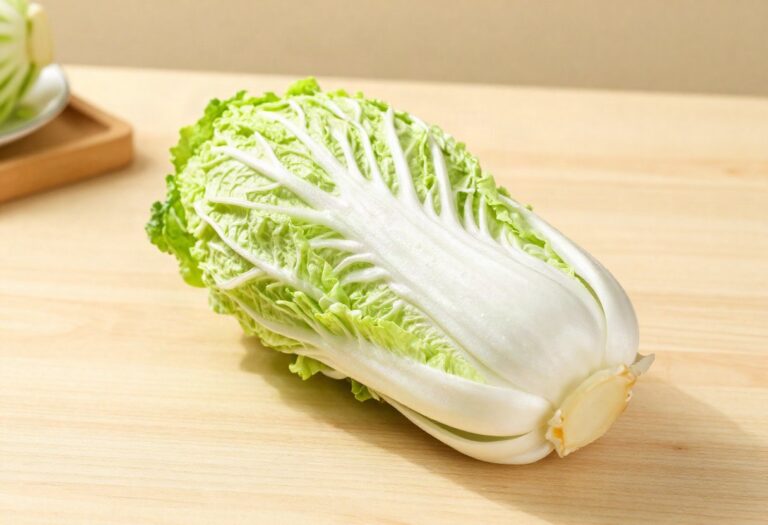
Chinese cabbage, also known as cabbage from China, pak choi or napa cabbage depending on the variety, is a leafy vegetable native to East Asia and very common in Asian cooking. Crunchy, mild and slightly sweet, it stands out for its fleshy white stalks and tender green leaves. With only 16.4 kcal per 100 g, it is one of the lightest vegetables, rich in water and fibre. Its modest carbohydrate content (1.7 g) and low calorie density make it a great choice for a balanced diet. Versatile, it can be eaten raw in salads or quickly cooked in a pan, in soups, stir-fries and broths.
Macronutrient breakdown
Nutrition table per 100 g
| Calories | 16 kcal |
| Kilojoules | 69 kJ |
| Protein | 1,7 g |
| Carbohydrate | 1,7 g |
| Fat | 0,2 g |
| Fibre | 1,3 g |
Micronutrients per 100 g
All measured nutrients, ranked by share of the daily reference intake.
- Vitamin K153,8 µg72 %
- Vitamin A147 µg18 %
- Potassium330 mg17 %
- Manganese0,25 mg13 %
- Vitamin E1,5 mg13 %
- Vitamin C9,54 mg12 %
- Calcium88 mg11 %
- Iron0,93 mg7 %
- Vitamin B9dietary folate equivalents71,9 µg
See the other 10 nutrients
- Vitamin B60,07 mg5 %
- Magnesium17 mg5 %
- Vitamin B20,06 mg4 %
- Phosphorus28 mg4 %
- Copper0,04 mg4 %
- Vitamin B50,18 mg3 %
- Zinc0,28 mg3 %
- Vitamin B10,03 mg2 %
- Vitamin B30,36 mg2 %
- Total omega-30,03 g1 %
Anses Ciqual 2025. Source: Anses, 2025, Ciqual food composition table
Tips
Chinese cabbage can be cooked in countless ways. To preserve its crunch and its nutrition facts, choose quick cooking in a wok, steaming or a brief dip in boiling water. Gentle cooking limits vitamin loss and keeps the leaves fresh. Raw and finely sliced, it adds zing to an Asian salad flavoured with sesame oil, ginger and soy sauce.
Key nutrients: Chinese cabbage is a good source of vitamin C, vitamin K, folate and provitamin A, as well as minerals such as potassium and calcium. Its fibre (1.3 g per 100 g) contributes to fullness and regular digestion without adding to the calorie intake. Its glycaemic index is low, which makes it an interesting vegetable for keeping blood sugar steady.
- Portions: allow 150 to 200 g per person as a side, more in a mixed salad.
- Pairings: it goes well with garlic, ginger, mushrooms, bamboo shoots or a piece of tofu for a complete stir-fry.
- Storage: keep it in the fridge’s vegetable drawer, wrapped in a damp cloth, and eat it within a few days.
Varieties and seasonality: there is pak choi (with white stalks and dark green leaves) and napa cabbage (elongated, with pale, tightly packed leaves). Available all year round, it is at its best in autumn and winter. You can vary things with other cruciferous vegetables such as red cabbage or broccoli, which share a richness in fibre and beneficial compounds.
For active people: light and rich in water, Chinese cabbage is an ideal accompaniment to a post-workout meal based on protein (fish, poultry, tofu) and starchy foods, while supporting hydration and micronutrient intake. When cutting or following a balanced diet, its low calorie and carbohydrate content lets you fill the plate without excess energy.
Weight control and points to watch: low in calories and filling, this vegetable fits perfectly into a weight management goal. Do watch the preparation, though: sweet sauces, deep-frying and too much oil push up the calorie bill. To go further, explore the vegetable family or check the food calorie table to put together varied, balanced meals.