Group · Fish
Swordfish
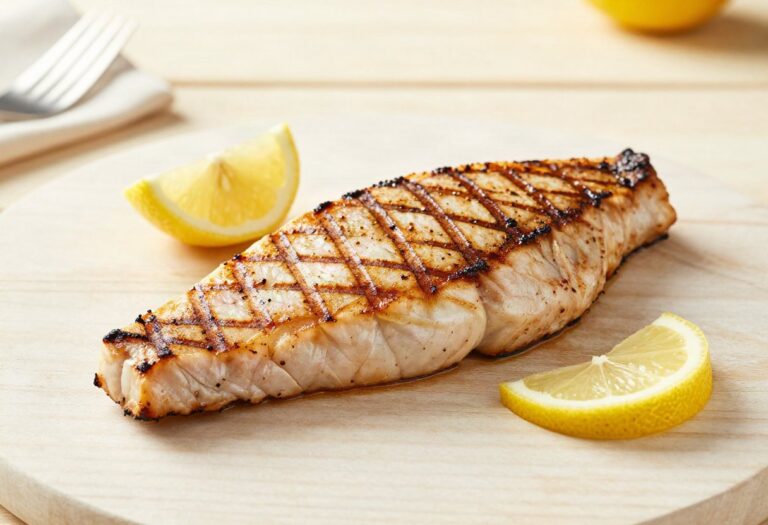
Swordfish is a large migratory fish of warm and temperate seas, recognisable by its long, sword-shaped bill. Its firm, dense flesh that does not flake easily, often sold as steaks or thick slices, appeals to barbecue fans and refined cooks alike. Nutritionally, swordfish is an interesting lean to semi-oily fish: per 100 g, it provides around 266 kcal, 28.7 g of good-quality protein, 16.9 g of fat and no carbohydrate. Rich in protein and naturally free of sugars, it fits perfectly into a balanced diet, whether you are watching your figure or looking for a solid protein intake. It is a tasty way to vary your fish sources.
Macronutrient breakdown
Nutrition table per 100 g
| Calories | 266 kcal |
| Kilojoules | 1110 kJ |
| Protein | 28,7 g |
| Fat | 16,9 g |
Micronutrients per 100 g
All measured nutrients, ranked by share of the daily reference intake.
- DHA1,31 g524 %
- Vitamin D16,6 µg332 %
- Selenium122 µg222 %
- Vitamin B122,91 µg116 %
- EPA0,2 g80 %
- Vitamin B39,8 mg61 %
- Total omega-31,51 g60 %
- Vitamin B60,62 mg44 %
See the other 15 nutrients
- Phosphorus200 mg29 %
- Potassium475 mg24 %
- Vitamin B20,13 mg9 %
- Magnesium34,1 mg9 %
- Zinc0,78 mg8 %
- Vitamin B50,46 mg8 %
- Iodine9,3 µg6 %
- Vitamin A43 µg5 %
- Copper0,05 mg5 %
- Vitamin B10,05 mg4 %
- Iron0,53 mg4 %
- Manganese0,02 mg1 %
- Vitamin B92 µg1 %
- Calcium5,5 mg1 %
- Vitamin K10,1 µg0 %
Anses Ciqual 2025. Source: Anses, 2025, Ciqual food composition table
Tips
Swordfish suits many preparations thanks to its meat-like texture, a bit like meat. A grilled steak, just seared on the griddle or pan-fried, remains a great classic: allow a portion of 120 to 150 g per person. To keep the flesh moist, as it dries out quickly, opt for brief, gentle cooking, or a marinade of olive oil, lemon, garlic and fresh herbs. Baked in parchment, on skewers or served medium-rare tataki style, it gives very different results.
In terms of nutrition facts, swordfish shines for its complete protein (around 28.7 g per 100 g), ideal for maintaining muscle, and for its total lack of carbohydrate, which gives it a glycaemic index of zero. It also provides minerals such as selenium, phosphorus and potassium, as well as B vitamins and vitamin D. Its fat includes a share of omega-3 fatty acids, welcome in a varied diet.
- Smart pairings: green vegetables, brown rice or quinoa for a complete, filling meal.
- Storage: eat it very fresh, within 24 hours, or freeze it quickly.
- Best time: at lunch or dinner, as part of a balanced diet.
For active people, swordfish is an excellent ally for recovery: its protein helps repair muscle fibres after exercise, while its moderate calorie density (266 kcal/100 g) makes it a sensible choice when cutting as well as for controlled bulking. Paired with a source of carbohydrate, it makes a balanced post-workout meal. You can top up your intake with other omega-3-rich fish such as mackerel or salmon, and explore the whole fish family for variety.
For weight control, swordfish ticks many boxes: low in calories, free of sugars and very filling. Beware of fatty preparations (creamy sauces, frying), though, which push up the calorie count. Like all large predatory fish, swordfish can accumulate mercury: it is advisable to eat it in moderation, alternating with smaller fish. To compare its calories and nutrition facts with other foods, always keep the overall balance of your plate in mind.