Group · Fruit
Nectarine
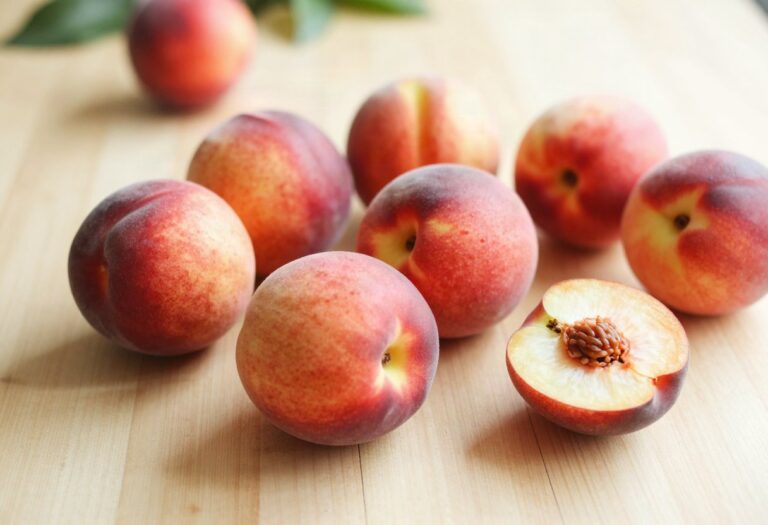
The nectarine is a delicious summer fruit, a cousin of the peach that differs from it by its smooth, shiny skin with no fuzz. It comes in white-fleshed varieties, more delicate and sweet, or yellow-fleshed ones, more fragrant and tangy. Some are clingstone (flesh sticking to the stone), others freestone. With only 49.5 kcal per 100 g, the nectarine is a light fruit, full of water, that provides fibre, vitamin C and antioxidants. Crisp or melting, it is eaten fresh in season and naturally has its place in a balanced diet, ideal for satisfying a sweet craving without too many calories.
Macronutrient breakdown
Nutrition table per 100 g
| Calories | 50 kcal |
| Kilojoules | 210 kJ |
| Protein | 0,8 g |
| Carbohydrate | 11,3 g |
| Fat | 0,4 g |
| Fibre | 0,5 g |
Micronutrients per 100 g
All measured nutrients, ranked by share of the daily reference intake.
- Potassium216 mg11 %
- Copper0,06 mg6 %
- Vitamin C3,24 mg4 %
- Vitamin B50,22 mg4 %
- Vitamin E0,42 mg4 %
- Manganese0,05 mg3 %
- Phosphorus18,6 mg3 %
- Vitamin B30,37 mg2 %
- Vitamin B9dietary folate equivalents9,74 µg
See the other 7 nutrients
- Magnesium8,04 mg2 %
- Total omega-30,03 g1 %
- Zinc0,11 mg1 %
- Vitamin A7,48 µg1 %
- Iron0,13 mg1 %
- Vitamin B20,01 mg1 %
- Calcium4,88 mg1 %
Anses Ciqual 2025. Source: Anses, 2025, Ciqual food composition table
Tips
The nectarine is best enjoyed fresh and fully ripe, simply bitten into as a snack or dessert. A portion is one medium fruit (about 130 to 150 g), which makes it a reasonable bite when you are watching your weight. Choose one that gives slightly under your finger and has a pronounced scent: a nectarine picked too early will stay floury and not very sweet.
In terms of nutrition facts, it stays low in calories at 49.5 kcal per 100 g, with about 11.3 g of carbohydrate, 0.47 g of fibre and little fat. Its moderate glycaemic index and richness in water make it a thirst-quenching fruit. It provides vitamin C, potassium, beta-carotene (especially the yellow-fleshed varieties) and polyphenols, compounds also found in antioxidant foods.
In the kitchen, the nectarine has a thousand uses: in a fruit salad with strawberry and apricot, roasted in the oven with a hint of honey, griddled to go with white meat, or blended into a smoothie or coulis. Its close relative, the peach, is used in a similar way. Just avoid the versions in syrup, which are sweeter, if you are after lightness.
- Seasonality: peak season runs from June to September, when its value for money and flavour is at its best.
- Storage: at room temperature to finish ripening, then in the fridge for a few days. You can also freeze it in wedges.
- Smart pairing: with a plain yoghurt or fromage blanc for a filling, higher-protein snack.
For active people: the nectarine is an excellent snack before exercise thanks to its easily absorbed carbohydrates and its water content, which helps with hydration. After training, pair it with a source of protein (fromage blanc, a protein shake, dried fruit) to support recovery. You can take inspiration from our high-protein snack ideas to work it in cleverly.
To explore other seasonal fruits and compare their nutrition, browse the fruit family. The nectarine remains one of the lightest options: the main thing to watch is quantity, because even a low-calorie fruit eaten in large numbers ends up counting. One to two portions a day, as part of a varied diet, are more than enough to enjoy its benefits and its summer freshness.