Group · Fruit
Prune
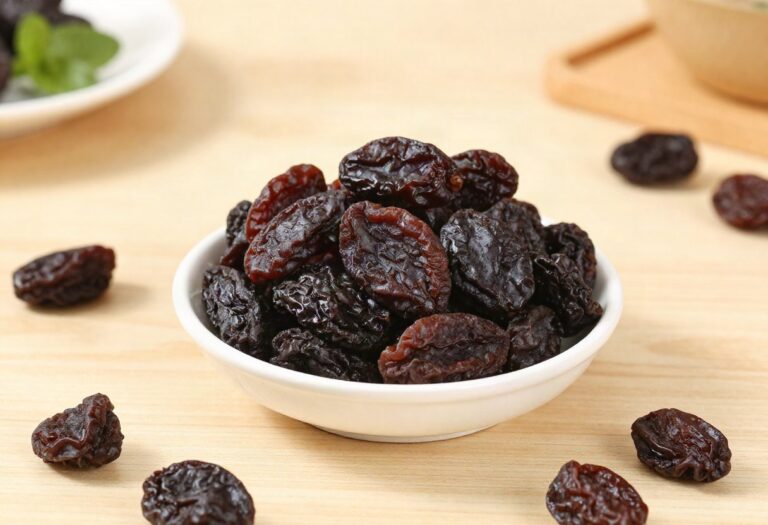
The prune is a dried plum, usually from the Ente variety, famous in particular under the name pruneau d’Agen. This dried fruit, with its soft, sweet flesh, stands out for its dark colour and concentrated flavour. Rich in carbohydrates, it is one of the most popular dried fruits in cooking, in both sweet and savoury dishes. In a balanced diet, the prune provides quickly available energy and is a handy snack. At around 229 kcal per 100 g, it remains an energy-dense food, to be enjoyed in moderation. On this page, find out about its nutrition facts, its benefits and our tips for eating it sensibly.
Macronutrient breakdown
Nutrition table per 100 g
| Calories | 229 kcal |
| Kilojoules | 969 kJ |
| Protein | 1,7 g |
| Carbohydrate | 55,4 g |
| Fat | 0,4 g |
| Fibre | 5,1 g |
Micronutrients per 100 g
All measured nutrients, ranked by share of the daily reference intake.
- Potassium610 mg31 %
- Copper0,23 mg23 %
- Vitamin B60,25 mg18 %
- Vitamin K112,8 µg17 %
- Manganese0,25 mg13 %
- Phosphorus66 mg9 %
- Magnesium30 mg8 %
- Vitamin B50,38 mg6 %
- Vitamin B9dietary folate equivalents2,5 µg
See the other 11 nutrients
- Calcium50 mg6 %
- Vitamin A32,8 µg4 %
- Vitamin E0,41 mg3 %
- Zinc0,28 mg3 %
- Iron0,38 mg3 %
- Vitamin B30,43 mg3 %
- Vitamin B10,03 mg3 %
- Vitamin B20,03 mg2 %
- Total omega-30,03 g1 %
- Iodine1,1 µg1 %
- Omega-6 LA0,05 g1 %
Anses Ciqual 2025. Source: Anses, 2025, Ciqual food composition table
Tips
The prune can be eaten as it is, as a snack, or cooked in countless ways. Allow a reasonable portion of 3 to 5 prunes (about 30 g) to benefit from its energy without overdoing it. You can rehydrate it in tea or warm water for a melt-in-the-mouth texture, add it to porridge, a yoghurt or a compote, or slip it into savoury dishes such as a lamb tagine or rabbit with prunes.
- Nutrition facts: with 229 kcal and nearly 55.4 g of carbohydrate per 100 g, the prune is concentrated in natural sugars. Its energy density comes from dehydration, which concentrates the nutrients.
- Minerals and vitamins: it provides potassium, magnesium, iron and antioxidant compounds.
- Storage: keep it in an airtight container, away from light and moisture, to preserve its softness.
As for benefits, the prune is traditionally valued for its sugars and its role in everyday digestive comfort, as part of a varied diet and good hydration. If you are watching your weight, keep its sugar concentration in mind: a few prunes as a snack are better than a big handful nibbled absent-mindedly. To compare, see our food calorie table and sort through the other dried fruits.
For active people, the prune is an excellent energy ally. Its richness in carbohydrates makes it an ideal snack before an endurance session or during a long outing, much like a homemade bar. After training, paired with a source of protein (fromage blanc, nuts), it helps replenish glycogen stores. You can work it into high-protein snack recipes for a tasty recovery. Its potassium is useful after sweating, as long as you drink enough.
The prune belongs to the broad fruit family of dried fruits. If you are looking for alternatives, try dried apricot or dried date, just as handy as snacks. To enjoy the flavour of fresh plum, which is lower in calories, turn to the plum in season. In short, the prune is a concentrate of pleasure and energy: a valuable food to portion according to your goals.