Group · Fruit
Dried apricots
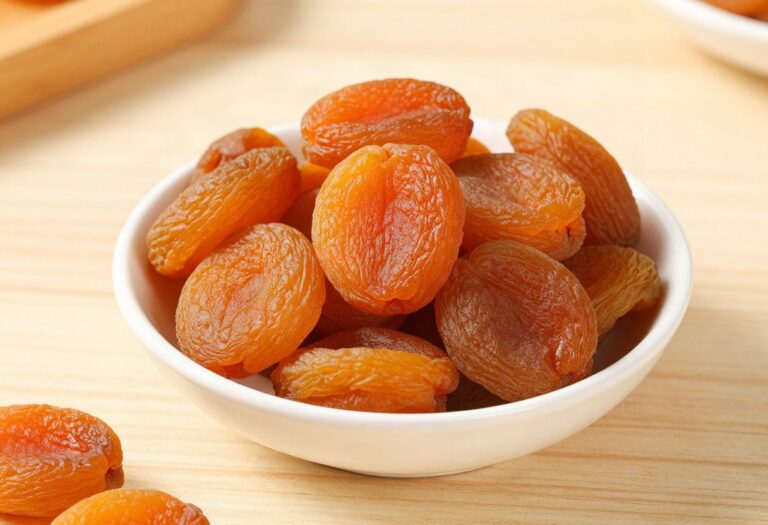
The dried apricot is a dehydrated fruit made from fresh apricot, from which most of the water is removed. This concentration gives it a soft texture, an amber colour and an intense flavour, both sweet and slightly tart. It is found as whole halves or in strips, sometimes treated with sulphur dioxide to keep their orange colour, sometimes organic and darker. Rich in fibre, natural carbohydrate and minerals such as potassium, it is a practical, nourishing snack. At 239 kcal per 100 g, the dried apricot is an energy-dense fruit that has its place in a balanced diet, as long as you measure portions carefully.
Macronutrient breakdown
Nutrition table per 100 g
| Calories | 239 kcal |
| Kilojoules | 1010 kJ |
| Protein | 2,9 g |
| Carbohydrate | 59,1 g |
| Fat | 0,5 g |
| Fibre | 8,3 g |
Micronutrients per 100 g
All measured nutrients, ranked by share of the daily reference intake.
- Potassium1400 mg70 %
- Vitamin E5,52 mg46 %
- Copper0,45 mg45 %
- Vitamin B60,48 mg34 %
- Manganese0,27 mg14 %
- Vitamin B50,69 mg12 %
- Phosphorus79 mg11 %
- Magnesium41 mg11 %
- Vitamin B9dietary folate equivalents8,85 µg
See the other 8 nutrients
- Iron1,4 mg10 %
- Calcium71 mg9 %
- Vitamin B31,12 mg7 %
- Zinc0,35 mg4 %
- Total omega-30,08 g3 %
- Omega-3 ALA0,06 g3 %
- Omega-6 LA0,09 g1 %
- Vitamin A3,89 µg0 %
Anses Ciqual 2025. Source: Anses, 2025, Ciqual food composition table
Tips
Its high calorie density comes from dehydration: the sugars and nutrients are concentrated. To enjoy its benefits without overdoing it, a sensible portion is around 25 to 30 g, or 4 to 6 halves. Keep its nutritional values in mind: around 59.1 g of carbohydrate, 8.3 g of fibre and only 0.5 g of fat per 100 g.
How to eat dried apricots?
- As a snack just as they are, or rehydrated in a little warm water for a softer texture.
- Chopped into porridge, muesli, yoghurt or a salad.
- In savoury dishes, in a tagine, a couscous or with slow-cooked meats.
- In baking, in a cake, homemade bars or energy balls.
Key nutrients and uses. Dried apricots provide potassium, non-haem iron, beta-carotene and fibre that contribute to digestive comfort and fullness. Their glycaemic index is moderate, but their concentrated sugars call for restraint, especially if you are watching your weight. To limit added sugars, choose dried apricots with no added sugar and check the ingredients list. Store them in an airtight container, away from light and heat.
Tips for active people. This is a quick, easy-to-carry source of energy. A few halves before a session provide absorbable carbohydrates, while after exercise they help replenish glycogen stores. Pair them with nuts for a complete snack, for example taking inspiration from these protein snack ideas. For a gentler carbohydrate top-up, alternate with a banana or raisins, also popular during endurance effort.
Varieties and alternatives. If you like dried fruit, explore the dried fig or the dried date, both rich in fibre and energy. To compare with the fresh version, take a look at the regular apricot. And to discover other sweet, nourishing options, browse the whole family of fruits.
In short, the dried apricot is a practical, tasty ally, full of fibre and minerals. The key remains moderation: a few pieces are enough to fill up on flavour and energy without weighing down your day’s calorie intake.