L-glutamine: benefits, muscle recovery, gut health and side effects
The short answer
L-glutamine is an amino acid your body makes on its own, and every protein on your plate contains some. It fuels gut cells and some immune cells, which explains its reputation. For healthy athletes, the evidence is weak: a meta-analysis of 25 trials found no effect on performance, body composition or immunity. For the gut, data are limited but more interesting: one randomised trial showed a clear benefit in a specific type of irritable bowel syndrome, at 15 g a day. It is well tolerated at usual doses, but it is not harmless for some patients.
This article is for information and does not replace medical advice. If you have a digestive, liver or kidney condition, talk to your doctor before taking glutamine.
What is L-glutamine?
Glutamine is one of the 20 amino acids that make up proteins. The “L” refers to the natural form, the one your body uses, so “glutamine” and “L-glutamine” mean the same thing on a label. It is called non-essential because your muscles and other organs produce plenty of it. It can become conditionally essential under severe stress (major burns, big surgery, intensive care), when needs outstrip production.
In the body, it fuels fast-renewing cells (the gut lining, lymphocytes), carries nitrogen between organs and helps with acid-base balance. You eat it every day, since all proteins contain it: meat, fish, eggs, dairy, pulses, tofu. Our guide highest protein foods lists the best sources. If you eat enough protein, you are not “running low” on glutamine.
Do not confuse it with glutamate (the flavour enhancer MSG) or with gluten: three different things. See is MSG safe?
What does glutamine do for muscle recovery?
This is the most common use in the gym, and the one with the most disappointing evidence.
The key meta-analysis: no effect on performance
An Iranian team (Ramezani Ahmadi et al., Clinical Nutrition, 2019) reviewed 47 studies in adult athletes and pooled 25 trials in a meta-analysis.
| Outcome | Effect of glutamine |
|---|---|
| Aerobic performance (VO2 max) | No effect |
| Lean mass, fat mass | No effect |
| White blood cells, lymphocytes | No effect |
| Neutrophils | Lower, only above 200 mg per kg of body weight |
| Body weight | -1.36 kg on average, an isolated finding |
The authors’ conclusion is plain: overall, glutamine has no effect on athletes’ immune system, aerobic performance or body composition. The small weight drop is not explained by a change in fat or lean mass, so it does not make glutamine a weight loss supplement.
Exercise physiologist Michael Gleeson (Loughborough University) reached the same conclusion back in 2008: you can keep blood glutamine steady during long exercise, but that does not prevent the temporary dip in immunity afterwards. The usual reasons to take it (immunity, glycogen, anti-catabolic effect) have received little support from well-controlled studies in healthy, well-fed people.
Muscle soreness: one small encouraging trial
A Canadian trial (Legault et al., 2015) gave 16 young adults 0.3 g of glutamine per kg per day (about 21 g for a 70 kg person) for 3 days after a very damaging leg workout. Strength came back slightly faster and soreness was lower (2.6 versus 3.9 on the pain scale at 48 hours). Interesting, but the trial is small and short, and the dose is about four times what typical products provide.
In practice: recovery mostly depends on enough protein and carbs around training, and good sleep. See what to eat before and after exercise and nutrition for muscle gain. If you want a supplement with solid evidence for strength, creatine is far better studied.
L-glutamine for gut health: limited data, one striking trial
The gut lining uses glutamine as fuel, hence the idea that it could repair a “leaky gut” (increased intestinal permeability). Human trials paint a mixed picture.
Intestinal permeability: no clear effect
A 2024 meta-analysis (Abbasi et al., Amino Acids) pooled 10 placebo-controlled trials with 352 participants, published between 1998 and 2014, in adults with various conditions. Overall, glutamine did not change intestinal permeability. A subgroup analysis hints at an effect with very high doses (over 30 g a day) over short periods, but it rests on a few old trials. That is not proof.
Post-infection irritable bowel syndrome: a very positive trial
The most quoted trial appeared in Gut (Zhou et al., 2019). It enrolled adults who developed diarrhoea-predominant IBS after a gut infection and whose gut had become too permeable.
| Point | What the trial showed |
|---|---|
| Participants | 106 adults (54 glutamine, 52 placebo), double-blind |
| Dose | 5 g three times a day, 15 g a day, for 8 weeks |
| Clear symptom improvement | 79.6% of patients on glutamine versus 5.8% on placebo |
| Bowel movements per day | 2.9 versus 5.4 on placebo |
| Intestinal permeability | Back to normal with glutamine, not with placebo |
| Tolerance | Few side effects, similar to placebo |
The limits: it is a single trial in one specific form of the condition, and the authors themselves call for larger trials. The results do not automatically apply to everyday bloating, other types of IBS or Crohn’s disease. For IBS, the low FODMAP diet remains the best-studied dietary approach, and our guide probiotics and gut microbiota covers the other common option.
L-glutamine side effects and who should avoid it
Healthy adults: well tolerated
According to Gleeson’s review (2008), single intakes of 20 to 30 g cause no problems in healthy adults, and athletes took 28 g a day for 14 days with no reported harm. In a 48-week trial in sickle cell disease (Niihara et al., 2018), mild nausea, fatigue and muscle or non-cardiac chest pain were slightly more common with glutamine than placebo, at a much higher dose (0.3 g per kg, twice a day).
Long-term, high doses: open questions
Biochemist Milan Holeček listed in 2013 the theoretical effects of long-term high intakes (around 40 g a day): amino acid imbalance, more ammonia and glutamate, a rebound effect on stopping. These are hypotheses, not effects seen in users, but they are a good reason to stick to studied doses rather than take glutamine for years without a reason.
Intensive care: a serious warning
In the REDOXS trial (Heyland et al., New England Journal of Medicine, 2013), 1,223 ICU patients with multiple organ failure received high doses of glutamine by drip and feeding tube. In-hospital and 6-month mortality were higher in the glutamine groups. This does not apply to a gym supplement, but it shows that a high-dose amino acid is not neutral in sick people.
Glutamine and cancer
Some cancer cells use a lot of glutamine in the lab. No human study shows that supplemental glutamine promotes cancer, but the question is not settled (Holeček raises it too). If you have or have had cancer, do not take glutamine without your oncologist’s agreement.
Who should avoid it or ask first?
- Liver disease (cirrhosis, encephalopathy) or kidney disease: glutamine produces ammonia and nitrogen to clear;
- pregnancy and breastfeeding: no data, so avoid without medical advice;
- children: no supplement use without a prescription;
- current or past cancer, intensive care, major surgery: a medical decision only.
How to take L-glutamine (studied doses)
- Trial doses: 15 g a day (5 g three times) in the IBS trial; 0.3 g per kg a day (about 20 g) in the soreness trial. Retail products often suggest 5 g a day, a lower dose than in the studies.
- Timing: no time of day has shown a clear advantage. Around training for athletes, or spread through the day as in the gut trial.
- How: the powder dissolves in a glass of water or juice.
- Duration: trials last from a few days to 8 weeks. After that, take stock: if you notice no difference, there is no point carrying on.
For perspective: a serving of protein powder or a protein-rich meal already provides glutamine. If you use whey, our best whey protein comparison can help you choose.
Nutrition•pro: pure L-glutamine powder
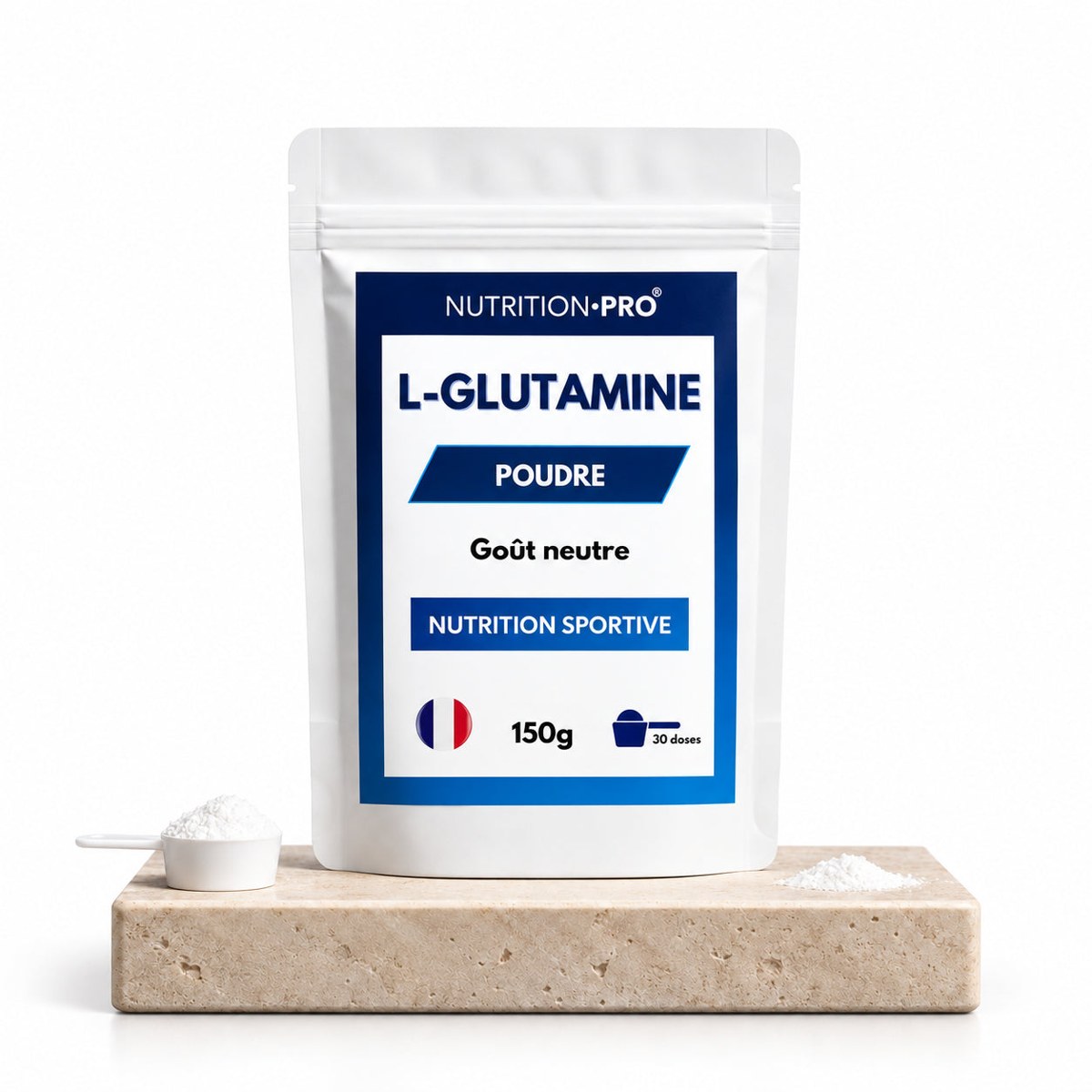
Nutrition•pro is a French brand that says it designs and makes its formulas in France. Its L-Glutamine keeps things simple:
- 100% L-glutamine powder, with no additives, colourings or fillers according to the product page;
- unflavoured and easy to dissolve in water or juice, with a measuring scoop;
- 5 g a day (1 scoop), or 2.5 g before and 2.5 g after training for athletes;
- 150 g pouch, 30 servings, a 30-day course;
- €22.99 per pouch (price checked on 22/11/2026), about €0.77 a day.
Product dose versus study doses: 5 g a day is a comfortable, well-tolerated amount, but three times less than the 15 g of the IBS trial and about four times less than the soreness trial. The powder format has one advantage: you can adjust the amount with your doctor if a higher dose has been suggested to you. The brand advises against use in pregnancy, breastfeeding, and kidney or liver disease unless medically advised, in line with the precautions above.
Promo code: SEOCONSULTINGSL for 10% off your order, €20.69 per pouch, about €0.69 a day (as of 22/11/2026).
See Nutrition•pro L-Glutamine →
Partner link: we earn a commission if you order through this link, at no extra cost to you.
Our pick: Natural L-Glutamine Dynveo (Dynveo) See the product → Partner link
Frequently asked questions
What is L-glutamine good for?
It fuels the gut and immune cells, but as a supplement its proven benefits are thin. In healthy athletes, no effect on performance or body composition. The strongest result concerns one specific type of IBS that started after a gut infection, at 15 g a day, in a single trial.
Does L-glutamine help with bloating?
No study has shown it for everyday bloating. In the post-infection IBS trial, gut symptoms improved markedly, but in a very specific group of patients. If you bloat often, look at your diet first (FODMAPs, fibre, meal timing) and talk to your doctor.
Is it safe to take glutamine every day?
At usual doses (5 to 15 g a day) for a few weeks, it is well tolerated in healthy adults. Daily high doses for years have not been studied: better to take it in courses and check it actually helps you.
Does L-glutamine help with weight loss?
Not in any useful way. A meta-analysis in athletes found an average 1.36 kg drop in weight, with no change in fat mass: an isolated finding the authors do not present as a slimming effect.
When is the best time to take glutamine?
No timing has proven superior. Athletes often take it around training; in the gut trial, it was split into three doses through the day.
Sources
- Ramezani Ahmadi A. et al. The effect of glutamine supplementation on athletic performance, body composition, and immune function: A systematic review and a meta-analysis of clinical trials. Clin Nutr, 2019; 38(3): 1076-1091. PubMed 29784526
- Gleeson M. Dosing and efficacy of glutamine supplementation in human exercise and sport training. J Nutr, 2008; 138(10): 2045S-2049S. PubMed 18806122
- Legault Z. et al. The Influence of Oral L-Glutamine Supplementation on Muscle Strength Recovery and Soreness Following Unilateral Knee Extension Eccentric Exercise. Int J Sport Nutr Exerc Metab, 2015; 25(5): 417-26. PubMed 25811544
- Abbasi F. et al. A systematic review and meta-analysis of clinical trials on the effects of glutamine supplementation on gut permeability in adults. Amino Acids, 2024; 56(1): 60. PubMed 39397201
- Zhou Q. et al. Randomised placebo-controlled trial of dietary glutamine supplements for postinfectious irritable bowel syndrome. Gut, 2019; 68(6): 996-1002. PubMed 30108163
- Heyland D. et al. A randomized trial of glutamine and antioxidants in critically ill patients. N Engl J Med, 2013; 368(16): 1489-97. PubMed 23594003
- Niihara Y. et al. A Phase 3 Trial of l-Glutamine in Sickle Cell Disease. N Engl J Med, 2018; 379(3): 226-235. PubMed 30021096
- Holeček M. Side effects of long-term glutamine supplementation. JPEN J Parenter Enteral Nutr, 2013; 37(5): 607-16. PubMed 22990615