Melatonin: side effects, dosage and does it work?

The short answer
Melatonin is the hormone that tells your body clock it is night. As a supplement it works best for jet lag; for falling asleep the effect is real but small, about 7 minutes faster on average. The EU recognises an effect on falling asleep at 1 mg taken close to bedtime, and on jet lag from 0.5 mg. Doses above 5 mg bring no extra benefit for jet lag. It is not for everyone: the French food safety agency (Anses) advises against it during pregnancy and breastfeeding, in children and teens, with inflammatory or autoimmune diseases, and before activities that need alertness.
This article is for information and does not replace medical advice. If you take medication, have a chronic condition or have had insomnia for more than a few weeks, talk to your doctor or pharmacist first.
What is melatonin and what does it do?
Melatonin is made by the pineal gland in the brain. Levels rise in the evening as light fades and drop in the morning. It does not knock you out like a sleeping pill: it sets the time for your body. That is why it helps most when your clock is off (travel, very late bedtimes) and much less when poor sleep has other causes (stress, pain, caffeine, sleep apnea).
In the US it is sold over the counter, often at 3, 5 or 10 mg, including gummies. In France, supplements usually stop at 1.9 mg, and a 2 mg prolonged-release medicine (Circadin) is approved for primary insomnia in people aged 55 and over.
Does melatonin work? What the studies show
Falling asleep: a real but modest effect
The reference meta-analysis (Ferracioli-Oda et al., 2013) pooled 19 placebo-controlled trials with 1,683 people with sleep disorders. Melatonin cut the time to fall asleep by 7 minutes and added 8 minutes of sleep per night, with a small gain in perceived quality. The effect is smaller than with sleeping pills, but it did not fade over time and side effects were milder.
Jet lag: the best-proven use
A Cochrane review (Herxheimer and Petrie, 2002) found that 9 of 10 trials showed melatonin, taken at local bedtime (10 pm to midnight), reduced jet lag after flights across 5 or more time zones. Only 2 travellers need to take it for one to benefit.
- doses of 0.5 to 5 mg work similarly; 5 mg helps people fall asleep a bit faster; above 5 mg, no added benefit;
- 2 mg slow-release seemed less effective: a short peak works better for jet lag;
- benefit is greater flying east and across more time zones;
- taken at the wrong time, during the day, it can cause sleepiness and delay adjustment.
| Use | What studies show | Evidence |
|---|---|---|
| Jet lag (5+ time zones) | 9 of 10 trials positive; 0.5 to 5 mg at local bedtime | Good |
| Trouble falling asleep | About 7 minutes faster, 8 minutes more sleep | Moderate, small effect |
| Insomnia, age 55+ | 2 mg prolonged-release medicine, up to 13 weeks | Approved indication (EU medicine) |
| Night waking, “deep” sleep | Little solid data | Insufficient |
To compare bedtime supplements, see our best sleep supplement comparison.
Melatonin dosage: how much should I take?
| Reference | Dose | Use |
|---|---|---|
| EU health claim | 1 mg close to bedtime | Falling asleep |
| EU health claim | At least 0.5 mg close to bedtime, first day of travel and a few days after arrival | Jet lag |
| Circadin (EU medicine) | 2 mg prolonged-release, 1 to 2 h before bed, after food, up to 13 weeks | Primary insomnia, 55+ |
| Jet lag trials | 0.5 to 5 mg; no gain above 5 mg | Jet lag |
How much melatonin is too much? A review of trials at 10 mg or more (Menczel Schrire et al., 2022; 79 studies, 3,861 adults) found no detectable rise in serious adverse events, but only 4 studies were reliable enough to judge, and high doses increased drowsiness, headache and dizziness. There is no evidence that 10 or 20 mg helps you sleep better than a small, well-timed dose.
Labels are not always accurate: tests of 31 products sold in Canada (Erland and Saxena, 2017) found 83% less to 478% more melatonin than stated, lot-to-lot swings of up to 465%, and serotonin in 8 products. Brands that publish batch tests have an edge.
Melatonin side effects: is melatonin bad for you?
Who should avoid melatonin
In 2018, after about 90 adverse event reports to its nutrivigilance scheme, the French agency Anses advised against melatonin supplements, or only with medical advice, for:
- pregnant and breastfeeding women;
- children and teenagers;
- people with inflammatory or autoimmune diseases;
- people with epilepsy, asthma, mood, behaviour or personality disorders;
- people on medication;
- anyone who needs to stay alert (driving, machinery).
Can you take melatonin while pregnant? The Circadin label advises against it in pregnancy and while breastfeeding, as no clinical data exist and melatonin likely passes into breast milk. Ask your doctor or midwife.
Drug interactions
| Combination | What to know |
|---|---|
| Fluvoxamine (antidepressant) | Raises melatonin exposure 17-fold: avoid |
| Sleeping pills (benzodiazepines, zolpidem, zopiclone) | Sedation may be increased |
| Alcohol | Avoid: it reduces the effect on sleep |
| Warfarin, epilepsy | Case reports of harm: medical advice |
Melatonin and heart failure: the 2025 study
In November 2025, a study presented at the American Heart Association’s Scientific Sessions made headlines. In health records of 130,828 adults with insomnia, those with melatonin recorded for a year or more had heart failure more often over 5 years: 4.6% vs 2.7%, about 90% higher. But it is an observational study and not peer reviewed; it cannot show cause and effect. The authors note they lacked data on insomnia severity and psychiatric conditions, and that over-the-counter use in the US was not captured, so many “non-users” may have taken melatonin. It is a signal to watch, not proof, and one more reason to avoid long-term nightly use without medical advice.
Liver, weight gain and common side effects
The liver clears melatonin; in liver failure it builds up, so the Circadin label advises against it. Abnormal liver tests and weight gain are listed as uncommon side effects (fewer than 1 in 100). In Circadin trials, the most frequent complaints (headache, sore throat, back and joint pain) were as common on placebo.
How to take melatonin
- To fall asleep: around 1 mg, 30 to 60 minutes before your target bedtime, at a fixed time, with dim light and no screens.
- For jet lag: 0.5 to 5 mg at local bedtime, from the travel day to 2 to 5 days after arrival. Never during the day.
- How long does melatonin last? Use it occasionally, for days to a few weeks; beyond that, see a doctor.
- No alcohol, no driving after taking it, and don’t stack it with sleeping pills or sedative herbs.
- Hormone-free options: glycine, magnesium glycinate or passionflower, each with its own limits; see also foods that help you sleep.
Dynveo: plant-based melatonin in two strengths
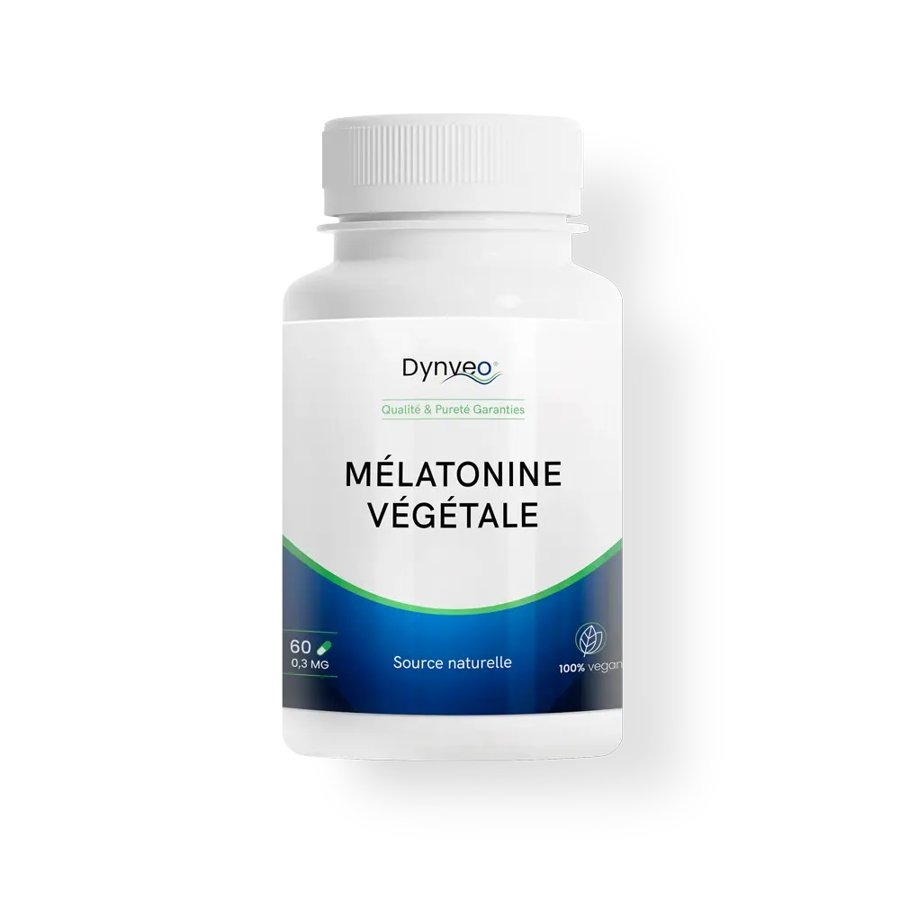
For occasional use, Dynveo’s Mélatonine végétale stands out for its choice of strengths and its transparency on batch testing:
- melatonin extracted from St John’s wort (dry extract standardised to 1%) using water and ethanol, no synthetic melatonin;
- two strengths: 0.3 mg for regular use and 1.9 mg for jet lag;
- published batch tests checking melatonin content and the absence of hypericin and hyperforin (St John’s wort’s active compounds), heavy metals and pesticides; the brand says it fills the capsules in its own lab in southern France and claims French manufacturing;
- 1 capsule in the evening, 30 minutes before bed; for jet lag, one 1.9 mg capsule at local bedtime from the travel day to 2 to 5 days after arrival;
- 60 capsules (2 months): €12.90 for 0.3 mg (about €0.22 a day) and €23.90 for 1.9 mg (about €0.40 a day), prices checked on 22/11/2026.
How do the doses compare? 1.9 mg sits within the 0.5 to 5 mg range of the jet lag trials, and the brand also limits it to short use. 0.3 mg is deliberately low, below the 1 mg of the EU sleep claim: a gentle option rather than a proven dose. The studies above did not test this product.
The label’s warnings mirror Anses advice: not for inflammatory or autoimmune disease, pregnancy, breastfeeding, children or before tasks needing alertness; medical advice for epilepsy, asthma, mood disorders or ongoing treatment.
See Dynveo Plant-Based Melatonin →
Partner link: we earn a commission if you order through this link, at no extra cost to you.
Frequently asked questions
Does melatonin work for sleep?
Yes, but modestly: about 7 minutes faster to fall asleep on average. It works much better for jet lag.
How much melatonin should I take?
Around 1 mg close to bedtime for sleep onset; 0.5 to 5 mg at local bedtime for jet lag. More is not better.
Is 20 mg of melatonin too much?
There is no evidence it works better than low doses, and high doses bring more drowsiness, headache and dizziness. For jet lag, trials show no gain above 5 mg.
Is melatonin linked to heart failure?
A 2025 observational study found an association with long-term use, but it was not peer reviewed and cannot prove cause. Avoid long-term nightly use without medical advice.
Is melatonin safe every night?
Trials over a few months show no loss of effect or dependence, and the EU medicine is limited to 13 weeks. Long-term data are lacking.
Sources
- Ferracioli-Oda E., Qawasmi A., Bloch M.H. Meta-analysis: melatonin for the treatment of primary sleep disorders. PLoS One, 2013; 8(5): e63773. PubMed 23691095
- Herxheimer A., Petrie K.J. Melatonin for the prevention and treatment of jet lag. Cochrane Database Syst Rev, 2002; (2): CD001520. PubMed 12076414
- Menczel Schrire Z. et al. Safety of higher doses of melatonin in adults: A systematic review and meta-analysis. J Pineal Res, 2022; 72(2): e12782. PubMed 34923676
- Erland L.A., Saxena P.K. Melatonin Natural Health Products and Supplements: Presence of Serotonin and Significant Variability of Melatonin Content. J Clin Sleep Med, 2017; 13(2): 275-281. PubMed 27855744
- Circadin 2 mg prolonged-release tablets: summary of product characteristics (EMA). ema.europa.eu
- Commission Regulation (EU) No 432/2012, annex (melatonin). eur-lex.europa.eu
- Anses. Recommendation to avoid melatonin food supplements for certain populations, April 11, 2018. anses.fr
- American Heart Association. Long-term use of melatonin supplements to support sleep may have negative health effects, November 3, 2025 (abstract MP2306). newsroom.heart.org