Water retention: causes, how to reduce it and when to worry
The short answer
Water retention (oedema) is fluid building up in your tissues, mostly in the ankles, feet and legs, sometimes in the face or belly. Most of the time it is harmless and comes from salt, heat, standing or sitting for long periods or your menstrual cycle. What helps: less salt, moving more, raising your legs, and compression if advised. Herbal water pills have a mild diuretic effect, but the evidence is weak: a handful of volunteers over a day or two. Swelling in one leg only, or swelling with shortness of breath, is not simple water retention: get medical help quickly, and call emergency services if you struggle to breathe.
This article is for information and does not replace medical advice. If you have heart, kidney or liver disease, are pregnant, or the swelling came on suddenly, talk to your doctor first.
What is water retention?
Doctors call it oedema (edema): fluid leaks out of small blood vessels and stays in the tissues under the skin. Gravity pulls it down during the day: swollen ankles, tight shoes, sock marks. After a night lying down, the puffiness often moves to the face and eyelids.
Water retention symptoms to look for:
- ankles and feet that swell in the evening and go down overnight;
- sock marks, tight rings or shoes;
- a dent that stays for a while after you press the swollen skin with a finger (pitting);
- weight that swings from one day to the next without a change in diet, bloating before your period.
A bloated stomach is far more often gas and digestion than water, and cellulite is fat, not fluid.
What causes water retention?
Salt
Your body holds on to water to dilute sodium, so salty meals make you puff up. The World Health Organization (WHO) recommends less than 5 g of salt a day (2,000 mg of sodium), about a teaspoon; the global adult average was 11 g in 2021, more than double. Most of it comes from processed foods: bread, processed meats, ready meals, snacks and sauces such as soy sauce.
Heat, standing and sitting still
Heat widens the veins, and standing or sitting for hours stops your calf muscles from pumping blood back up. The UK’s NHS lists staying in one position for too long first among common causes of swollen legs, alongside salty food, overweight and pregnancy. Long flights and car journeys do the same.
Hormones and your cycle
Sex hormones affect how the body regulates water and salt (Stachenfeld, 2008). In a Canadian study that followed 62 women for a year (765 cycles), self-reported fluid retention peaked on the first day of the period, was lowest in the first half of the cycle and rose around ovulation (White et al., 2011). Pregnancy also causes leg swelling, usually harmless, but mention it to your midwife or doctor.
Medicines
According to the NHS, some blood pressure medicines, contraceptive pills, steroids and antidepressants can cause swelling. Never stop a treatment on your own: ask the prescriber, there is often an alternative.
Veins and medical conditions
Varicose veins and venous insufficiency cause swollen ankles and heavy legs. Less often, oedema is a sign of heart, kidney, liver or thyroid disease, which is why swelling that lasts or gets worse needs a medical check.
When to see a doctor
| Situation | What to do |
|---|---|
| Shortness of breath, chest pain or tightness, feeling faint | Call emergency services: it could be a blood clot in the lungs or a heart problem |
| Swelling in one leg, ankle or foot with no known cause, especially with calf pain | Get an urgent same-day appointment: a blood clot (DVT) must be ruled out |
| Sudden, severe or painful swelling; red or hot skin; fever or chills | Urgent medical advice |
| Swelling in the face or belly as well | Urgent medical advice |
| Diabetes with swollen feet or ankles | Urgent medical advice |
| Swelling in both legs that has not improved after a few days, is getting worse, or a known heart, kidney or vein condition | See your doctor |
The risk of a clot is higher after a journey of more than 4 hours, surgery or bed rest, during pregnancy and in the 6 weeks after giving birth, and with the combined pill or HRT, according to the NHS.
How to get rid of water retention
Less salt, more potassium
This is the most useful step. Cook from scratch more often, taste before salting, and cut down on processed foods. Fruit, vegetables and legumes provide potassium, which goes hand in hand with a lower-salt diet: banana, avocado, spinach, lentils or potato. See our guide to foods high in potassium. If you have kidney disease or take heart or blood pressure medication, check with your doctor before boosting potassium a lot.
Move, elevate, cool down
- Walk: French health insurance advice is about 20 minutes of walking a day and taking the stairs; see our guide to daily physical activity.
- Break up long stretches of sitting or standing: get up, walk, flex your feet.
- Raise your legs: lifting the foot of the bed by 10 to 15 cm works better than pillows under your feet.
- Cool water: a cool shower on your legs at the end of the day helps; avoid hot baths, saunas and sun on your legs.
- Loose clothing: avoid tight belts, socks with tight elastic and high boots.
Compression
In 108 hairdressers, light compression stockings (15 to 20 mmHg) reduced lower leg volume by about 19 ml and eased pain and the feeling of swelling, compared with days without stockings (Blazek et al., 2013). A pharmacist can fit them. For post-exercise recovery, some people use pneumatic compression: see our best compression boots comparison.
Should you drink less water?
No. In healthy people, drinking less does not treat water retention, and fluid restriction is a medical prescription for specific conditions. Keep a normal intake: see how much water to drink a day.
How to reduce water retention fast (or overnight)
Swelling from salt or heat usually settles within a few days with the steps above, and raising your legs overnight helps. Nothing safely “melts” kilos of water. Rapid, large weight gain with very swollen legs is not normal and needs a doctor, not a water pill.
Water retention pills and natural diuretics: what studies show
Herbal water pills often combine dandelion, orthosiphon (Java tea), cherry stems, birch or green tea. The promise: more urine. Here is what the human studies we read show:
| Herb | Human study | Result |
|---|---|---|
| Dandelion leaf | Clare et al., 2009: 17 volunteers, fresh leaf extract, 3 doses over one day, no placebo | More frequent urination after the 1st dose and more urine after the 2nd; no effect from the 3rd |
| Cherry stems | Hooman et al., 2009: 13 healthy volunteers, 2 g of powder in capsules | Mild rise in urine volume and urinary sodium; potassium unchanged; caution with kidney stones |
| Orthosiphon | We found no solid trial on water retention | Traditional use |
Bottom line: a mild diuretic effect is plausible, but it was measured in a few people over a single day, without measuring leg swelling. None of these studies shows lasting weight loss or any effect on cellulite: the water comes back if the cause (salt, heat, inactivity) stays. For the tea, see our guide to cherry stem tea benefits, and to compare products, our best natural diuretic comparison.
What about prescription diuretics? They are powerful drugs for oedema caused by disease (heart, kidneys, liver) or for blood pressure. They make you lose sodium and potassium and need blood test monitoring: never take them to de-puff before an event.
Water pills: precautions
- Oedema from heart, kidney or liver disease: no water pill without medical advice.
- Medication (diuretics, blood pressure, heart, lithium, blood thinners): ask your pharmacist.
- Pregnancy and breastfeeding: usually not recommended; report pregnancy swelling to your midwife.
- Allergy to the daisy family (dandelion, chamomile, arnica): avoid dandelion formulas.
- Kidney stones: caution with cherry stems.
- Caffeine: some green tea or guarana formulas contain it.
Nutrition•pro Diurétine: herbs plus potassium and magnesium
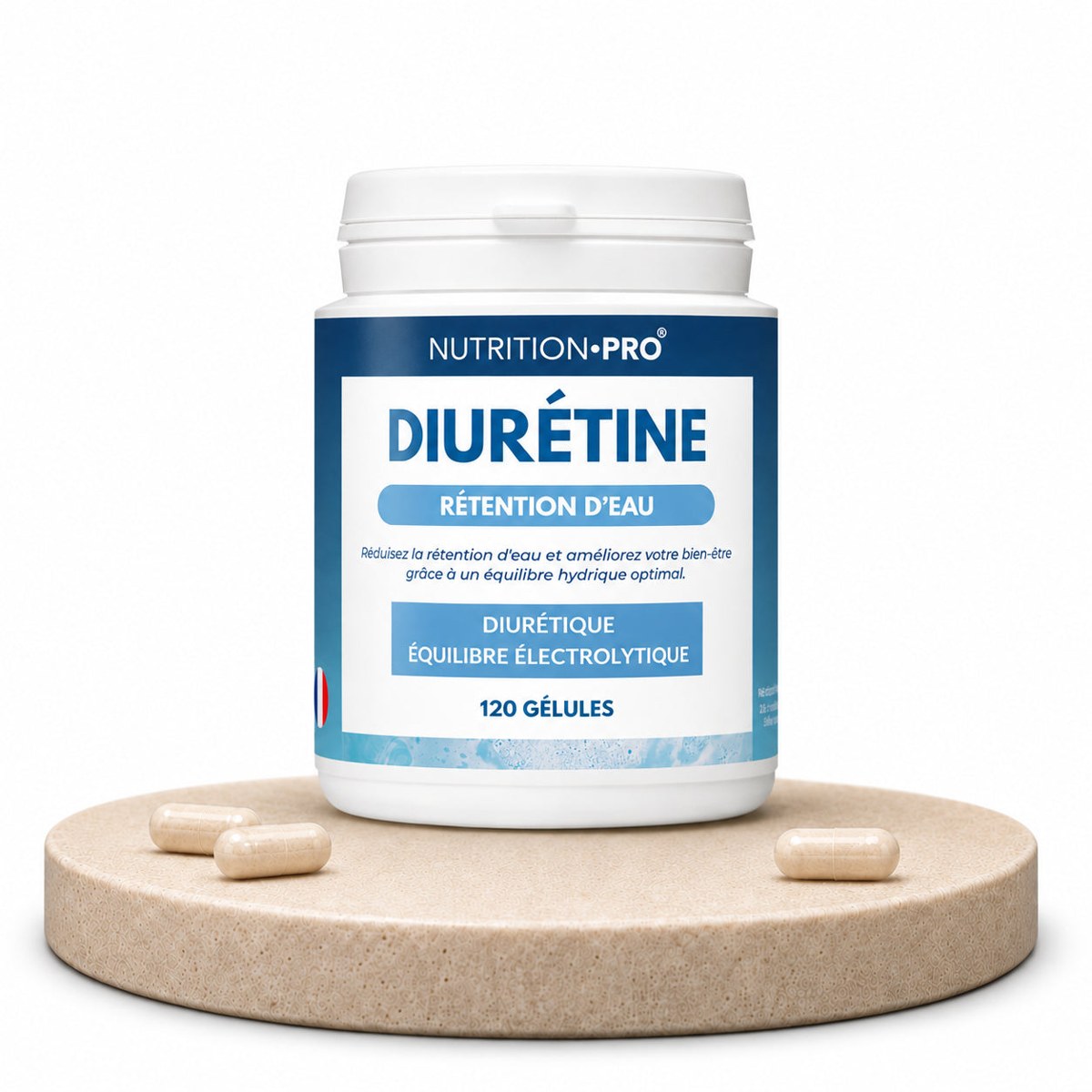
Nutrition•pro is a French brand that says it designs and makes its formulas in France. If you want to try a water pill after ruling out a medical cause, its Diurétine has a fully disclosed formula and pairs the herbs with minerals rather than caffeine:
- dandelion (extract, 300 mg), orthosiphon (extract, 93.75 mg) and cherry stem (extract, 93.75 mg) per day;
- 285 mg of potassium (citrate, 14% of the EU reference value) and 120 mg of magnesium (bisglycinate, 32%);
- caffeine free, vegetable capsules (HPMC);
- 3 capsules a day with a large glass of water, preferably morning or midday according to the brand; 120 capsules, a 40-day supply;
- €29.99 per jar (price checked on 22/11/2026), about €0.75 a day.
How does it compare? The studies above did not test this product: the dandelion trial used a liquid fresh leaf extract, and the cherry stem study 2 g of powder. The label does not give the extraction ratios, so dose comparisons are rough. The potassium is modest: it adds to a diet rich in fruit and vegetables, it does not replace it. Being caffeine free is a real plus if you are sensitive to it.
The brand advises against it during pregnancy and breastfeeding, in children, older people, and in case of kidney disease, stomach ulcer, bile duct obstruction, heart or kidney failure with oedema, or daisy family allergy, and recommends asking a health professional if you take medication. These are clear precautions, in line with this article.
Promo code: SEOCONSULTINGSL for 10% off your order, €26.99 per jar, about €0.67 a day (as of 22/11/2026).
Partner link: we earn a commission if you order through this link, at no extra cost to you.
Frequently asked questions
What causes water retention?
Most often: too much salt, heat, long periods standing or sitting, the menstrual cycle, pregnancy, overweight and some medicines. Less often, heart, kidney, liver, thyroid or vein disease.
How do you get rid of water retention?
Cut down on salt, eat fruit and vegetables, walk daily, raise your legs, avoid heat and wear compression if advised. If swelling persists, see a doctor to find the cause.
Do water retention pills work?
Herbal ones have a mild diuretic effect shown only in small groups over one day. They do not burn fat, and the water returns if the cause stays. Prescription diuretics are for medical oedema only.
Does drinking more water reduce water retention?
Drinking normally is enough: in healthy people the kidneys clear extra water. Drinking less does not help, except in specific conditions under medical advice.
What are the symptoms of water retention?
Swollen ankles in the evening, sock marks, a dent that lingers after pressing the skin, day-to-day weight swings. Swelling on one side or with breathlessness needs prompt medical attention.
Sources
- White C.P., Hitchcock C.L., Vigna Y.M., Prior J.C. Fluid Retention over the Menstrual Cycle: 1-Year Data from the Prospective Ovulation Cohort. Obstet Gynecol Int, 2011; 2011: 138451. PubMed 21845193
- Stachenfeld N.S. Sex hormone effects on body fluid regulation. Exerc Sport Sci Rev, 2008; 36(3): 152-9. PubMed 18580296
- Clare B.A., Conroy R.S., Spelman K. The diuretic effect in human subjects of an extract of Taraxacum officinale folium over a single day. J Altern Complement Med, 2009; 15(8): 929-34. PubMed 19678785
- Hooman N. et al. Diuretic effect of powdered Cerasus avium (cherry) tails on healthy volunteers. Pak J Pharm Sci, 2009; 22(4): 381-3. PubMed 19783515
- Blazek C. et al. Compression hosiery for occupational leg symptoms and leg volume: a randomized crossover trial in a cohort of hairdressers. Phlebology, 2013; 28(5): 239-47. PubMed 22451457
- NHS. Oedema; Deep vein thrombosis (DVT). nhs.uk, nhs.uk
- World Health Organization. Salt reduction, fact sheet. who.int
- Assurance maladie (France). Heavy legs and swollen ankles: everyday tips. ameli.fr