Group · Seafood
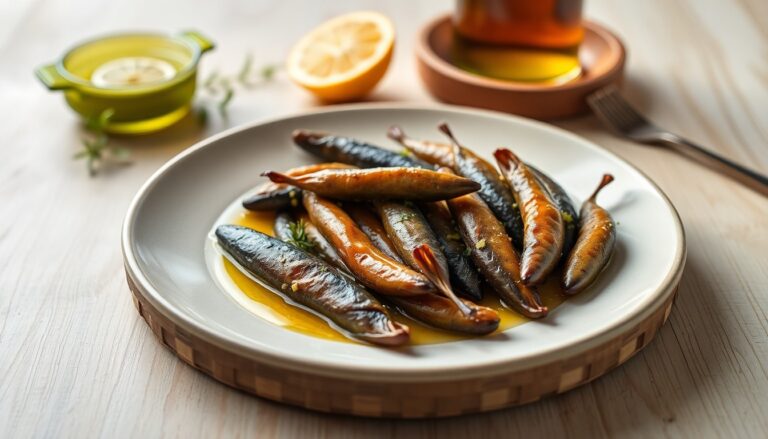
Anchovies in olive oil
The anchovy in olive oil is a small fish of the Engraulidae family, salted and then preserved in a flavoured oil. It is found as fillets in jars or tins, sometimes rolled around a caper. Its brown, melting, intensely briny flesh makes it a leading condiment of Mediterranean cooking. Nutritionally, it stands out for a remarkable protein content, nearly 20.6 g per 100 g, and for fat rich in good-quality fatty acids from the fish and from the olive oil. With 167 kcal per 100 g and no carbohydrate, it fits easily into a balanced diet, provided you watch the salt. Tasty and practical, it lifts a multitude of recipes.
Macronutrient breakdown
Nutrition table per 100 g
| Calories | 167 kcal |
| Kilojoules | 697 kJ |
| Protein | 20,6 g |
| Carbohydrate | 0,5 g |
| Fat | 9,1 g |
Tips
The anchovy in olive oil is rarely eaten on its own because its taste is so strong. A portion of 10 to 20 g is enough to flavour a plate. Drain it lightly before use, then add it to a sauce, on a pizza, in a tapenade, a niçoise salad or an anchoïade. It goes wonderfully with garlic, lemon, confit tomatoes and grilled vegetables. You can also slip a fillet into melted butter to liven up pasta or a leg of lamb.
In terms of nutrition facts, the anchovy has an interesting profile: 20.6 g of complete protein per 100 g, 0.47 g of carbohydrate and 9.08 g of fat including marine omega-3s. It also provides calcium (thanks to the tiny bones), iron, selenium and vitamin D. Its main point of concern remains the salt, present in large amounts because of the salting: moderate it if you are watching your blood pressure. For more recipes that are both tasty and good for the heart, take a look at the Cretan diet.
- Storage: once opened, keep the jar in the fridge with the fillets well covered in oil, and eat them within a few days.
- Reducing the salt: you can soak the fillets for a few minutes in milk or cold water.
- Energy density: the 167 kcal come mostly from the oil, so go easy on adding more oil to your dishes.
For active people, the anchovy is an excellent source of high-biological-value protein, useful for muscle recovery after exercise. Its protein-to-calorie ratio is favourable, but its richness in sodium means it is not meant to be eaten in large quantities. It is better seen as a flavour enhancer than as a main source. To optimise your daily protein intake, complete it with other options from the seafood family, such as prawns or mussels, which are leaner and lower in calories.
As part of a slimming approach, the total absence of carbohydrate and the high protein content are assets for fullness. The trick is to use the anchovy as a clever seasoning: a single crushed fillet is a good substitute for a fatty vinaigrette or extra salt. To compare calories with other seafood, see the food calorie table. Well measured, the anchovy in olive oil becomes a flavour ally full of benefits.