Group · Seafood
Mussels
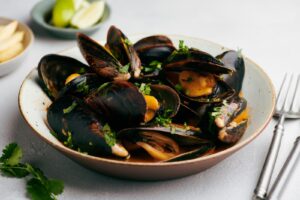
The mussel is a bivalve shellfish that has become emblematic of the French coast, enjoyed from the Atlantic to the Mediterranean and along the North Sea. Rope-grown mussels, Bouzigues mussels, Spanish mussels: there are many varieties, and all share a tender, briny flesh. With just 108 kcal per 100 g, it has an interesting nutritional profile: 17.2 g of protein, 5.12 g of carbohydrate and 2.09 g of fat. Rich in minerals and naturally low in fats, the mussel earns its place in a balanced, tasty diet. Inexpensive, quick to cook and endlessly versatile, it appeals to food lovers and to anyone watching their waistline.

Macronutrient breakdown
Nutrition table per 100 g
| Calories | 108 kcal |
| Kilojoules | 457 kJ |
| Protein | 17,2 g |
| Carbohydrate | 5,2 g |
| Fat | 2,1 g |
Micronutrients per 100 g
All measured nutrients, ranked by share of the daily reference intake.
- Vitamin B1217,6 µg704 %
- EPA0,35 g140 %
- Selenium55,7 µg101 %
- Iodine106 µg71 %
- DHA0,16 g64 %
- Iron3,99 mg29 %
- Zinc2,85 mg29 %
- Phosphorus179 mg26 %
See the other 15 nutrients
- Vitamin B948 µg24 %
- Vitamin E2,68 mg22 %
- Total omega-30,52 g21 %
- Vitamin B20,29 mg21 %
- Magnesium66,6 mg18 %
- Copper0,11 mg11 %
- Manganese0,19 mg10 %
- Potassium166 mg8 %
- Calcium59,4 mg7 %
- Vitamin C5,87 mg7 %
- Vitamin B31,16 mg7 %
- Vitamin B50,28 mg5 %
- Vitamin B60,04 mg3 %
- Omega-3 ALA0,01 g1 %
- Omega-6 LA0,02 g0 %
Anses Ciqual 2025. Source: Anses, 2025, Ciqual food composition table
Tips
The mussel lends itself to countless dishes. The most famous is moules marinière, cooked for a few minutes with shallots, white wine and parsley. You can also enjoy them in a cream sauce, Provençal style, gratinéed or as a curried mouclade. Cooking is lightning quick: allow 5 to 8 minutes over a high heat, and the shellfish are ready as soon as the shells open (throw away any that stay closed).
Nutrition facts and benefits: the mussel is an excellent source of complete protein and provides iron, zinc, manganese, selenium and vitamin B12. Its low energy density and lack of fibre make it a light food, perfect as part of a balanced diet. Its glycaemic index is very low, and its moderate fat content includes marine omega-3s.
- Recommended portion: 250 to 300 g of mussels in their shells per person as a main course.
- Pairings: serve them with steamed vegetables or a small portion of starchy foods for a complete, filling meal.
- Storage: buy mussels that are tightly closed and alive, and eat them within 24 to 48 hours. Keep them cool under a damp cloth.
- Timing: ideal for lunch or dinner, keeping things light.
For active people: thanks to their high-quality protein and their richness in iron and zinc, mussels support muscle recovery and oxygen transport. After a workout, pair them with carbohydrates such as rice or home-made oven-baked chips to replenish your reserves. If you are looking for other seafood sources of protein, try scallops or prawns, which are just as good. Fitness nutrition makes the most of these lean proteins to preserve muscle mass.
Weight control: plain mussels are low in calories, but watch out for preparations that push the total up. Cream, butter, cheese sauces or a side of chips multiply the calories and fat. Choose steamed, marinière or herb versions to keep things slimming. To compare intakes, see the calorie table. And to vary your briny recipes, discover the whole seafood family, a category full of flavour and light on calories.