Group · Meat
Brawn (head cheese)
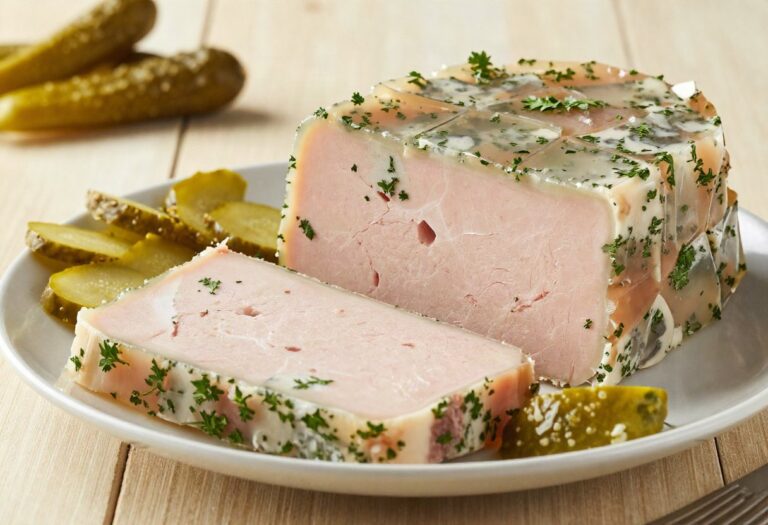
Brawn, also known as head cheese (fromage de tête in French), is a traditional charcuterie made from pieces of pork head that are cooked for a long time, boned, then set in jelly. Despite its name, it contains no cheese: the name comes from its compact texture and its look once sliced. It is a rustic preparation found on butchers’ counters and in many regions of France. In terms of nutrition facts, it provides 184 kcal per 100 g, with 13.8 g of protein, 12.9 g of fat and 3.15 g of carbohydrate. Its low sugar content and protein contribution make it a food worth knowing about if you are watching your diet, provided you eat it in moderation.
Macronutrient breakdown
Nutrition table per 100 g
| Calories | 184 kcal |
| Kilojoules | 766 kJ |
| Protein | 13,8 g |
| Carbohydrate | 3,2 g |
| Fat | 12,9 g |
Micronutrients per 100 g
All measured nutrients, ranked by share of the daily reference intake.
- Vitamin B121,05 µg42 %
- Vitamin D0,9 µg18 %
- Vitamin B50,9 mg15 %
- Vitamin B60,19 mg14 %
- Selenium7,4 µg13 %
- Omega-6 LA1,28 g13 %
- Copper0,12 mg12 %
- Iron1,5 mg11 %
See the other 14 nutrients
- Zinc0,97 mg10 %
- Vitamin B20,12 mg9 %
- Phosphorus56 mg8 %
- Omega-3 ALA0,09 g5 %
- Vitamin K13,4 µg5 %
- Vitamin B30,44 mg3 %
- Magnesium9 mg2 %
- Vitamin B10,02 mg2 %
- Vitamin E0,25 mg2 %
- Calcium16 mg2 %
- Potassium31 mg2 %
- Iodine2,1 µg1 %
- Manganese0,02 mg1 %
- Vitamin B92 µg1 %
Anses Ciqual 2025. Source: Anses, 2025, Ciqual food composition table
Tips
Brawn is eaten cold, in thin slices, usually as an appetiser, a starter or on a charcuterie board. To lift its flavour and cut through the jellied texture, it is often served with a drizzle of vinaigrette, gherkins, pickled baby onions or a dab of mustard. A little country bread and a green salad are enough to make a light, balanced meal.
Recommended portion: a slice of 40 to 60 g is a reasonable serving. At that level, the calorie intake stays moderate (about 63 to 94 kcal) while providing good-quality protein. Always keep the product in the fridge, well wrapped, and eat it soon after opening, as this jellied charcuterie is perishable.
- Protein: with nearly 14 g per 100 g, brawn contributes to your daily protein intake and to feeling full.
- Carbohydrate: 3.15 g, which makes it compatible with a low-sugar diet, with a glycaemic index of zero.
- Fat: 12.9 g per 100 g, partly in the form of saturated fat, hence the value of eating it in moderation.
- Salt: like most charcuterie, it is high in sodium; remember to balance the rest of your meals.
For weight control, brawn has the advantage of containing virtually no sugars, but its density in fat and salt calls for moderation. Avoid combining it with other fatty charcuterie such as rillettes or salami in the same meal. If you are looking for a leaner alternative, sliced ham remains an interesting option.
For active people: its protein content without carbohydrate can appeal during a fat-loss diet, as an occasional savoury snack. However, because of the salt and fat, it is not an ideal recovery food around exercise. To support your goals, favour more targeted sources and, if you like, complete them with the strategies described in our protein snack ideas.
You can explore other comparable products in our Meat family and check the nutrition of each food with the food calorie table. In summary: a tasty, traditional product to enjoy in small amounts as part of a varied diet.